
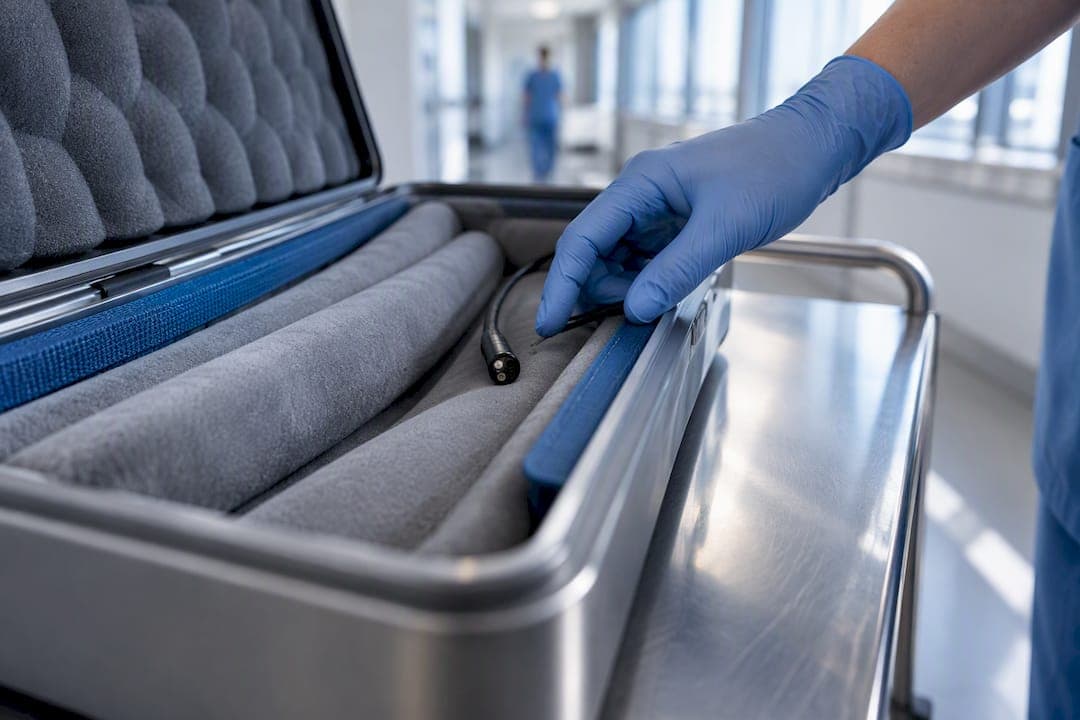
An endoscope transport tray is a rigid or molded container, usually paired with a sterile liner, that moves a flexible endoscope between the procedure room and reprocessing while shielding the scope's distal tip from impact and cross-contamination. Facilities generally choose among three approaches: stackable tray-and-liner systems, vacuum-sealed bag systems, or multi-shelf carts for higher-volume transport. Whichever you pick, the priority list stays the same: protect the tip, keep clean and contaminated scopes visibly separate, and confirm the tray matches your reprocessing equipment under guidance such as ANSI/AAMI ST91.
TL;DR:
- For mid-to-high-volume facilities, stackable rigid trays with color-coded liners are optimal, while molded trays with retention features better protect scope tips during transport.
- Vacuum-sealed systems are suitable for short-term preservation when scopes cannot reach reprocessing immediately, but are not designed for long storage periods.
- Proper handling relies on consistent staff adherence to color-coding protocols and visual inspections to prevent scope damage and cross-contamination during handoffs.
- Tray material and lid temperature ratings must match washer cycle specifications to avoid warping and ensure cost-effective, repeatable reprocessing.
- Always verify tray and cart dimensions with scope sizes and facility layout before purchasing, especially for longer therapeutic scopes or high-volume operations.
Table of Contents
- Endoscope Transport Tray Types and What Each One Solves
- How Transport Trays Fit Into the Reprocessing Workflow
- Materials, Washer Compatibility, and Tray Lifespan
- Matching Tray Size to Your Scope Fleet
- Choosing the Right Transport System for Your Facility
- What Protects Scopes Best Between Procedures
- Getting the Balance Right Between Cost and Protection
- Sources
- FAQ
Endoscope Transport Tray Types and What Each One Solves
Not every procedure room needs the same transport setup, and the market reflects that with a handful of distinct product families rather than one universal design.
Stackable rigid trays with sterile liners are the most common setup in mid-to-high-volume endoscopy suites. A hard plastic tray holds a color-coded liner bag: one color signals a clean, patient-ready scope, the other signals a contaminated scope headed for decontamination. STERIS's CLEANASCOPE system uses exactly this three-part liner approach, and it's built to integrate with no-touch handling protocols rather than requiring staff to physically handle a soiled scope during transfer.
Molded trays with retention features go a step further on physical protection. Olympus's Endo SafeStack system uses a patented O-ring guide wall inside the tray to hold the scope in position, preventing it from sliding or coiling against the tray walls during transit. Trays stack directly or load into optional 5, 7, or 10-shelf carts, which matters if your department moves several scopes at once between rooms.
Vacuum-sealed systems take a different route entirely. Getinge's Vac-a-Scope combines a tray, a vacuum bag, and a monitoring unit to create a sealed environment for short-term preservation, useful when a scope won't reach reprocessing immediately.
Multi-shelf transport carts make sense when volume outgrows single trays. Reusable tray and lid systems from Harloff fit into cart frameworks built for exactly this. Medline offers a simpler reversible-lid tray aimed at the same clean-to-procedure, soiled-to-decon workflow at a smaller scale.
- Stackable tray + liner: best for standard endoscopy suites doing regular procedure volume
- Molded O-ring tray: best when tip protection during handling is the top concern
- Vacuum-sealed system: best for intermittent procedures or longer gaps before reprocessing
- Multi-shelf cart: best for high-volume departments moving multiple scopes at once
How Transport Trays Fit Into the Reprocessing Workflow
A transport tray only works as infection control if the handoffs around it are consistent. The liner, not the tray itself, carries most of the contamination-control value, and that only holds up if staff actually follow the color-coding every time.
- Before the procedure: Place the reprocessed scope in a clean-designated liner (commonly color-coded green in STERIS's system) inside the tray.
- During transport to the procedure room: Keep the lid secured; avoid opening the liner until the scope is needed at the point of use.
- After the procedure: Immediately place the used scope into a separate contaminated-designated liner (commonly red) before it leaves the room.
- En route to decontamination: Confirm the tray lid or liner is visibly marked as contaminated so no one downstream mistakes it for a clean unit.
- At the automated reprocessor: Some systems, including CLEANASCOPE, are built to work with transport cassettes compatible with automated endoscope reprocessors, letting staff load the scope without direct contact.
Pro Tip: Assign one liner color to "clean" facility-wide and never deviate, even across departments that use different tray brands. Mixed color conventions between endoscopy and same-day surgery are a common source of misrouted scopes.
Staff transferring scopes between rooms should do a quick visual check at every handoff: liner intact, lid seated, color visible from arm's length. Cross-reference your protocol against the manufacturer's instructions for use and against ANSI/AAMI ST91 guidance for flexible endoscope processing, since local policy sometimes lags behind updated society recommendations. Our step-by-step sterilization guide walks through how tray handoffs connect to the cleaning steps that follow.
Materials, Washer Compatibility, and Tray Lifespan
Tray material determines whether it survives a cart washer cycle or needs hand cleaning every time, and that single fact drives a lot of the total cost of ownership.
Most reusable trays are molded polypropylene or another rigid, autoclave-tolerant plastic, while cart frames are typically stainless steel. Lid material matters just as much as the tray itself:
- Gray high-temperature lids on Harloff's transport trays are rated up to 270°F, suitable for standard cart-washer cycles.
- Clear lids on the same product line carry a lower rating of 180°F, which means running them through a high-heat cycle designed for the gray lids can warp or degrade the plastic.
That temperature gap is easy to miss during procurement and expensive to discover after the fact. Reusable trays cost more upfront but spread that cost across years of cycles; single-use liners cost little per unit but require a steady supply chain and recurring line-item spending. Before purchasing, match the part number on any tray or lid against your washer's documented cycle temperatures and against the vendor's device-compatibility matrix.
Matching Tray Size to Your Scope Fleet
Tray specs only mean something when checked against your actual scope inventory, not a generic average scope length.
Check tray length, width, and internal depth, plus lid clearance, since a lid that closes on a standard gastroscope may not clear a longer duodenoscope. Cart shelf spacing matters too. Systems range from single-tray setups to Endo SafeStack's optional 5, 7, or 10-shelf carts, so match shelf count to your daily procedure volume, not your total inventory. For long therapeutic scopes used in ERCP, do a physical mock-fit with an empty scope before ordering in bulk. A tray that comfortably secures a diagnostic gastroscope may leave a long ERCP scope unsupported at both ends, risking exactly the tip damage the tray is supposed to prevent. Also measure corridor width and elevator dimensions if you're adding a multi-shelf cart. A 10-shelf cart that can't turn a hospital corner is a wasted purchase.

Choosing the Right Transport System for Your Facility
Start with an honest count of your scope inventory and daily throughput before comparing products. A single-procedure-room clinic and a five-suite endoscopy center need different scales of solution entirely.
- Assess volume and space: Count scopes processed daily and map the physical distance between procedure rooms and your reprocessing area.
- Check washer compatibility: Confirm tray and lid temperature ratings against your cart washer's actual cycle settings, not just the washer's maximum spec.
- Plan liner logistics: If you're using a color-coded liner system, calculate weekly liner consumption and build it into recurring supply orders.
- Verify device compatibility: Cross-check the vendor's compatibility matrix and IFU against your specific scope models, especially longer therapeutic scopes.
- Confirm regulatory alignment: Review your protocol against ANSI/AAMI ST91 and consult resources like AdvaMed or vendor training portals such as STERIS University for reprocessing policy updates.
- Line up parts and repair contacts: Order spare lids and liners alongside the initial purchase, and know who to call when a tray cracks or a scope gets damaged in transit.
| Facility profile | Likely fit | Key check before buying |
|---|---|---|
| Single-room clinic, low volume | Basic tray + reversible lid | Fits longest scope in fleet with lid clearance |
| Mid-volume endoscopy suite | Stackable tray + color-coded liner | Liner supply matches daily procedure count |
| High-volume, multiple rooms | Multi-shelf transport cart | Corridor and elevator clearance for cart footprint |
| Intermittent procedures, longer gaps to reprocessing | Vacuum-sealed system | Monitoring unit reliability and consumable cost |
Our veterinary sterilization guide covers how these same principles apply outside human hospital settings, where procedure volume and staffing look different.
What Protects Scopes Best Between Procedures
Damage tends to happen in the gaps, not during the procedure itself. A distal tip that survives a colonoscopy can still get scratched sliding loose inside an unsecured tray on the way to decon, and a scratched tip harbors bacteria that make reprocessing failures more likely down the line.
Build a quick visual inspection into both ends of the transport trip: check the distal tip for scratches before the scope leaves the tray and again when it arrives at reprocessing. Tip protectors and padded sleeves add a second layer of defense for scopes that travel longer corridor distances or ride in multi-shelf carts. Label trays and liners consistently so a scope never sits unrouted because nobody could tell if it was clean or contaminated at a glance. If you spot damage during inspection, get the scope into repair before it goes back into rotation. Our equipment storage guide has more detail on short-term storage between uses, and 1800endoscope's repair services can handle scopes that need attention before they go back into service.

Getting the Balance Right Between Cost and Protection
Reusable trays cost more upfront than single-use liners but pay off across years of cycles. The real return on investment shows up in fewer damaged tips and fewer repair calls, not in the sticker price. Consistent staff training on labeling matters more than which brand you buy.
— Endoscope
Sources
- Endo SafeStack™ Endoscope Transport System | Olympus America | Medical
- CLEANASCOPE Transport and Short-term Storage Systems | STERIS
- Vac-a-Scope System brochure | Getinge
FAQ
What Is an Endoscope Transport Tray Used For?
It moves a flexible endoscope safely between the procedure room and reprocessing, protecting the distal tip and, when paired with a color-coded liner, keeping clean and contaminated scopes clearly separated during the handoff.
Can I Use the Same Tray for Clean and Contaminated Scopes?
Not at the same time. Systems like STERIS's CLEANASCOPE use separate color-coded liners inside the same tray design specifically so clean and contaminated scopes never get confused during transit.
How Long Can a Scope Sit in a Vacuum-Sealed Transport System?
Vacuum-sealed systems like Getinge's Vac-a-Scope are built for short-term preservation, not extended storage, so check the vendor's stated time window and your facility's own reprocessing policy before relying on extended hold times.
Do Transport Tray Lids Need Special Cleaning?
Yes, and lid material determines the limit. Harloff's gray high-temperature lids tolerate up to 270°F in a cart washer, while clear lids on the same line are rated only to 180°F, so running the wrong lid through a high-heat cycle can damage it.
How Do I Know If a Transport Tray Fits My Longest Scope?
Measure tray length, internal depth, and lid clearance against your longest therapeutic scope, and do a physical mock-fit before bulk ordering. A tray sized for a standard gastroscope may not safely secure a longer ERCP scope without added support.