
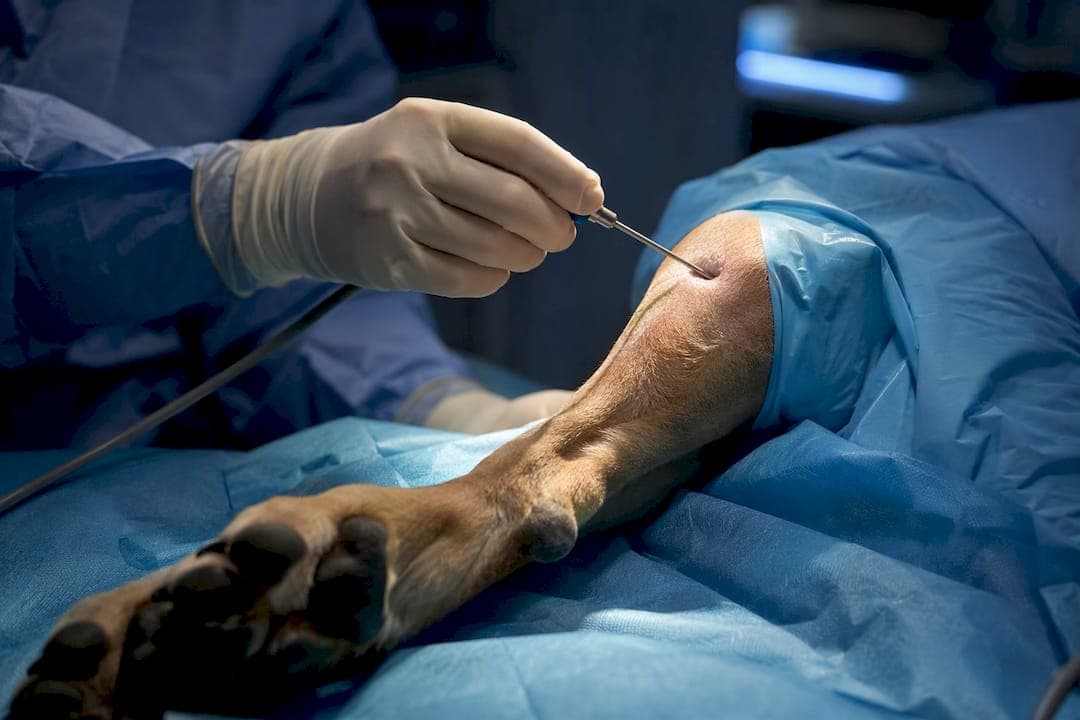
Use 2.7 mm as your default canine arthroscope for stifle, shoulder, and most medium-to-large joint work. Reach for 2.4 mm when minimizing cartilage injury risk matters most, especially in the elbow. Drop to 1.9 mm or a needle-style scope for small joints, small-breed dogs, or tight portals. The tradeoff running through every choice is the same: better visualization and instrument compatibility versus a smaller footprint and lower iatrogenic risk. Whatever diameter you pick, confirm the sheath's outer diameter matches your instrument set before you're mid-procedure.
TL;DR:
- Use a 2.7 mm scope for general medium-large joint procedures, but switch to 2.4 mm for elbow work where cartilage preservation is critical.
- Smaller scopes like 1.9 mm are best for small joints and breed-specific cases but result in longer procedures and limited instrument compatibility.
- Confirm the sheath's outer diameter matches your instruments before surgery, especially when switching scope sizes to avoid delays.
- Higher magnification and smaller scopes can increase cartilage injury risk if not managed carefully; minimizing manipulation and using known reference sizes help.
- Opt for a versatile long 2.7 mm scope for routine use and add a smaller diameter scope if your cases frequently involve tight joint spaces or small patients.
Table of Contents
- What Arthroscope Diameter Should You Use for Canine Joints?
- How Do Scope Length and Viewing Angle Affect Access?
- Cannula and Instrument Compatibility: What to Verify First
- What Does the Evidence Say About Cartilage Injury Risk?
- Are Needle Arthroscopy Systems Practical for Dogs?
- What Should You Check Before Buying Arthroscopy Equipment?
- How Does Visualization Quality Differ Across Scope Sizes?
- What Cleaning and Sterilization Steps Do Smaller Scopes Need?
- Which Instruments Are Compatible With Each Scope Size?
- How Much Do Different Scope Sizes Cost to Own and Run?
- Reconciling the Evidence With Clinic Realities
- Finding the Right Arthroscopy Equipment for Your Practice
- Sources
- FAQ
What Arthroscope Diameter Should You Use for Canine Joints?
Diameter selection in canine arthroscopy comes down to three practical sizes, and each has a distinct clinical personality. Vendors market plenty of intermediate variants, but 1.9 mm, 2.4 mm, and 2.7 mm cover the range most general and orthopedic practices actually stock.
2.7 mm scopes remain the workhorse. They deliver a wider field of view, more light throughput, and broader instrument compatibility than smaller options, which matters when you're chasing a loose fragment or need a shaver in tight quarters. WSAVA's basic principles guidance identifies 2.7 mm as the most commonly used diameter in dogs, available in both short and long shaft lengths. For stifle exploration in a 30 kg Labrador or shoulder work in a large-breed dog, this is still the scope most surgeons reach for first.
2.4 mm scopes sit in the middle, and recent evidence gives them a specific edge. A 2025 cadaveric study of canine elbow arthroscopy found the 2.4 mm arthroscope produced a significantly lower median area of iatrogenic articular cartilage injury than the 2.7 mm scope, a finding worth weighing heavily if you're doing elbow work regularly. The field of view is narrower than 2.7 mm, but not so narrow that it slows you down meaningfully in most stifle and elbow cases.
1.9 mm and needle-style scopes trade visualization for access. Field of view drops noticeably, and procedures tend to run longer because you're doing more scope manipulation to see the same anatomy a 2.7 mm scope covers in fewer moves. That tradeoff makes sense for hock and carpus arthroscopy in dogs, or for any small-breed patient where a larger sheath simply won't fit the joint space without excessive distraction. The smaller shafts are also more fragile and pair with a narrower set of compatible instruments, so you're often locked into a dedicated small-diameter kit rather than mixing and matching from your general inventory.
Here's a quick breakdown of how the three sizes stack up in practice:
- 2.7 mm: widest field of view, most instrument options, best for stifle and shoulder in medium-large dogs. Higher cartilage contact risk occurs in tight joints like the elbow.
- 2.4 mm: strong middle ground, evidence-backed lower cartilage injury risk in elbow work, still compatible with most standard instrument sets.
- 1.9 mm / needle systems: smallest footprint, best for hock, carpus, and small-breed patients, longer procedure times, and more fragile with limited instrument compatibility.
The real decision rule is this: prioritize the smaller diameter when the joint geometry is tight and cartilage preservation is the priority, but only if your instrument tray can actually support the procedure you're planning. A perfectly sized scope with no matching shaver or grasper doesn't help you mid-surgery.
How Do Scope Length and Viewing Angle Affect Access?
Diameter gets most of the attention, but shaft length and angle of inclination decide whether you can actually see what you need to see once the scope is inside the joint.
Working length needs to match the depth of the joint and the size of the patient. Short scopes work well for superficial access in small to medium dogs, letting you maneuver without excess shaft hanging outside the portal. Long scopes become necessary for large-breed shoulders and deeper joint spaces, where a short shaft simply won't reach the structures you need to visualize without awkward external angling. WSAVA references note that 2.7 mm scopes commonly ship in both 67 mm and 120 mm lengths for exactly this reason.
Viewing angle matters just as much, and it's the spec surgeons underestimate most often. A fore-oblique angle of 25 to 30 degrees is the standard recommendation for canine joint work, and for good reason. This angle gives you a reasonable compromise between straight-ahead visualization and the ability to angle your view around curved anatomy without losing orientation. Higher-angle scopes can help you peek around tighter corners in congruent joints, but they introduce a central blind spot directly in front of the lens, which can be disorienting if you're not used to compensating for it during navigation.
A few practical notes worth keeping in mind when planning portals and picking your shaft:
- Match shaft length to joint depth and patient size, not habit. A short scope that worked fine for a 10 kg terrier's stifle will frustrate you in a mastiff's shoulder.
- Default to 25 to 30 degree fore-oblique scopes unless you have a specific reason to deviate. Field of view and magnification both shift with lens diameter and angle, so consistency across your case load reduces the learning curve.
- Plan your portal placement before you pick up the scope. The wrong entry angle relative to shaft length forces awkward triangulation that no amount of skill fully compensates for.
- Keep a longer scope in reserve for deep joints even if your everyday caseload is mostly small dogs. You'll need it eventually.
Cannula and Instrument Compatibility: What to Verify First
Three numbers matter every time you set up for a case, and they are not the same number. The core scope diameter is the size of the arthroscope shaft itself. The cannula, or sheath, outer diameter is what actually sits in the portal, and it's always larger than the core scope diameter to accommodate the working space around it. The instrument channel size determines what shavers, graspers, or probes can pass alongside the scope inside that sheath.
Typical sheath outer diameters run larger than their core counterparts by a meaningful margin. A 1.9 mm core scope, for example, commonly pairs with cannulas in the 2.2 to 2.7 mm range, according to NanoScope technical documentation. That gap between core and sheath diameter directly affects portal size, fluid ingress and egress during the procedure, and how much room you have left for a second instrument working alongside the scope.
Before any case, run through this checklist:
- Confirm the sheath outer diameter against your planned portal size and the joint's actual capacity.
- Verify the obturator fits the cannula snugly, with no play that could cause inadvertent cartilage contact on insertion.
- Cross-check instrument diameters (shaver, probe, grasper) against the cannula's stated instrument channel capacity.
- Confirm your fluid pump and shaver system are rated for the cannula you're using, not just the scope.
- Document working lengths for every scope and cannula combination in your inventory so staff aren't guessing during setup.
Pro Tip: Keep a laminated compatibility card taped inside your arthroscopy cart. Losing five minutes mid-case to find out your shaver doesn't fit the cannula is the kind of delay that turns a routine stifle scope into a longer, higher-risk procedure.
Disposable cannulas simplify sterilization logistics but add per-case cost, while reusable sheaths need documented sterilization cycles and periodic inspection for scratches or seal wear that can compromise fluid dynamics. Clinics running high case volumes on small-diameter systems often find the disposable route more practical, since the fragility of 1.9 mm hardware makes repeated sterilization cycles a real durability concern. Reviewing a small-diameter endoscope buying guide before committing to a specific cannula system can save you from a mismatch discovered only after the equipment arrives.
What Does the Evidence Say About Cartilage Injury Risk?
Every canine elbow arthroscopy in a 2025 cadaveric study produced some degree of iatrogenic articular cartilage injury (IACI), a 100 percent incidence rate that should reset expectations about how "routine" this complication actually is. The same study found meaningful differences by scope size.
The numbers: Median IACI surface area was 5.7 mm² for the 2.4 mm arthroscope, compared to 11.4 mm² for the 2.7 mm scope, a statistically significant difference (p = .004) according to the cadaveric canine elbow study. The 1.9 mm scope came in at 8.6 mm², landing between the other two.
That middle position for the 1.9 mm scope is the counterintuitive part. You'd expect the smallest instrument to cause the least cartilage contact, but it didn't outperform the 2.4 mm scope in this dataset. The likely explanation ties back to procedure time: the same study found procedure times were significantly longer with the 1.9 mm scope than the 2.7 mm scope, and longer procedure time correlated with increased total IACI. More manipulation inside a tightly congruent joint like the elbow apparently outweighs the theoretical safety benefit of a smaller shaft.
A few practical steps reduce IACI risk regardless of which diameter you choose:
- Insert the obturator with controlled, deliberate pressure rather than forcing it through resistance, since uncontrolled advancement is a common cause of unintended cartilage contact in tightly congruent joints.
- Minimize unnecessary scope repositioning once you've established a good view; every additional manipulation is another chance for inadvertent contact.
- Use a probe of known size as an in-joint scale to judge distances accurately, since magnification through the arthroscope distorts your sense of scale more than most surgeons expect.
Keep the caveats in mind before you extrapolate too far. This was a cadaveric model, not a live clinical trial, so tissue response and bleeding that would normally guide a surgeon's caution weren't present. Surgeon experience level, specific joint anatomy, and case complexity all shift the real-world numbers. The elbow's tight congruency makes it particularly prone to cartilage contact compared to looser joints like the stifle, so don't assume these exact figures transfer directly to every joint you scope.
Are Needle Arthroscopy Systems Practical for Dogs?
Chip-on-tip, or needle, arthroscopy systems shrink the handpiece down to roughly 1.9 mm while pairing it with disposable cannulas and dedicated micro-instruments. The NanoScope Nano Operative Arthroscopy System is the most documented example, built around a 1.9 mm handpiece supported by 2.2 mm and 2.7 mm cannula options depending on the instrumentation the case requires.
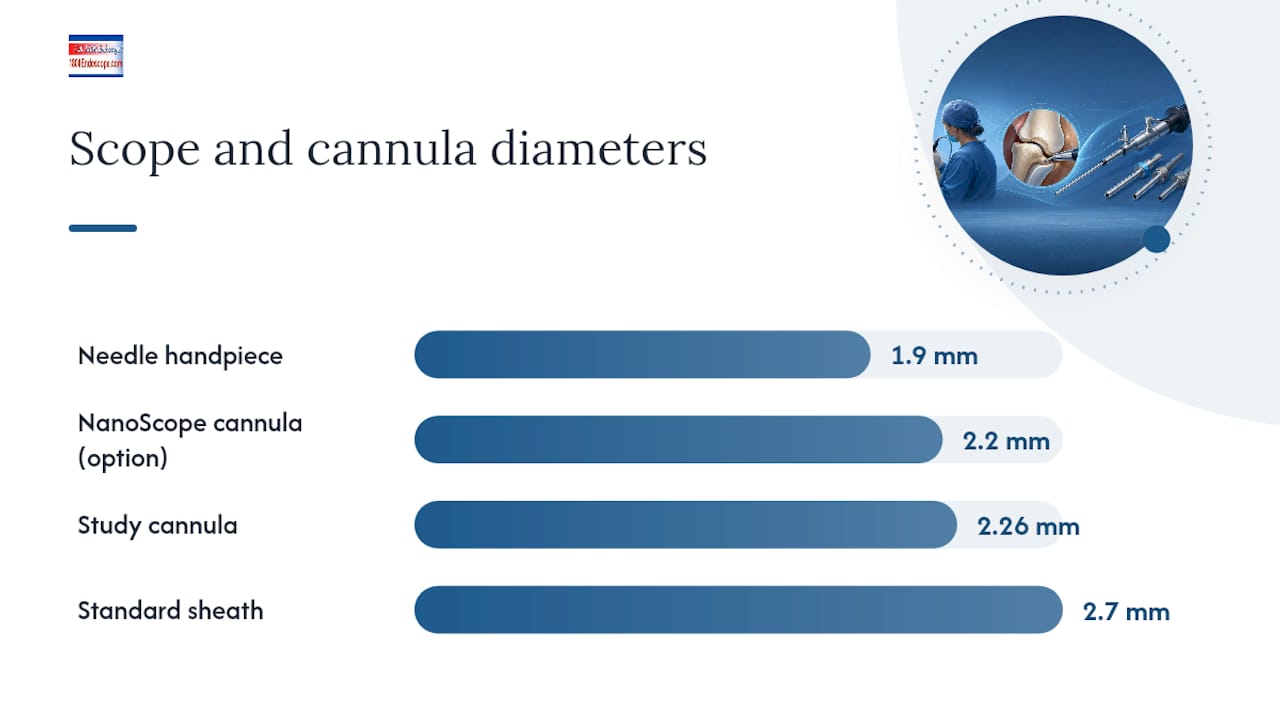
The evidence for what these systems can actually do comes largely from human orthopedic research, but it's directly relevant to small-joint veterinary work. A technical study of 2 mm diameter operative arthroscopy in cadaveric ankles found that a 1.9 mm handpiece with a 2.26 mm cannula provided adequate visualization and surgical reach for anterior joint structures, including successful biopsy procedures without causing iatrogenic damage in the cadaver models tested.
That capability opens up a few genuinely useful scenarios:
- Minimally invasive portals for diagnostic looks into small joints where a standard 2.7 mm sheath would be disproportionately large relative to the joint capsule.
- Office-based or targeted diagnostics in cases where a full surgical setup feels like overkill for a quick look at suspected pathology.
- Small-breed and toy-breed patients where standard cannula sizes simply don't fit the available joint space without excessive forced distraction.
The limitations are just as real. These systems depend on dedicated single-use instruments, so if your planned intervention needs a specific probe or micro-biter that doesn't have a needle-scope equivalent, you're stuck improvising or converting to a standard scope mid-case. Per-case disposable costs add up faster than clinics expect when they first budget for the system. Nerve proximity is another consideration worth flagging in smaller joints, where the working space between scope, instrument, and adjacent neurovascular structures shrinks along with the joint itself, and joint-specific suitability should be confirmed before committing to a needle system for anything beyond diagnostic exploration.
What Should You Check Before Buying Arthroscopy Equipment?
Procurement decisions get expensive fast when a scope arrives and the instrument tray doesn't match. Before ordering, walk through this list with your vendor:
- Confirm the scope's core diameter and the exact sheath outer diameter it ships or pairs with.
- Ask which instrument sets and shaver sizes are validated for that specific cannula, not just "compatible in general."
- Verify working lengths for both short and long shaft options if your caseload spans small and large-breed patients.
- Clarify which components are single-use versus reusable, and what sterilization method the reusable parts require.
- Request documentation you can hand to surgical staff, not just marketing specs.
Beyond the scope itself, a few operational decisions shape how well the equipment fits your workflow. Deciding between a full camera and tower setup versus a portable recorder affects both cost and mobility between exam rooms and surgical suites. A portable video recording system can be a practical middle ground for clinics that need documentation flexibility without a fixed tower footprint. Pump compatibility deserves its own check, since fluid management systems aren't universally interchangeable across cannula sizes. And image capture matters for medical records and client communication, an area where optimizing your recording setup pays off in fewer post-procedure headaches.
Staff training is the piece clinics most often underbudget. A surgeon comfortable with 2.7 mm scopes needs real hands-on time before a 1.9 mm needle system feels natural, and support staff need to know the difference in setup between the two.
Pro Tip: Before committing to a new diameter across your practice, borrow or demo the exact cannula and instrument combination you intend to buy. Spec sheets rarely capture how a sheath actually handles fluid flow or how an obturator seats in your specific portal technique.
How Does Visualization Quality Differ Across Scope Sizes?
Field of view scales with lens diameter, and that relationship drives most of the practical differences surgeons notice between scope sizes. Larger lens diameters capture more of the joint in a single view, which reduces how much you need to reposition the scope to see adjacent structures. A 2.7 mm scope typically shows you more of the joint capsule and surrounding structures in one glance than a 1.9 mm scope covers without repositioning.
That difference compounds during longer procedures. Fewer repositioning maneuvers with a 2.7 mm scope generally means a faster, more fluid exploration. With a 1.9 mm scope, you're piecing together a mental map from more sequential, narrower views, which takes practice to do quickly and accurately.
Magnification interacts with field of view in a way that catches less experienced surgeons off guard. Smaller-diameter scopes often carry higher relative magnification for a given working distance, which distorts your perception of true distances inside the joint. That's precisely why an in-joint reference, like a probe of known size, becomes more valuable as scope diameter decreases. Light throughput follows a similar pattern: larger scopes generally transmit more light to the sensor or fiber bundle, giving you a brighter, more color-accurate image, particularly useful when assessing subtle cartilage discoloration or synovial changes.
None of this makes smaller scopes inferior for their intended use. It just means the visualization tradeoff needs to be a conscious decision tied to the joint and patient, not an afterthought discovered mid-procedure.
What Cleaning and Sterilization Steps Do Smaller Scopes Need?
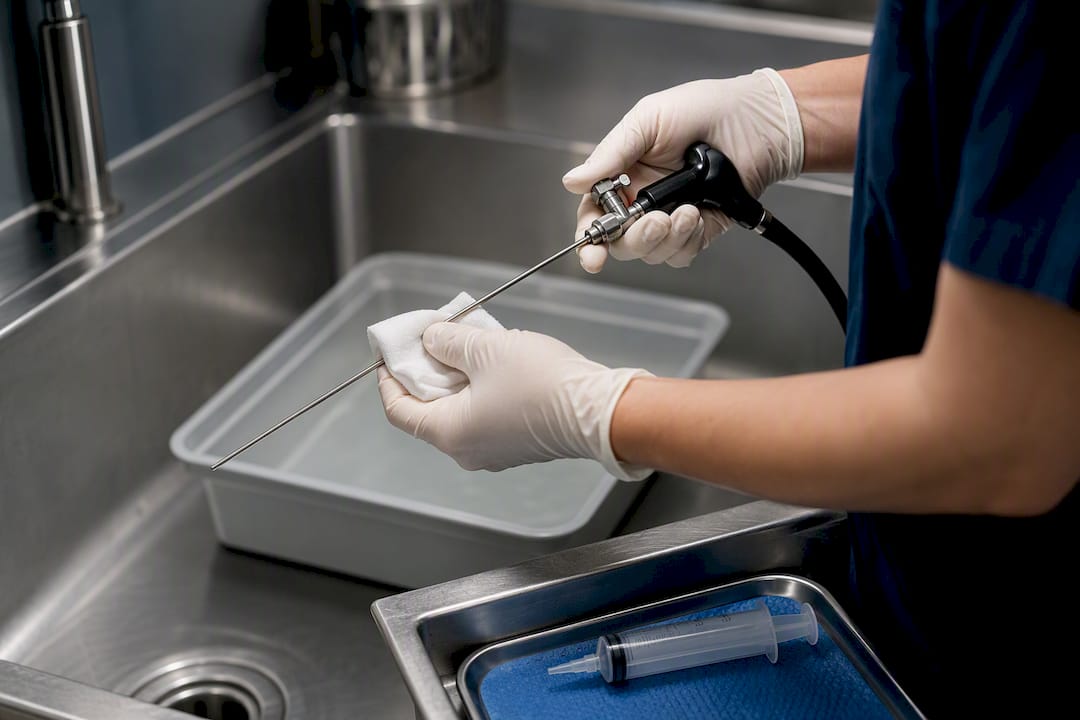
Smaller-diameter arthroscopes demand more careful handling during cleaning, and the reason is mechanical rather than chemical. A 1.9 mm shaft has thinner walls and more delicate internal optics than a 2.7 mm scope, which makes it more vulnerable to bending or lens damage during manual cleaning, brush passes, or even routine handling between cases.
Reusable sheaths and scopes across all diameters need the standard cycle: point-of-use wiping to prevent tissue debris from drying on the surface, enzymatic pre-cleaning, thorough channel flushing where applicable, and validated sterilization, typically steam autoclave or a low-temperature method depending on the manufacturer's specification for that particular model. Smaller scopes more often carry low-temperature sterilization requirements because their construction can't tolerate the same thermal stress as bulkier rigid scopes.
Disposable components common in needle-style systems sidestep the sterilization question for those specific parts, but they shift the maintenance burden toward inventory management instead. Clinics need enough disposable cannulas and instruments on hand to avoid a case-day shortage, along with a tracking system for expiration dates on sterile packaging.
Routine inspection matters more as diameter shrinks. A scratched lens or bent shaft tip is more likely on a 1.9 mm instrument simply because there's less material margin for error, and a compromised small-diameter scope often can't be repaired as cost-effectively as a standard 2.7 mm model. Building a scheduled inspection habit, checking optical clarity and shaft straightness between uses, catches problems before they show up as a frustrating surprise mid-surgery.
Which Instruments Are Compatible With Each Scope Size?
Cannulae aren't the only compatibility question. Graspers, shavers, probes, and biopsy forceps all need to match both the cannula's inner channel and the specific procedure you're planning, and compatibility narrows as scope diameter shrinks.
| Scope core diameter | Typical cannula OD | Compatible ancillary instruments |
|---|---|---|
| 2.7 mm | Widest range, includes 67 mm and 120 mm lengths | Standard graspers, motorized shavers, full-size probes, biopsy forceps |
| 2.4 mm | Mid-range cannulas | Most standard probes and graspers; some shaver systems require size-matched adapters |
| 1.9 mm / needle | 2.2 to 2.7 mm depending on system | Dedicated micro-instruments and disposable probes specific to the manufacturer's system |
The 2.7 mm platform gives you the broadest instrument flexibility, largely because it's the most established size and most manufacturers design their standard instrument lines around it first. The 2.4 mm tier sits comfortably with most probes and graspers but occasionally needs a size-specific shaver adapter, worth confirming before you assume cross-compatibility with your existing 2.7 mm tray.
Needle systems are where compatibility gets genuinely restrictive. Because certain nano operative systems require specific retractable probes and micro-biters that only function through their dedicated cannulas, you can't simply borrow an instrument from your standard tray when the disposable kit runs short. Confirm instrument availability for your planned intervention before you schedule the case, not after the patient is already prepped.
How Much Do Different Scope Sizes Cost to Own and Run?
Upfront hardware cost generally rises with optical sophistication rather than falling with smaller diameter. A 1.9 mm needle system's handpiece and camera electronics often cost comparably to, or more than, a standard 2.7 mm rigid scope, since the miniaturized optics and chip-on-tip technology carry their own engineering premium.
The bigger cost differentiator is the ongoing consumables model. Standard 2.7 mm and 2.4 mm systems typically rely on reusable cannulas, obturators, and instruments that get sterilized and reused across many cases, keeping the per-case cost relatively low after the initial capital investment. Needle systems built around single-use cannulas and dedicated micro-instruments shift a meaningful share of the total cost into recurring, per-procedure spending. That model can make sense for lower-volume specialty cases but adds up quickly for a clinic running needle arthroscopy as a routine offering.
Brand also affects price beyond just diameter. Established rigid endoscopy lines with broad instrument ecosystems tend to carry different pricing than newer chip-on-tip platforms, and replacement part availability varies by manufacturer in ways that affect long-term cost of ownership. Before committing budget to any system, price out the full package: handpiece, cannula sets, instrument compatibility, sterilization or disposable costs, and light source or camera integration, not just the headline scope price. Browsing a full rigid endoscopy catalog side by side helps surface these total-cost differences before you're locked into a purchase decision.
Reconciling the Evidence With Clinic Realities
The research points toward 2.4 mm as the smarter default for elbow work, but most clinics can't justify stocking a separate scope for every joint. A practical middle ground: keep one versatile long 2.7 mm scope for general caseload, and add a 2.4 mm or small-diameter needle adjunct for elbow-heavy or small-patient work.
Single-scope convenience is real, and juggling multiple cannula systems adds setup complexity your staff has to learn. But the IACI data makes a genuine case for a second option when your caseload skews toward tightly congruent joints. The smarter move isn't picking one diameter forever. It's tracking your own outcomes, watching for cartilage injury patterns in your own surgical logs, and letting that data guide which second scope earns a spot in your cart.
— Endoscope
Finding the Right Arthroscopy Equipment for Your Practice
Matching scope diameter to procedure only works if your cannulas, obturators, and instruments actually fit together, which is exactly where a lot of clinics get stuck comparing spec sheets from three different vendors. Small-diameter rigid scopes, cannulas, obturators, light sources, and portable video recorders are available from vendors that consolidate these items, which can help ensure compatibility questions get answered before checkout instead of after your first mismatched case.
If you're building out a canine arthroscopy setup from scratch or adding a second scope diameter to an existing tray, start with the Veterinary Rigid Endoscopy Catalog to compare core diameters, cannula options, and instrument sets side by side. For clinics weighing a portable recording setup alongside their surgical scope, the borescope and endoscope catalog covers imaging hardware built for exactly this kind of procedural documentation. Have a specific compatibility question about sheath sizing or obturator fit? Reach out through the FAQ and inspection procedures page before you order, not after the scope arrives and doesn't match your tray.
Sources
- Evaluation of iatrogenic articular cartilage injury associated with arthroscopic exploration of the canine elbow
- Two-millimetre diameter operative arthroscopy of the ankle is safe and effective
- Arthroscopy in Dogs: Basic Principles - WSAVA 2001
- Basic arthroscopic principles | Musculoskeletal Key
- NanoScope™ Nano Operative Arthroscopy System
FAQ
What Kind of Scope Is Used for Arthroscopy?
Canine arthroscopy uses a rigid arthroscope, most commonly 1.9 mm, 2.4 mm, or 2.7 mm in diameter, paired with a cannula and a light source for direct joint visualization.
What Is the Silent Killer in Dogs?
This question isn't related to arthroscopy equipment; it typically refers to conditions like hemangiosarcoma or heartworm disease, which is best discussed with a veterinarian rather than answered through orthopedic equipment guidance.
How Much Smaller Is the Arthrex NanoScope Compared to a Traditional Arthroscopy Scope?
The NanoScope handpiece measures roughly 1.9 mm in outer diameter, compared to the 2.7 mm diameter common in traditional canine arthroscopy setups, making it noticeably smaller for tight-joint or small-patient access.
How Long Does It Take for a Dog to Recover From Arthroscopy?
Recovery timelines vary by joint, procedure complexity, and patient factors, so exact timeframes are best confirmed with the treating surgeon based on the specific case rather than a general estimate.
Does a Smaller Scope Always Mean Lower Cartilage Injury Risk?
Not necessarily. A 2025 cadaveric elbow study found the 2.4 mm scope had significantly lower median cartilage injury area than the 2.7 mm scope, while the 1.9 mm scope fell in between, likely due to longer procedure times increasing manipulation.