
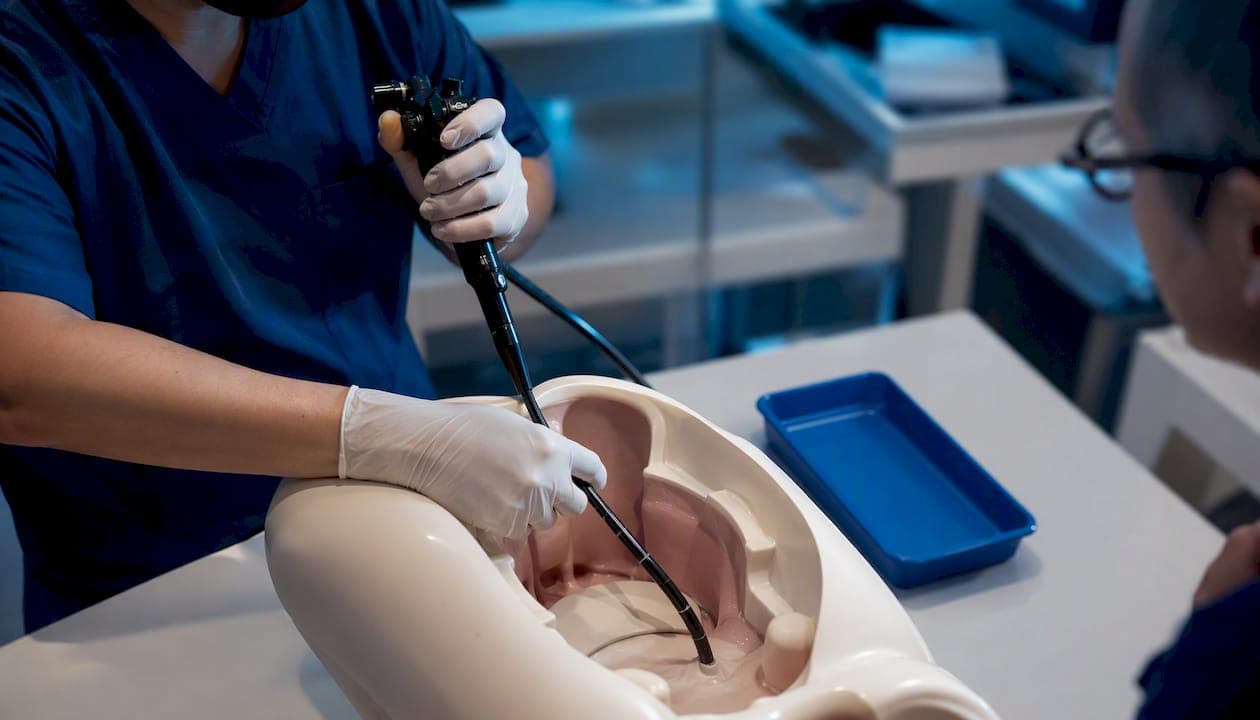
If you want real competence with a scope in your hand, chase three routes: integrated hybrid courses that pair online prework with wet labs, short hands-on wet-lab intensives for a single skill, and self-study CE for the fundamentals. Start with the Veterinary Endoscopy Society, KARL STORZ's immersive course, and VIN's self-study catalog. Whatever you pick, prioritize supervised scope time over lecture hours.
TL;DR:
- Hybrid courses offer wide competency through online didactics and extensive lab hours but can be costly and require multiple procedural investments.
- Wet-lab intensives focus on mastering a single skill quickly, often in just one or two days, at a lower overall cost.
- Pre-course online modules and detailed lab descriptions ensure better preparation and more effective hands-on practice during training.
- Good courses should include scope handling, GI, respiratory, and urinary procedures, along with maintenance and safety protocols.
- Portable, affordable scopes with recording capabilities enable clinics to continue practicing and build competence outside formal courses.
Table of Contents
- Veterinary Endoscopy Training Resources by Format
- What Each Course Format Actually Delivers
- Skills and Procedures a Good Course Should Teach
- How to Choose a Veterinary Endoscopy Course
- Where to Find and Book Verified Endoscopy Courses
- Books and Video Resources to Pair With Any Course
- Practice Resources After You Finish a Course
- Prerequisites and Pre-Course Preparation
- Species-Specific Endoscopy Considerations
- Safety Protocols and Common Complications in Training
- New Technology Changing Veterinary Endoscopy
- Certification Paths After Course Completion
- After the Course, What Actually Builds Competence
- Build In-Clinic Practice With the Right Equipment
- Sources
Veterinary Endoscopy Training Resources by Format
Sorting through veterinary endoscopy training resources gets easier once you group them by what they actually deliver, not by brand name. Three formats cover almost every practitioner's needs.
Hybrid immersive courses front-load online material, then hand you a scope. KARL STORZ's Diagnostic Endoscopy course offers roughly 20 online CE hours of didactic content before intensive labs on flexible and rigid endoscopy, bronchoscopy, cystoscopy, GI endoscopy, and laparoscopy. Some integrated offerings list a substantial total CE hour count once you add lecture and lab time together. This format suits a vet who wants broad competency across multiple scope types in one structured program.
Wet-lab intensives go narrow and deep. Viticus Group's Endoscopic Foreign Body Removal course packs roughly 11 lab hours around 5 hours of lecture, aimed squarely at retrieval technique in the GI and respiratory tracts. If your clinic sees a steady stream of sock-eating Labradors and you need one skill nailed down fast, this beats a broad survey course.
Self-study CE fills knowledge gaps between bigger commitments. VIN's Endoscopy Basics module (DIAG426-2024) covers indications, equipment, and cleaning for about 1.5 CE credits at low cost and no travel.
- Hybrid/integrated: broad competency, higher cost, multi-week commitment
- Wet-lab intensive: one skill mastered fast, lower cost, one to two days
- Self-study CE: cheapest entry point, no hands-on component
- Professional society webinars and video atlases: free or low-cost supplements between courses
What Each Course Format Actually Delivers
CE hour counts vary wildly, and that range matters when you're comparing tuition against value. Self-study modules run 1 to 2 hours. Two-day introductory courses land around 16 total hours, with most of that time in person. Full integrated programs stack 20-plus online hours on top of 20 to 40-plus lab hours.
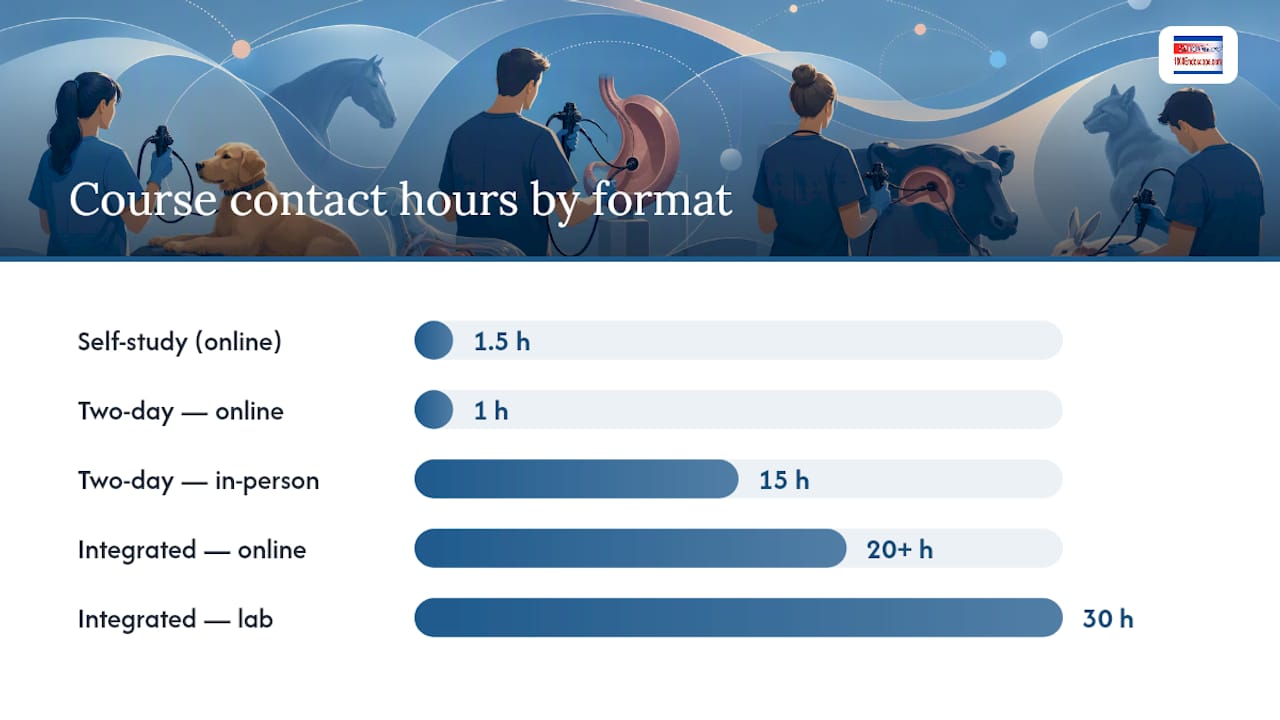
Statistic to remember: A two-day flexible GI endoscopy course at a university continuing-education catalog runs about 16.0 total contact hours, with only an hour of that online. Fifteen hours in person, split between cadaver work and live patients, is a very different experience than a course that calls itself "hands-on" but delivers three hours of scope time across two days.
Lab type shapes what you actually learn:
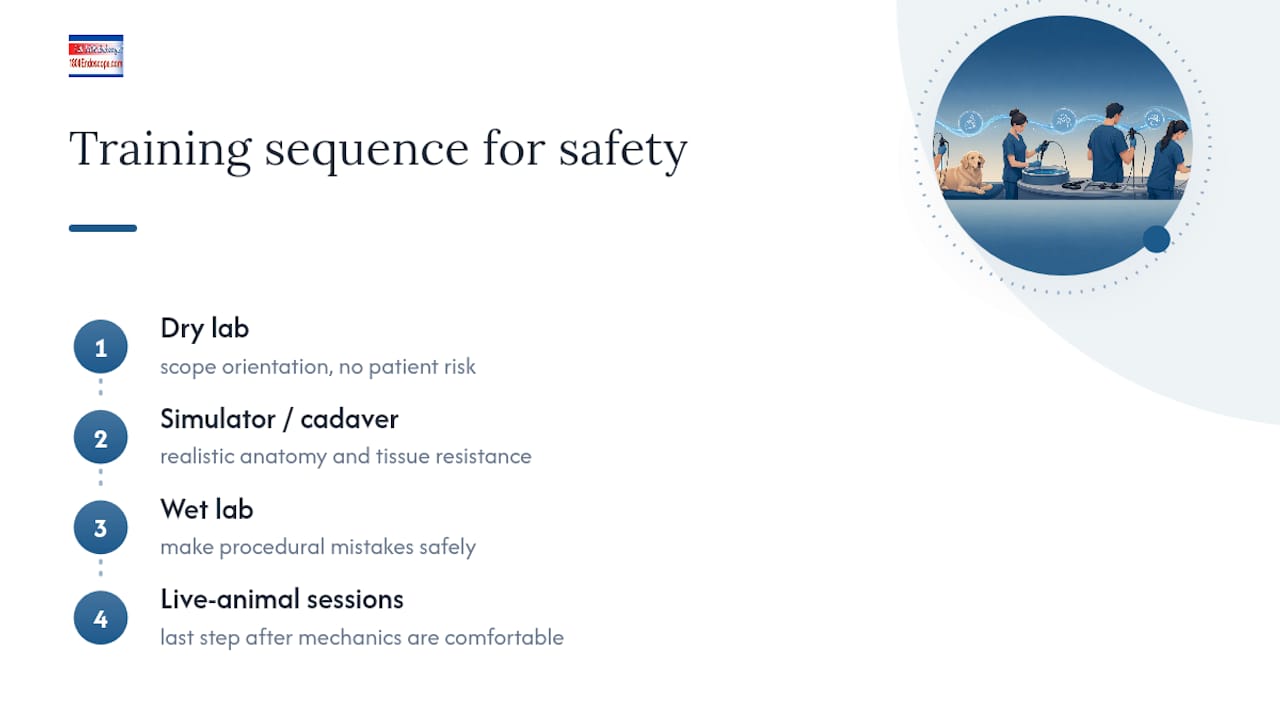
- Dry labs/simulators build muscle memory for scope orientation and hand-eye coordination without tissue risk.
- Cadaver labs teach anatomy negotiation, biopsy technique, and instrument handling on real tissue with zero pressure.
- Live-animal sessions consolidate skills under realistic conditions, ideally after simulator and cadaver work, not instead of it.
Integrated courses commonly bundle pre-course online modules, a scope setup and cleaning lab, and laser safety training when laser lithotripsy or ablation is on the syllabus. Ask about attendee-to-scope ratios before you register. A lab with six people sharing one tower teaches almost nobody anything useful.
Skills and Procedures a Good Course Should Teach
A reputable veterinary endoscopy course should leave you able to perform, not just describe, the following:
- Scope handling fundamentals — manipulation, orientation, the J-maneuver, negotiating the pylorus, and PEG tube placement, all skills that show up repeatedly in university short-course objectives like Nottingham's Introduction to Practical Endoscopy.
- Upper and lower GI procedures — diagnostic endoscopy, colonoscopy, biopsy collection, and foreign body retrieval.
- Respiratory and ENT work — bronchoscopy, rhinoscopy, and bronchoalveolar lavage technique.
- Lower urinary tract procedures — cystoscopy and vaginoscopy, including catheter and stone-retrieval basics.
- Endoscope maintenance — disassembly, cleaning protocol, and recognizing early signs of fiber damage or channel blockage before a $15,000 scope becomes a repair bill.
That last item gets skipped by course marketing more often than it should. A scope you can't clean properly is a scope you'll eventually break, and our own troubleshooting guide for veterinary endoscopes covers the failure points most technicians never get warned about in school.
How to Choose a Veterinary Endoscopy Course
Run every course listing through the same checklist before you commit tuition and travel budget:
- Explicit lab hours stated in numbers, not vague language like "hands-on component"
- CE or RACE approval clearly listed, with credit count spelled out
- Defined learning objectives, not a generic "introduction to endoscopy" blurb
- Named instructors with stated credentials or institutional affiliation
- A stated attendee-to-scope ratio, ideally one or two people per station
- Post-course access to recordings, notes, or a resource library
The pre-course didactic prework question deserves its own line item. Programs modeled on RVC's practical endoscopy CPD provide online modules three to four weeks before the wet lab, so in-person time goes to hands-on repetition instead of basic orientation lectures. Skip that prework, even when it's optional, and you'll spend half your lab time relearning things a video could have taught you at home.
Pro Tip: Call the course organizer and ask directly how many minutes of solo scope time each attendee gets during the lab. If they can't answer with a number, assume it's less than you'd like.
Cost versus value tips toward the longer integrated course once you're trying to add a second or third procedure type to your clinical repertoire. A single wet-lab intensive is the better buy when you need one skill fixed fast and don't want to pay for content you already know.
Red flags worth walking away from: no stated CE credit, no prerequisite information, and marketing copy that leans on adjectives instead of numbers.
Where to Find and Book Verified Endoscopy Courses
Four sources cover almost everything worth attending:
- The Veterinary Endoscopy Society maintains webinar archives, a video atlas, and course listings that double as a running education hub.
- VIN's CE catalog lists self-study modules and RACE-approved courses searchable by topic and credit count.
- University continuing-education pages at institutions like Colorado State, NC State, and the Virginia-Maryland College of Veterinary Medicine post detailed syllabi with contact-hour breakdowns, useful for comparing claims against reality.
- Specialist providers like KARL STORZ and Viticus Group run named courses with published lab-hour counts. Always cross-check the advertised hours against the actual daily schedule before booking.
Verify lab descriptions directly with the organizer when a listing is ambiguous about cadaver versus live-animal time. That single question separates a course built for real skill-building from one built for a marketing brochure.
Books and Video Resources to Pair With Any Course
Veterinary Endoscopy for the Small Animal Practitioner is the reference most instructors assume you've already read. Study the instrumentation and GI endoscopy chapters before any wet lab, then return to the bronchoscopy and cystoscopy sections once you've got basic scope handling under your belt.
- Read core textbook chapters on instrumentation and GI technique before registering for a lab
- Work through the Veterinary Endoscopy Society's video atlas for procedure visualization
- Complete a short self-study CE module on equipment basics before attending any hands-on course
- Pair recorded procedure videos with supervised practice sessions to lock in what you watched
Video alone won't make you competent, but watching a technique correctly before you try it cuts down the fumbling that eats up expensive lab minutes.
Practice Resources After You Finish a Course
CE credit doesn't equal clinic-ready hands. 1800endoscope publishes guides built for that gap, including Animal Endoscopy: A Veterinary Procedure Guide and Small Animal Endoscopy Tips for Veterinary Professionals, plus operation and cleaning procedure videos for portable scope systems.
- Procedure guides for pre-course review and post-course reinforcement
- Troubleshooting content for common scope and tower malfunctions
- Operation and cleaning videos matched to portable scope systems
- Equipment basics content for technicians new to scope handling
A clinic that buys an affordable portable scope after a course can run supervised practice sessions on low-risk cases, repeating the maneuvers taught in the wet lab until they stick. None of this replaces accredited training. It's the bridge between the CE certificate and the first solo procedure.
Prerequisites and Pre-Course Preparation
Most reputable courses assume basic sedation and patient positioning knowledge going in. What separates a well-prepared attendee from one who wastes lab time is the didactic prework, not prior scope experience.
Programs built like RVC's model send online modules three to four weeks ahead of the in-person session. That window matters. It gives you time to actually absorb anatomy review, equipment orientation, and safety protocols instead of skimming them the night before. Skip the prework and you'll spend your first lab hour catching up while everyone else is already practicing scope insertion.
Before showing up, confirm you understand: basic endoscope anatomy (insertion tube, control body, light guide, working channel), standard patient positioning for GI versus respiratory procedures, and sedation protocols specific to the species you'll be working with. If a course provides a reading list or video series beforehand, treat it as mandatory even when it's labeled optional. Instructors design lab exercises assuming you've done it.
Technicians attending alongside veterinarians benefit from separate prework focused on scope handling, cleaning protocol, and instrument passing, since their in-lab role often differs from the primary operator's. Courses that split prework by role tend to produce better lab outcomes for both.
If your last formal endoscopy exposure was in vet school, budget extra self-study time. A few hours with a procedure guide or video atlas before you arrive will save you from spending expensive lab minutes on material you could have learned for free.
Species-Specific Endoscopy Considerations
Small animal, large animal, and exotic endoscopy training diverge fast once you get past basic scope handling.
Small animal work dominates most general courses because it's the highest-volume clinical need. GI endoscopy, bronchoscopy, and cystoscopy in dogs and cats use standard flexible scopes and make up the bulk of course curricula you'll find through the Veterinary Endoscopy Society or university CE catalogs.
Large animal endoscopy, particularly equine work, demands different scope lengths and handling technique entirely. Equine gastroscopy requires scopes long enough to reach the stomach through a much longer esophagus, and airway evaluation for performance horses is its own specialty with distinct positioning and sedation protocols. Courses built around small animal procedures rarely translate directly. If equine work is your focus, look specifically for equine-labeled labs rather than assuming general endoscopy CE covers it.
Exotic species introduce the widest variation. Avian, reptile, and small mammal endoscopy often requires smaller-diameter scopes, modified insufflation approaches, and species-specific anatomical knowledge that general courses skip entirely. Exotic-focused wet labs are rarer and worth seeking out specifically rather than expecting broad coverage from a standard small animal course.
The practical takeaway: match the course to your caseload, not the other way around. A mixed-animal practitioner may need two separate CE investments rather than one course that claims to cover everything.
Safety Protocols and Common Complications in Training
Wet labs exist to make mistakes safely, before they happen on a real patient under time pressure. The complications instructors watch for during training sessions mirror what happens in clinical practice: perforation risk during scope advancement, oversedation in fragile patients, and equipment damage from improper handling.
Cadaver and simulator work exists precisely to let you make these errors without consequence. A dry lab lets you practice scope orientation without any patient risk at all. Cadaver sessions add realistic tissue resistance and anatomy without the pressure of a living, breathing patient on the table. Live-animal sessions, when a course includes them, should come last in that sequence, once basic mechanics are already comfortable.
Instructors in well-run labs enforce specific safety habits: checking insufflation pressure before advancing a scope, confirming sedation depth before starting a procedure, and requiring a spotter for anyone new to a given technique. If a course skips these basics or rushes attendees straight to live-patient work without simulator time first, that's a sign the program prioritizes throughput over safety.
Equipment-related complications get less attention than patient-related ones, but they matter just as much in a training context. Improper scope handling during a lab, forcing an angle the instrument wasn't built for, damages expensive equipment and teaches bad habits that follow you home. A course worth its tuition spends real time on scope care alongside procedure technique, not as an afterthought on the last afternoon.
New Technology Changing Veterinary Endoscopy
Portable, wireless-capable scope systems have changed what's realistic for smaller clinics to own and practice on between formal courses. HD video recording built into compact towers means a clinic can document procedures for case records or for reviewing technique with a mentor, without the capital cost of a full hospital-grade endoscopy suite.
Single-use and low-cost disposable scope components are also shifting how some courses structure their labs, reducing the sterilization burden between attendee rotations. That change alone speeds up lab throughput and gives each participant more actual scope time per hour of instruction.
On the clinical side, capsule endoscopy and smaller-diameter flexible scopes are expanding what's feasible in exotic and small-patient work, where a standard adult-sized flexible scope simply won't fit. Improved image processing in newer video systems also makes subtle mucosal changes easier to spot during training, which matters when biopsy targeting is exactly the skill a wet lab is trying to teach.
None of this technology replaces supervised repetition. It does make it more affordable for a clinic to keep a scope on hand for practice between courses, which is precisely the gap that turns CE credit into actual competence.
Certification Paths After Course Completion
Completing a course earns you CE hours, not a credential, and that distinction trips people up. Most veterinary endoscopy training, whether from KARL STORZ, Viticus Group, or a university CE catalog, awards continuing education credit toward state licensing renewal requirements, tracked through RACE approval where applicable.
Formal board certification in a related specialty, such as internal medicine or surgery through the American College of Veterinary Internal Medicine or the American College of Veterinary Surgeons, requires a residency pathway that goes far beyond any standalone endoscopy course. Endoscopy CE supports that pathway but doesn't substitute for it.
For general practitioners and technicians, the realistic goal after a course isn't a certificate on the wall. It's documented CE hours toward license renewal, plus enough supervised repetition to perform the procedure independently and safely in your own clinic. Some professional societies track cumulative CE in specific skill areas, which can matter if you're building a case for expanded scope of practice within your clinic or seeking referral status for endoscopic procedures locally. Keep your certificates and course syllabi on file. They document exactly what you were taught, which matters if a procedure's outcome is ever questioned.
After the Course, What Actually Builds Competence
Debrief the lab within a week while details are fresh, then schedule supervised practice sessions on low-risk cases before attempting anything solo. Build a minimum equipment checklist: scope, light source, biopsy forceps, cleaning tools. Questions about compatibility? Reach out to us anytime.
— Endoscope
Build In-Clinic Practice With the Right Equipment
CE hours only convert into clinic capability when you actually have a scope to practice on between courses, and that's where most clinics stall out. The Fully Portable PVSM6150 Endoscope System gives your team an affordable, SD card recording setup for exactly the kind of supervised repetition a wet lab can't provide on its own.
Whether you're outfitting a first scope purchase after a foreign-body-retrieval intensive or adding a second unit so two technicians can practice simultaneously, portability matters more than most vendors admit. You don't need a hospital-grade tower to build real scope-time between formal training. Browse the veterinary rigid endoscopy catalog to compare rigid options for cystoscopy and arthroscopy work, or check the PortaScope operation and cleaning videos to see exactly what daily use looks like before you buy. Request a quote today and get your team practicing before the CE certificate even arrives in the mail.
Sources
- Endoscopy Basics (DIAG426-2024) Self Study
- Endoscopic Foreign Body Removal for Emergency and Primary Care Veterinarians
- Veterinary Endoscopy Webinars | Veterinary Endoscopy Society
- Practical endoscopy courses (RVC)