
For most clinics, an equipment lease or a vendor-backed zero-down program is the fastest path to a new endoscope without draining cash reserves, while a term loan makes more sense if you plan to keep the scope for its full working life and want the Section 179 deduction. Either way, the move that saves you the most money isn't picking a lender first. It's getting a written product quote and two competing finance offers before you sign anything.
Here's the shortlist by clinic profile:
- New clinic or startup: Application-only equipment financing through a program like GeNESIS Commercial Capital, which can approve deals under $250,000 based on the practitioner's credit rather than business age.
- Tech upgrade or scope refresh: A fair-market-value lease through a broker such as Trust Capital USA, since endoscopy technology tends to age out faster than the loan term on a traditional purchase.
- Single-scope purchase under $25,000: Vendor financing bundled directly with the equipment purchase, often through the dealer selling the scope.
- High-value video system or full imaging tower: A structured equipment loan with a 24 to 84 month term, where ownership and long-term tax treatment matter more than monthly payment size.
Your next move, and it takes less than 30 minutes: pull a written price quote on the exact endoscope model you want (1800endoscope's portable veterinary video system is a useful benchmark for pricing), then request prequalification from two lenders in the same week. Comparing real numbers beats comparing marketing pages every time.
Key Takeaways
Choosing between a lease and a loan for veterinary endoscope financing comes down to whether the equipment's usable life outlasts the financing term.
| Point | Details |
|---|---|
| Fastest approval route | Application-only programs under $250,000, like those from GeNESIS Commercial Capital, often approve in same-day to 2 business days. |
| Lowest total cost, long-term | A term loan paired with Section 179 expensing typically beats a lease when you plan to keep the scope for its full useful life. |
| Match structure to obsolescence | Choose an FMV lease for video and software-dependent scopes, a loan for durable rigid equipment. |
| Get quotes before signing | Compare at least two written offers on APR, term, and buyout figure, not just monthly payment. |
| Start with a real product price | 1800endoscope's product catalog gives you the exact quote lenders need to begin the approval process. |
Table of Contents
- How Does Veterinary Endoscope Financing Actually Work?
- How Much Do Veterinary Endoscopes Cost?
- Which Financing Route Fits Your Clinic Best?
- What Will My Monthly Payment Actually Be?
- How Does the Approval Process Work?
- How Does Financing Affect My Taxes?
- Which Lenders Should You Actually Call First?
- A Worked Example: Financing a $30,000 Endoscope System
- What Veterinary Buyers Get Wrong About Financing Offers
- Get a Financing-Ready Quote From 1800endoscope
- Where to Read More Before You Sign
- Frequently Asked Questions
- Sources
How Does Veterinary Endoscope Financing Actually Work?
Veterinary endoscope financing works largely the way any equipment finance deal works: a lender or the equipment vendor fronts the purchase price, and you repay it over a fixed term through either a loan (you own the equipment from day one) or a lease (the lender owns it until a buyout, if there is one). The distinction that matters most for endoscopy specifically is obsolescence risk. A rigid arthroscope holds its value for a decade. A wireless video endoscope with proprietary software might feel outdated in five years, which changes which financing structure actually saves you money.
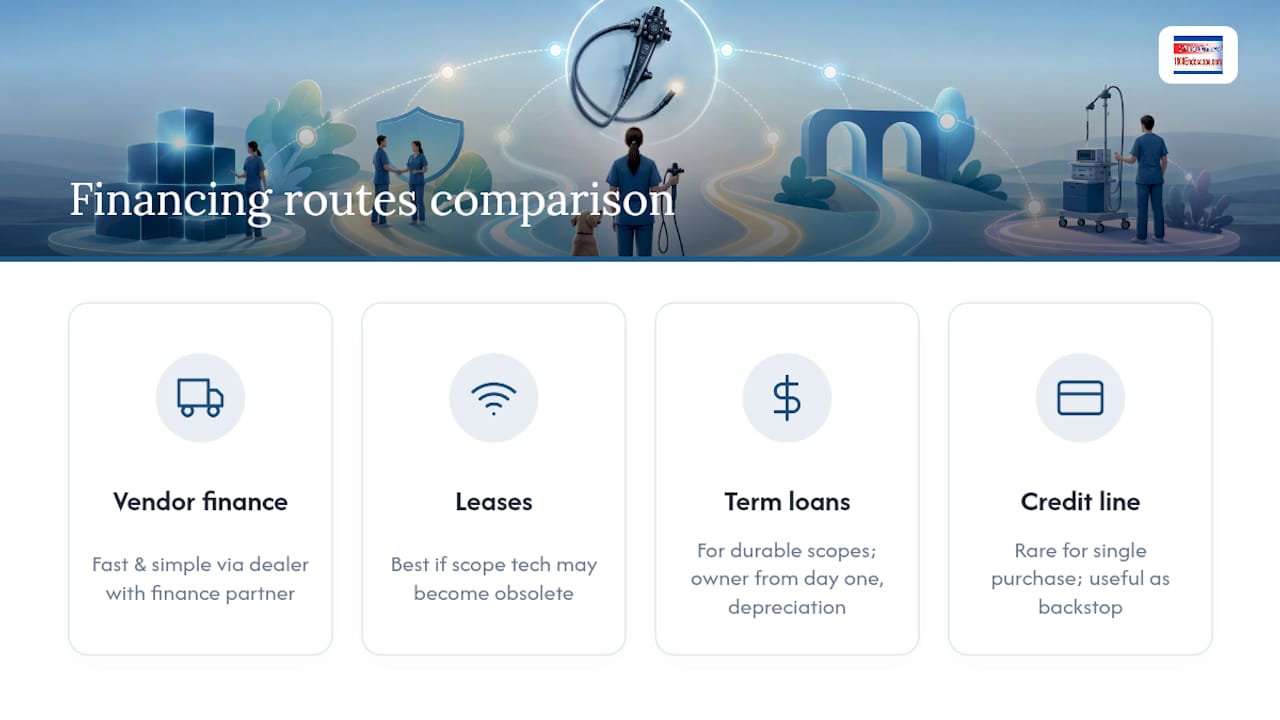
Here's how the main routes stack up against each other.
Vendor financing wins on speed and simplicity when you're buying one scope through a dealer who already has a finance partner in place. Leases win when the technology inside the scope, not just the housing, is likely to change. Term loans win when you're financing something durable, like a rigid diagnostic scope, and want the depreciation benefit. A line of credit is rarely the right tool for a single large purchase, but it's useful as a backstop if a financing approval takes longer than expected.
One more thing worth knowing before you shop rates: a retailer like 1800endoscope isn't a lender. It sells the equipment and can point you toward financing partners, but the actual approval, rate, and paperwork come from a finance company. Get your product quote first, then shop that number to lenders.
How Much Do Veterinary Endoscopes Cost?
Price ranges vary enormously by scope type, and that range is exactly why financing structure matters so much. A basic rigid diagnostic scope for otoscopy or minor procedures might run $3,000 to $8,000. A flexible fiberoptic scope for GI or bronchoscopy work typically lands between $8,000 and $25,000. Portable wireless video systems, the kind gaining traction for their SD card recording and no-monitor-cart convenience, often price out in the $2,500 to $10,000 range depending on chip diameter and working length. Full video endoscopy towers with a dedicated monitor, recorder, and light source can run $25,000 to $150,000 or more, especially for human-grade systems adapted for large-animal work.
The scope itself is rarely the whole bill. Budget for these components separately:
- Light source: $500 to $5,000 depending on LED versus xenon and brightness output.
- Monitor and recorder: $1,000 to $8,000 for a dedicated video tower setup.
- Biopsy forceps and accessories: $200 to $1,500 per instrument, and most practices need several.
- Service contract or extended warranty: Often 8% to 15% of purchase price annually.
- Disposables (sheaths, cleaning supplies): A recurring line item, small individually but real over a year.
- Shipping and installation: Usually a few hundred dollars, sometimes waived by the vendor.
Pro Tip: Refurbished or used scopes can cut your upfront cost by 30% to 50%, but confirm the financing terms before you assume it's cheaper. Some lenders shorten the term or raise the implied rate on used equipment because it depreciates faster and has less resale value as collateral. Ask for the used-equipment rate sheet specifically, not just the new-equipment quote.
Translating that into financing brackets: anything under $5,000 usually qualifies for an application-only, no financials needed approval. The $5,000 to $25,000 range is the sweet spot for vendor financing and fast equipment loans. Above $25,000, especially into six figures for a full tower system, lenders start asking for tax returns and bank statements, and that's where Elevex Capital notes financing can scale all the way up to $1 million in application-only decisions for practices with strong credit profiles.
Which Financing Route Fits Your Clinic Best?
Vendor and dealer financing is the path of least resistance when you're buying one scope and the seller already has a finance partner integrated into checkout. Patterson Vet, for example, commonly runs application-only approvals up to $500,000 with 100% financing available up to certain thresholds, which means no down payment and a fast yes-or-no. The tradeoff is you're locked into whatever rate the vendor's finance partner offers, and that's not always the most competitive number on the market.
Equipment leases come in two flavors, and the difference matters more for endoscopy than for almost any other equipment category. A fair-market-value (FMV) lease keeps monthly payments lower because you're not paying toward eventual ownership. At the end of the term, you return the scope, renew the lease, or buy it at whatever it's worth then. A $1 buyout lease functions more like a loan; the token buyout means you own it outright at term's end, but you pay for that ownership through a slightly higher monthly rate. Trust Capital USA structures many of its endoscopy leases around FMV terms specifically because scope technology changes fast enough that owning a five-year-old video processor isn't always a win.
Equipment loans and bank financing put ownership in your hands from the first payment. This route makes the most sense for rigid scopes and other equipment with a long useful life, where you're not worried about the technology aging out. Credit and collateral carry more weight here than with application-only leases; expect a bank or specialty lender to want to see your credit score, and possibly two years of tax returns for anything above the mid five figures.
Lines of credit aren't built for a single equipment purchase, but they're worth having open as a cash-flow buffer. If an approval on your term loan takes longer than the vendor's price hold, a line of credit covers the gap without forcing you into a rushed decision.
Rent-to-own and short-term rental programs exist mainly for practices that want to trial a technology, like a new wireless video system, before committing to a multi-year lease. The effective cost per month runs higher than a standard lease, but the flexibility to walk away after a few months has real value if you're not sure the scope fits your caseload.
For a solo DVM opening a first practice, application-only vendor or dealer financing usually wins on speed. For a multi-doctor hospital adding a second video system, an FMV lease often protects you from technology risk. For a practice buying a durable rigid scope it plans to use for 15 years, a term loan with Section 179 in play is usually the cheaper route over the full life of the equipment.
What Will My Monthly Payment Actually Be?
Numbers help more than percentages here, so let's run a few. Assume a $30,000 flexible video endoscope system, a reasonably common price point for a mid-size practice upgrade.
Equipment loan example: $30,000 financed at a 9% APR over 60 months, with a 10% down payment ($3,000). The financed amount is $27,000. Monthly payment lands around $560. Total repayment over five years runs approximately $33,600, meaning total interest cost of roughly $6,600 on top of the $27,000 principal.
Monthly payment runs approximately $790.
Vendor 0-down promo example: Same system, promotional 0% APR for 36 months through a dealer program. Monthly payment is a flat $833. Total cost equals the purchase price exactly, assuming you qualify for the promotional rate and pay no origination fee.
Your own numbers will shift based on credit tier, term length, and whether the lender charges an origination or documentation fee. Change these four inputs to model your clinic's actual deal: purchase price, down payment, term length, and the implied rate or APR quoted to you. A simple amortization calculator, the kind built into most bank websites or a basic spreadsheet formula, will convert those four numbers into a monthly payment estimate in seconds. Crestmont Capital's guide to clinic equipment financing notes that terms commonly run from 24 to 84 months across the industry, so plug in a few different term lengths and see how much the monthly number moves before you commit to one structure.
How Does the Approval Process Work?
Most veterinary equipment financing uses the endoscope itself as collateral, which is the single biggest reason approvals move faster than a typical business loan. U.S. Bank notes that this collateral structure lets even newly opened practices qualify based on the practitioner's personal credit and production history, rather than needing years of business tax returns.
Here's the document checklist most lenders will ask for, though the exact list shrinks for smaller deals:
- Tax ID or EIN (sole practitioners may be able to use an SSN instead)
- Two to three most recent business bank statements
- Two years of business and personal tax returns, typically required only above $100,000
- A signed equipment quote or invoice from the seller
- Proof of veterinary license or practitioner credentials
- Business license or practice formation documents
For deals under roughly $250,000, GeNESIS Commercial Capital and similar lenders commonly run application-only programs that skip the tax returns and bank statements entirely, relying instead on a credit check and the signed equipment quote. That's a meaningful shortcut if your purchase falls in that range.
Timeline expectations break into two clear buckets. Application-only deals for smaller-ticket purchases often close same-day to 2 business days once the paperwork is in. Financial-statement deals, the kind required for six-figure systems or newer practices with thin credit history, typically take 1 to 3 weeks once full documentation is submitted.
Three tactics speed things up:
- Get prequalified before you finalize your equipment choice, so financing isn't the bottleneck once you've picked a scope.
- Ask the vendor for a finance worksheet upfront; many dealers already have a lender relationship that skips a step.
- Consolidate every document into one submission rather than trickling paperwork to the lender over several days.
How Does Financing Affect My Taxes?
Buying outright, whether with cash or a loan, opens the door to Section 179 expensing and bonus depreciation, both of which let you deduct a large portion of the equipment's cost in the year you place it in service rather than depreciating it slowly over years. That timing advantage tends to favor loans over leases for practices planning to keep the scope for its full useful life, since you get the ownership deduction immediately instead of spreading it out.
Lease payments work differently on your books. Rather than a depreciation deduction, you typically deduct the lease payment itself as an operating expense each year, which smooths out cash-flow impact but usually delivers a smaller total deduction in year one compared to Section 179 on a purchase. Crestmont Capital's guidance frames this as one reason leasing tends to fit shorter-lived technology better: you're not locking in a large upfront deduction against equipment you might replace in three years anyway.
Pro Tip: Ask each lender for the total finance charge and the payment schedule in writing, then run a simple after-tax comparison: subtract your estimated Section 179 deduction from the loan option's total cost, and compare that number against the lease's total payments plus any buyout. The cheaper monthly payment isn't always the cheaper option once tax timing is factored in.
Tax rules around equipment expensing change periodically, and clinic-specific factors like taxable income and entity structure affect how much of a deduction you can actually use. This is general information, not tax advice. Confirm current-year Section 179 limits and your clinic's specific treatment with a CPA before finalizing either a purchase or a lease.
Which Lenders Should You Actually Call First?
1800endoscope is the starting point for the product side of this decision. Its catalog of rigid veterinary endoscopes and portable video systems gives you a real price quote to bring to a lender, and its team can point you toward financing partners once you know exactly which scope you want.
Covetrus Finance operates through the Covetrus distributor network and markets flexible leasing and practice financing programs, with term options ranging from one to 15 years and same-day approval in some cases. It's a natural fit if you're already buying supplies through Covetrus and want financing bundled into the same account.
Financial Pacific Leasing is a specialty equipment lessor frequently used in medical and veterinary equipment deals, with established lease structures that dealers often reference directly on their finance worksheets.
Trust Capital USA focuses specifically on medical and endoscopy equipment, structuring many deals as FMV leases with upgrade paths built in, and advertises next-day funding for qualifying transactions.
GeNESIS Commercial Capital runs application-only programs up to $250,000 with flexible pay structures, including 90-day deferrals and seasonal payment plans that suit practices with caseload swings.
Crestmont Capital functions partly as an information resource alongside its financing offers, publishing term ranges (24 to 84 months) and lease-versus-buy guidance that's worth reading even if you finance elsewhere.
Patterson Vet financing bundles financing directly with equipment purchased through Patterson's veterinary supply channel, offering 100% financing up to vendor-specified thresholds and fast decisions on application-only requests.
Before you sign with any of them, request the same four numbers from each: the APR or implied lease rate, the term length, the residual or buyout figure if it's a lease, and any origination or documentation fees. Ask directly about prepayment penalties too; some equipment finance contracts charge a fee if you pay off early after selling the practice or upgrading equipment. Comparing two or three of these quotes side by side, on paper, is the single most effective negotiating tool you have.
A Worked Example: Financing a $30,000 Endoscope System
Let's put real numbers side by side for that same $30,000 system, comparing the three most common structures a mid-size practice would actually consider.
The loan wins on total cost if you keep the scope for its full useful life and can use Section 179 in year one. The FMV lease costs more in raw dollars but protects you from being stuck with an outdated video processor in year four.
The right pick depends on how confident you are that this specific technology will still be current in five years. A rigid diagnostic scope: finance it and keep it. A wireless video system with proprietary software: lean toward the lease.
Once you've picked a structure, the next steps are straightforward: lock in a written equipment quote, confirm what the service contract and warranty will cost annually, and get formal pre-approval in writing before the vendor's price hold expires.
What Veterinary Buyers Get Wrong About Financing Offers
Most practices shop for the lowest monthly payment. That's the wrong number to optimize for, and it's the single easiest way to overpay by thousands of dollars on an endoscope purchase.
Here's what actually protects your clinic's cash: ask every lender for the total cost of the deal in writing, not just the payment, before you compare offers. A 48-month lease at $790 a month looks cheaper than a 60-month loan at $560 a month until you realize the lease term is shorter and the loan carries a down payment that changes the real comparison. Run both to their actual end dates and compare total dollars out the door, including any buyout.
Watch for a few red flags that show up more often in equipment leases than loans. A blanket lien lets the lender claim other business assets, not just the scope, as collateral; ask specifically whether the lien is limited to the financed equipment. An undisclosed prepayment penalty can cost you real money if you sell the practice or upgrade early. Variable-rate leases, less common but not rare, can raise your payment mid-term if reference rates move. And a large hidden residual, the amount you'd owe to buy out an FMV lease, can turn what looked like a cheap lease into an expensive one if you decide to keep the equipment.
On negotiation, three things are almost always worth asking for and rarely offered upfront: no documentation fee, a written buyout figure locked in at signing rather than "market value at term end," and a same-as-cash promotional period if you're buying through a vendor. Dealers have more room to move on these terms than their initial quote suggests, especially if you've got a competing offer in hand.
Timing matters more than most practices realize. If you're financing a system likely to be outdated in three to four years, time your lease term to match, and ask upfront whether the lender's upgrade program lets you roll into a new lease before the old one ends. That single question, asked before you sign, is often the difference between a smooth technology refresh and being stuck paying off equipment you've already replaced.
Get a Financing-Ready Quote From 1800endoscope
1800endoscope sells the equipment side of this decision directly, which means you get a real, itemized price quote instead of a vague estimate to bring to a lender. Its catalog covers everything from low-cost portable video systems to full rigid endoscopy setups, so you can match a specific model and price point to the financing route that fits your clinic.
If you're ready to start pricing out a system, browse the portable veterinary endoscope system for a concrete benchmark, or check the borescope catalog if you're targeting a lower-ticket, application-only financing bracket. Have your target price range and preferred scope type ready, then request a quote directly. That quote becomes the document every lender in this article will ask to see first, so getting it locked in now shortens every step that follows.
Where to Read More Before You Sign
Six sources cover the ground this article draws from, and each is worth a direct read if you're deep in a financing decision right now.
Equipment finance providers increasingly structure deals around the practice's actual cash flow rather than a one-size-fits-all term, offering step payments, seasonal deferrals, and application-only paths that didn't widely exist a decade ago.
- U.S. Bank's veterinary practice financing page explains how collateral-backed equipment loans work and why startups can often qualify.
- Trust Capital USA's endoscopy equipment page details FMV lease structures built specifically around technology obsolescence.
- GeNESIS Commercial Capital's veterinary financing page outlines application-only thresholds and flexible payment structures.
- Crestmont Capital's 2026 clinic financing guide walks through typical term ranges and lease-versus-buy logic.
- Elevex Capital's veterinary industry page covers financing for used and refurbished equipment and larger practice deals.
- Patterson Vet's financial services page shows a typical dealer-backed financing model with high application-only thresholds.
Tax treatment of any financing structure depends on your clinic's specific numbers and current federal rules, so confirm Section 179 eligibility and depreciation timing with a CPA before you finalize a purchase or lease.
Frequently Asked Questions
Is it better to lease or buy a veterinary endoscope? It depends on how long the scope will stay current. Buy or finance with a loan for durable rigid equipment you'll use for a decade or more. Lease video and software-dependent systems that are likely to need replacing within five years.
How much down payment do I need for veterinary endoscope financing? Many vendor and application-only programs require no down payment at all.
Can a new veterinary clinic qualify for endoscope financing? Yes. Because the equipment itself usually serves as collateral, lenders often approve startups based on the practitioner's personal credit and production history rather than requiring years of business tax returns.
What credit score do I need to finance a veterinary endoscope? Requirements vary by lender and deal size, but stronger personal credit generally unlocks better rates and application-only approval paths, especially for financing under $250,000.
Does financing a veterinary endoscope qualify for Section 179? Purchases financed through a loan or a $1 buyout lease typically qualify for Section 179 expensing, since you own the equipment. FMV leases are usually treated as a rental expense instead. Confirm specifics with a CPA.
This article is general information, not a substitute for advice from a qualified financial advisor. Consult a qualified financial professional about your own circumstances before acting on anything here.
Sources
- Endoscopy equipment financing — Trust Capital USA
- Veterinary equipment financing — GeNESIS Commercial Capital
- Veterinary clinic equipment financing & leasing: The complete 2026 guide — Crestmont Capital
- Veterinary equipment financing — Elevex Capital
- Veterinary practice equipment financing — Patterson Vet