
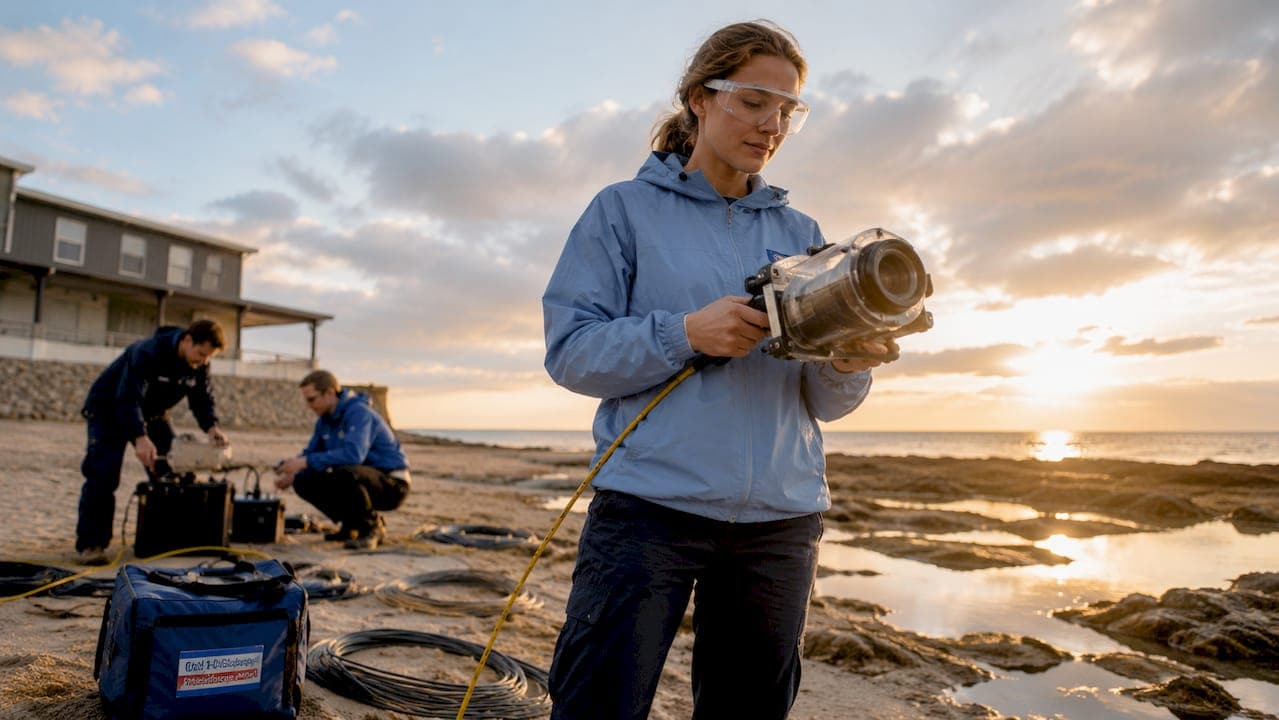
Underwater inspection cameras are the primary tool professionals use to assess submerged infrastructure, marine assets, and confined aquatic environments without deploying human divers. Known in industry as remote visual inspection (RVI) systems, these cameras serve marine engineering, civil construction, industrial maintenance, and environmental monitoring. They deliver real-time HD visuals that reduce risk, cut costs, and catch failures before they become catastrophic. Whether you are managing offshore platforms, inspecting bridge foundations, or surveying sewer lines, the right underwater camera application determines whether you get actionable data or wasted dive time.
1. Underwater inspection camera uses in marine engineering
Marine engineering represents the most demanding and highest-stakes environment for underwater inspection cameras. Offshore platforms, riser pipes, and wellheads require continuous monitoring because corrosion, biofouling, and mechanical stress accumulate invisibly below the waterline. A single missed crack in a riser pipe can trigger a blowout; a camera inspection cycle catches it first.
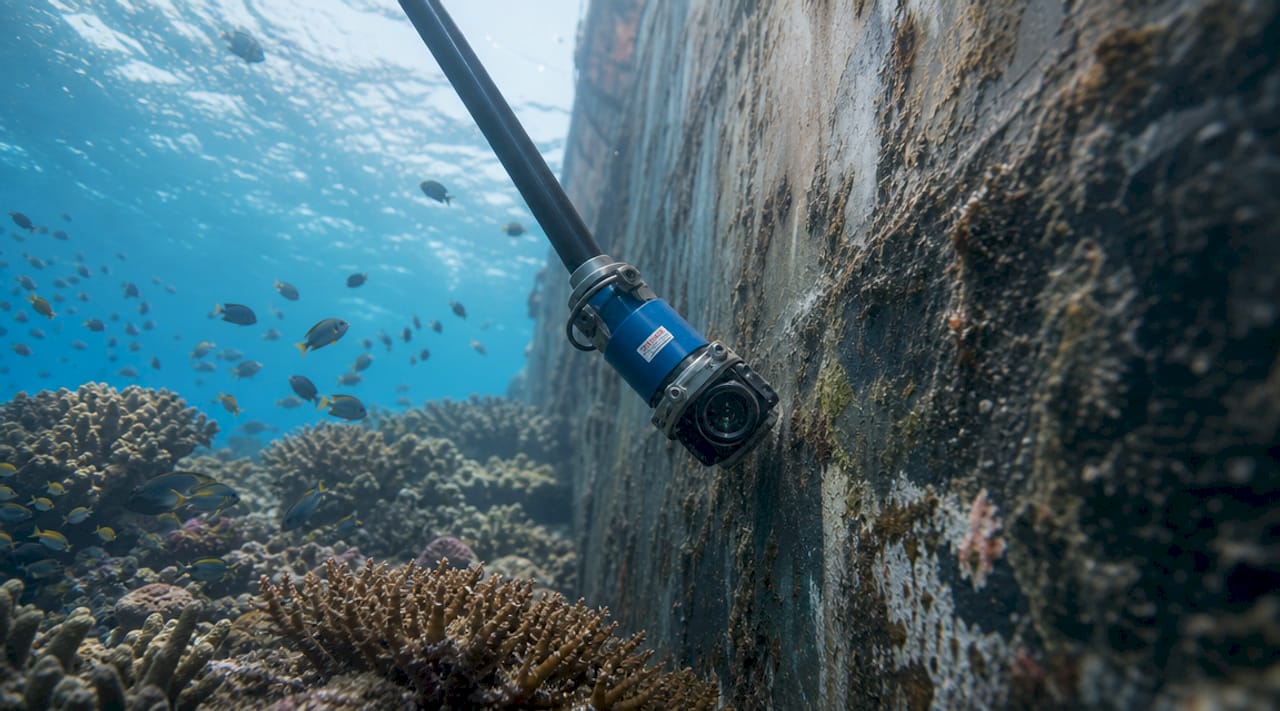
Ship hull and propeller surveys are another core marine application. Inspection teams deploy drop cameras or ROVs alongside a vessel in port to detect impact damage, weld fatigue, and marine growth without dry-docking the ship. Dry-docking costs tens of thousands of dollars per day, so even one avoided haul-out pays for years of camera equipment.
Subsea pipeline integrity assessment relies on cameras tethered to ROVs that travel the pipe route and record continuous video. Operators review footage for joint separation, external corrosion, and seabed movement that could stress the line. Environmental and ecological monitoring rounds out marine uses, with cameras tracking reef health, sediment disturbance, and protected species near construction zones.
- Riser pipe and wellhead visual surveys
- Ship hull, keel, and propeller damage detection
- Subsea pipeline corrosion and joint integrity checks
- Harbor entrance and navigation channel clearance surveys
- Ecological baseline monitoring near offshore structures
Pro Tip: When inspecting ship hulls in port, use a pole-mounted camera with a wide-angle lens before deploying an ROV. You will cover 80% of the hull surface in a fraction of the time and reserve the ROV for flagged areas only.
2. Construction and civil infrastructure inspection
Submerged bridge foundations are among the most under-inspected assets in civil infrastructure. Scour, the erosion of riverbed material around a bridge pier, is the leading cause of bridge collapse in the United States. Underwater cameras mounted on articulated poles or drop systems give inspectors a direct view of scour depth and foundation exposure without a dive team.
Harbor and port infrastructure assessments use cameras to check sheet pile walls, quay fenders, mooring bollards, and concrete aprons for cracking and spalling. These structures sit in brackish or saltwater environments that accelerate deterioration, making annual visual inspection the minimum standard for responsible asset management.
Borehole and chimney inspections under water are a less obvious but growing application. During dam construction or geotechnical surveys, cameras are lowered into water-filled boreholes to verify rock quality, joint spacing, and grout penetration. The camera replaces a diver in a space where a diver cannot safely fit.
- Deploy a fixed-view camera at known scour-prone piers for continuous seasonal monitoring
- Use a drop camera for initial harbor surveys before committing to a full ROV deployment
- Document all findings with timestamped HD video to support engineering reports and regulatory submissions
- Pair camera footage with sonar data for a complete structural health picture on large bridge spans
3. Industrial pipeline, sewer, and confined space inspection
Industrial pipeline inspection is one of the highest-volume uses for underwater cameras globally. Professional pipeline cameras offer 1080P HD resolution, 360-degree pan and 180-degree tilt articulation, and IP68 waterproofing rated for depths from 20 to 300 meters. Those specifications matter because a camera that cannot pan inside a pipe junction misses the exact location where blockages and cracks concentrate.
Sewer inspection cameras navigate flooded lines to locate root intrusion, joint offset, and structural collapse. Municipal utilities and private contractors use self-propelled crawler systems or push-rod cameras depending on pipe diameter, which typically ranges from 50mm to 200mm for standard inspection tools. The footage feeds directly into asset management software for repair prioritization.
Industrial tank and confined space assessments use cameras to inspect the interior of storage vessels, cooling towers, and process tanks that cannot be drained without halting production. A camera on a flexible insertion rod gives inspectors a full interior view in under an hour.
| Specification | Typical Range | Why It Matters |
|---|---|---|
| Resolution | 1080P HD | Captures hairline cracks and joint gaps clearly |
| Pan / Tilt | 360° / 180° | Covers full pipe circumference without repositioning |
| Waterproof rating | IP68, 20–300 m | Survives flooded lines and deep industrial tanks |
| Battery runtime | 6 to 8 hours | Supports full-shift inspections without recharging |
| Pipe diameter range | 50mm to 200mm | Matches standard municipal and industrial pipe sizes |
Pro Tip: For sewer inspections in pipes smaller than 75mm, use a push-rod camera with a self-leveling head. Self-leveling keeps the image upright regardless of pipe rotation, which makes defect location reporting far more accurate.
4. Comparing deployment methods: fixed systems, drop cameras, and ROVs
Three main deployment methods define how professionals get cameras underwater: fixed systems for continuous monitoring, drop cameras for spot checks, and ROVs for complex maneuverable surveys. Choosing the wrong method wastes time and money regardless of camera quality.
Fixed systems mount cameras permanently on structures such as pier pilings, dam faces, or offshore platform legs. They stream continuous video to a surface control station and trigger alerts when conditions change. The tradeoff is limited field of view and the cost of subsea cabling and housing maintenance.
Drop cameras are the fastest and lowest-cost option for shallow inspections. You lower the camera on a tether, position it visually, and record. No piloting skill required, no power-hungry thrusters, and no tether management headaches. For stationary or repeated inspections, fixed or pole-mounted cameras consistently outperform ROVs in efficiency, stability, and cost. Many teams over-specify by defaulting to ROVs when a drop camera would deliver better results faster.
ROVs justify their complexity when the inspection target requires active navigation, such as following a pipeline route, inspecting the underside of a hull, or accessing a confined space with multiple turns. Modular payload systems allow quick tool swaps between cameras, NDT sensors, and grabbers, which reduces downtime on multi-task inspection dives.
- Fixed systems: best for continuous monitoring of known high-risk locations
- Drop cameras: best for shallow spot checks, harbor surveys, and budget-constrained projects
- ROVs: best for pipeline routes, hull undersides, and tasks requiring AI-assisted measurement
5. Advanced camera features that improve inspection accuracy
High-definition underwater cameras provide real-time monitoring that improves operational efficiency and directly reduces diver risk. HD resolution alone does not guarantee useful data, though. Lighting and optics engineering determine whether you get a clear image or a washed-out blur.
Adjustable high-intensity LED arrays are the standard solution for murky environments. LEDs mounted close to the lens create backscatter, the same effect as driving with high beams in fog. Positioning lights at an angle to the lens, or using side-mounted arrays, cuts backscatter dramatically and reveals surface texture that a front-lit camera would obscure.
Stereo camera geometry and specialized lighting overcome light scattering in turbid water to yield precise 3D models. This matters for structural assessments where you need to measure crack width or corrosion depth, not just see that damage exists. Waiting for perfect water clarity is not a practical inspection strategy. Optimized optics and lighting deliver reliable results in the conditions you actually face.
Effective inspection systems rarely stand alone. Integrating cameras with thermal and AI layers maximizes operational effectiveness, especially for port security and offshore platform asset management.
- HD resolution: minimum 1080P for structural defect detection
- LED lighting: angled or side-mounted arrays to reduce backscatter
- Stereo imaging: enables 3D modeling and precise dimensional measurement
- AI integration: automates defect flagging and measurement in real time
- Real-time streaming: supports surface-based decision-making without dive delays
6. Environmental monitoring and aquatic habitat assessment
Environmental monitoring is an expanding underwater camera application that sits outside traditional engineering but demands the same equipment rigor. Regulatory agencies require baseline surveys before and after marine construction projects, and cameras provide the documented visual record that satisfies those requirements.
Coral reef health assessments, fish population surveys, and invasive species tracking all use videoscope applications adapted for aquatic environments. Research institutions and environmental consultancies deploy drop cameras on transect lines to photograph benthic communities systematically. The footage is georeferenced and compared year over year to detect change.
Aquaculture operations use fixed underwater cameras to monitor fish behavior, feeding activity, and net pen integrity in real time. A camera that shows fish crowding at the surface signals low dissolved oxygen before a mortality event occurs. That early warning is worth more than any post-event analysis.
Key takeaways
Underwater inspection cameras deliver the most value when the deployment method, camera specifications, and lighting configuration are matched precisely to the inspection task.
| Point | Details |
|---|---|
| Match deployment to task | Use fixed cameras for continuous monitoring, drop cameras for spot checks, and ROVs for complex routes. |
| Prioritize lighting over resolution | Angled LED arrays and stereo geometry outperform raw megapixels in turbid water conditions. |
| Marine and civil uses are highest stakes | Offshore platforms, bridge foundations, and subsea pipelines carry the greatest failure risk and benefit most from regular camera inspection. |
| Industrial specs matter | IP68 waterproofing, 360-degree pan, and 6 to 8 hour battery life are the minimum for professional pipeline and sewer work. |
| Integration amplifies results | Cameras paired with AI, thermal sensors, or sonar deliver data that standalone visual inspection cannot match. |
What I have learned after years of watching inspection teams get this wrong
The most common mistake I see is teams spending their entire budget on an ROV when a well-specified drop camera would have done the job in half the time. ROVs are genuinely impressive tools, but they require a trained pilot, tether management, battery logistics, and a surface support team. For a harbor survey or a bridge pier scour check, that overhead is pure waste.
The second mistake is treating resolution as the only camera specification that matters. I have reviewed footage from 4K cameras that was completely unusable because the lighting setup created backscatter across the entire frame. A 1080P camera with properly angled LEDs will beat a 4K camera with front-mounted lights every single time in real-world turbid conditions.
My practical recommendation: start with the inspection task, not the equipment catalog. Define the depth, the target structure, the required data output, and the access constraints. Then select the simplest deployment method that meets those requirements. You can always add complexity later. You cannot recover the time lost to over-engineered setups that slow your crew down in the field.
The future of this technology sits in AI-assisted defect detection integrated directly into the camera system. Real-time flagging of cracks, corrosion, and joint displacement during the inspection pass eliminates the post-processing bottleneck that currently delays reporting by days or weeks. That integration is already available in high-end ROV systems and will reach portable drop cameras within the next few years.
— Endoscope
Explore professional inspection systems from 1800endoscope
If you are sourcing equipment for underwater or confined-space inspection work, 1800endoscope carries a broad range of portable and industrial video inspection systems built for exactly these applications.
The portable inspection endoscope from 1800endoscope delivers HD video recording with direct monitor output and SD card storage, making it a practical choice for field teams who need reliable documentation without a laptop on site. For teams that need a wider selection across pipe diameters and application types, the full borescope catalog covers industrial NDT borescopes, flexible videoscopes, and specialty systems for both veterinary and industrial inspection workflows. 1800endoscope focuses on cost-effective solutions that do not compromise on image quality or build durability.
FAQ
What are the main underwater inspection camera uses?
Underwater inspection cameras are used for marine engineering surveys, ship hull inspections, subsea pipeline integrity checks, bridge foundation scour monitoring, industrial sewer and pipeline inspections, and environmental habitat assessments. Each application requires different deployment methods and camera specifications.
How do underwater inspection cameras work?
An underwater inspection camera uses a waterproof housing, high-intensity LED lighting, and a video sensor to capture real-time footage at depth. The signal travels through a tether cable or wireless transmitter to a surface monitor where operators review and record the footage.
When should you use an ROV instead of a drop camera?
Use an ROV when the inspection target requires active navigation, such as following a pipeline route or accessing a confined space with multiple turns. Drop cameras are more efficient and cost-effective for shallow spot checks and stationary structure surveys.
What resolution do professional underwater inspection cameras need?
Professional systems use a minimum of 1080P HD resolution paired with IP68 waterproofing and articulated pan and tilt heads. Resolution alone is insufficient without properly engineered lighting, particularly in turbid or low-visibility water.
Can underwater cameras work in murky water?
Yes. Optimized optics, angled LED arrays, and stereo camera geometry allow reliable inspection results in turbid conditions. Waiting for clear water is not a practical strategy for most industrial or marine inspection schedules.