
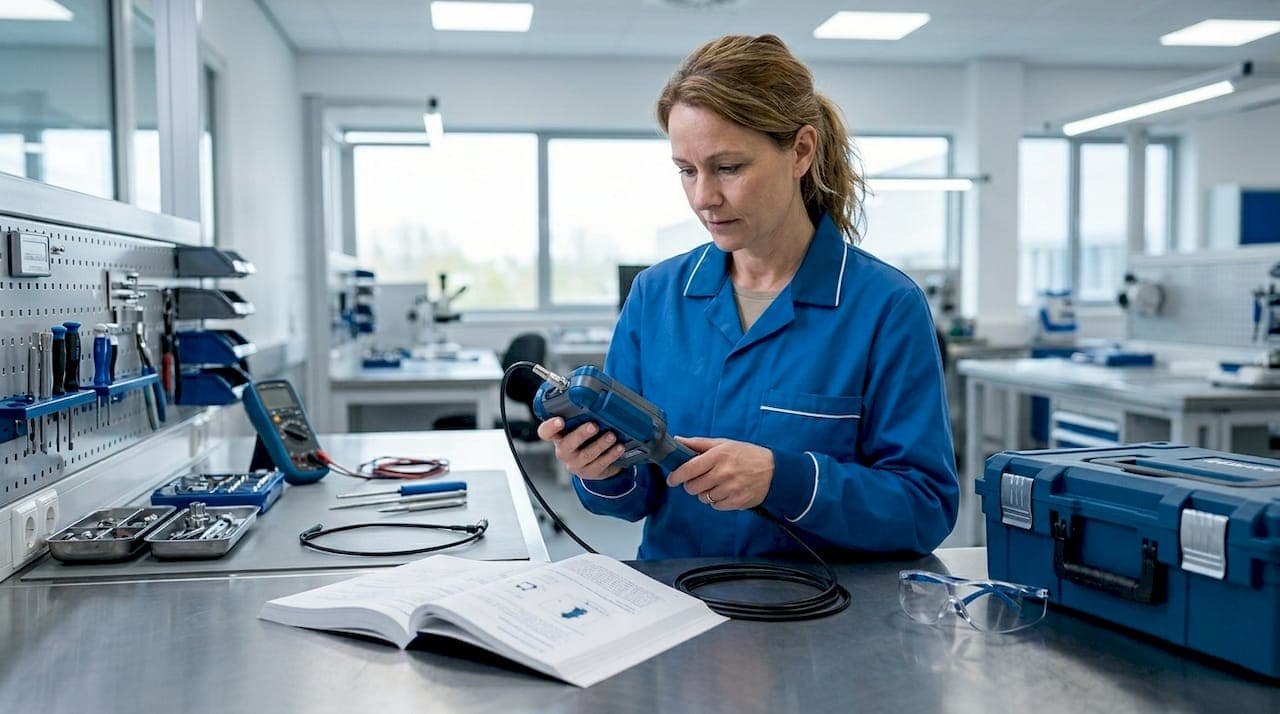
Industrial video inspection is a discipline that far exceeds pointing a camera at a surface and hoping for the best. At its core, what is industrial video inspection comes down to deploying remote camera systems to detect defects, measure dimensions, and document the internal condition of assets that human eyes simply cannot reach without costly teardown. Turbine blades, buried pipelines, pressure vessels, engine bores, and weld joints all fall within its scope. This guide covers the technology behind it, where it gets applied, its real advantages over traditional methods, and how to implement it effectively in your maintenance or quality assurance workflow.
Table of Contents
- Key takeaways
- What industrial video inspection really is
- Applications across industries
- Benefits and limitations of video inspection technology
- Advancements integrating video with other inspection technologies
- Practical considerations for implementation
- My perspective on what video inspection has become
- Inspection equipment built for field professionals
- FAQ
Key takeaways
| Point | Details |
|---|---|
| More than visual observation | Industrial video inspection captures measurable, documented evidence, not just images, for decision-making. |
| Tool selection is critical | No single camera system works for all applications; match the tool to geometry, defect type, and access constraints. |
| Standards drive usable data | Following NASSCO PACP and similar protocols ensures inspection reports are consistent and defensible. |
| Advanced tech extends capability | Smart pigs, 3D measurement, and fiber optic monitoring complement periodic video inspections for continuous integrity management. |
| Training multiplies ROI | Certified operators using the right equipment produce actionable diagnostics; untrained operators produce footage that sits unused. |
What industrial video inspection really is
Industrial video inspection uses cameras mounted on remote delivery systems to inspect internal areas that are inaccessible, hazardous, or prohibitively expensive to expose through physical disassembly. The output is not just a recording. It is documented visual evidence linked to dimensional measurements, defect coding, and asset condition data that feeds directly into maintenance decisions.
The equipment family is broad. Borescopes are rigid or semi-rigid optical instruments suited for straight or slightly angled bores in engines, cylinders, and heat exchangers. Videoscopes replace the optical fiber bundle with a digital camera sensor at the tip, delivering HD or 4K images with articulation control, making them far more versatile in complex geometries. CCTV tractor systems push motorized cameras through pipelines and sewers for interior surveys. Smart pig tools travel inside pressurized pipelines under flow, gathering sensor data across kilometers.
How the technology works
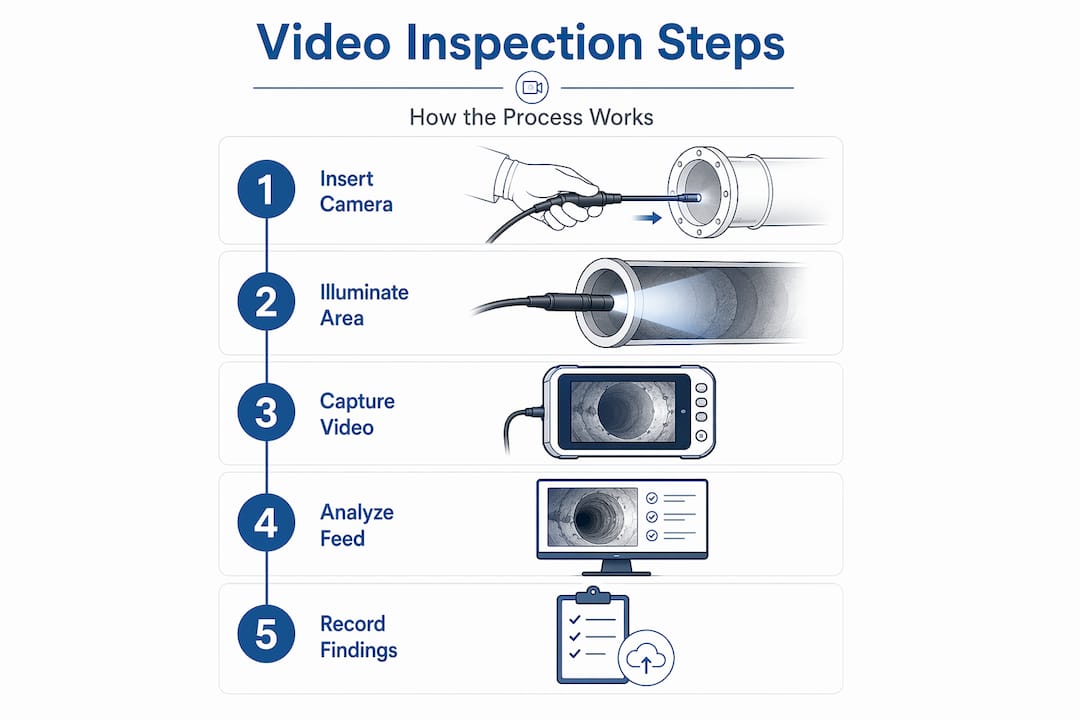
How does video inspection work in practice? The camera system is inserted through an access point, whether that is a borescope port, a manhole, or an inline launcher. The operator views the feed in real time on a monitor and controls tip articulation to steer around bends and target areas of interest. High precision videoscopes provide HD and 4K quality with millimetric articulation that lets you position the sensor within fractions of a millimeter of a suspect area.
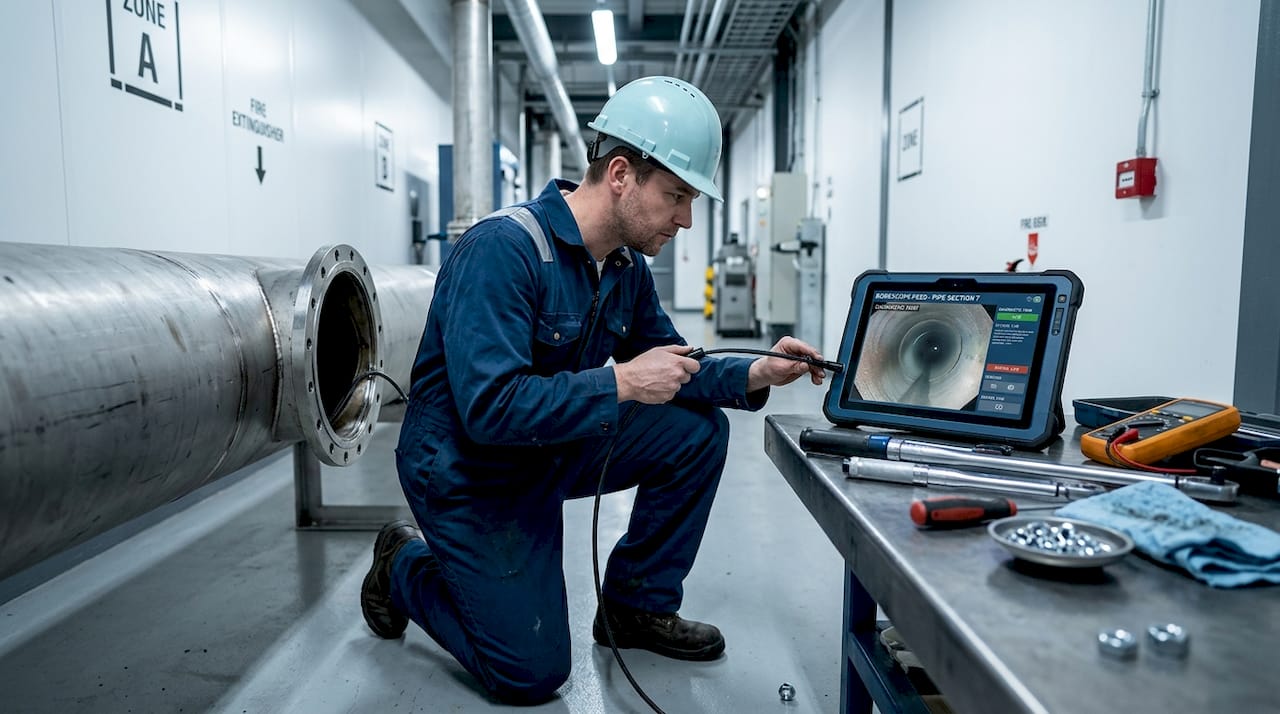
The critical technical factors affecting inspection quality are image resolution, lighting intensity at the tip, working length, and the range and precision of tip articulation. A tool that checks all those boxes for one task can be completely wrong for another. Image processing algorithms are increasingly built into the hardware itself, flagging anomalies automatically and reducing the subjectivity that comes with manual review.
| Camera type | Typical application | Key advantage |
|---|---|---|
| Rigid borescope | Engine cylinders, gun barrels | Highest optical clarity in straight bores |
| Articulating videoscope | Turbines, pressure vessels, complex piping | Steerable, HD digital imaging with documentation |
| CCTV tractor system | Sewer and storm drains, large diameter pipe | Motorized travel, 360-degree side scan capability |
| Smart pig (ILI tool) | Transmission pipelines | Full-bore inspection under operating conditions |
Pro Tip: Before selecting a videoscope, measure your access port diameter and the minimum bend radius you need to navigate. Many operators order tools that physically cannot reach the target zone because they skipped this step.
Applications across industries
The breadth of applications is one reason industrial inspection methods built around video have become standard practice rather than a specialty service.
- Pipeline and sewer inspection. CCTV systems use pan and tilt cameras with side-wall scanning to capture 360-degree images of pipe interiors. This enables faster surveys and richer data capture compared to traditional single-axis cameras. Defects like cracks, joint offsets, root intrusion, and corrosion deposits are coded using standardized systems.
- Non-destructive testing (NDT) in turbines and engines. Articulating videoscopes inspect turbine blades, combustion liners, and compressor stages through existing borescope ports without engine teardown. A single inspection that catches a developing blade crack before it propagates can save six figures in forced outage costs.
- Pressure vessel and heat exchanger inspection. Remote visual inspection avoids costly dismantling while delivering auditable evidence for compliance and maintenance scheduling. Corrosion pit mapping, scale buildup identification, and weld integrity checks are all performed without taking the vessel out of service for extended periods.
- Manufacturing quality control. Inline video inspection catches casting voids, machining defects, surface finish deviations, and assembly errors before components ship. Automated video inspection stations are now standard on precision manufacturing lines, linking inspection outcomes directly to production data systems.
- Condition monitoring and predictive maintenance. Periodic borescope inspections of rotating equipment capture deterioration trends over time. When combined with vibration and thermography data, video evidence helps teams decide whether to run to failure, schedule a repair, or pull the asset immediately.
What is pipe video inspection, specifically? It is a subset of industrial video inspection focused on the interior of pipelines and conduits. The delivery mechanism is typically a wheeled tractor or push-rod system, and the output is a coded inspection report tied to video footage, GPS coordinates, and distance measurements from reference points.
Benefits and limitations of video inspection technology
The advantages of video inspection technology over traditional methods are significant, but they are not unconditional.
- Access without disassembly. The most concrete benefit is avoiding teardown. Video inspection provides reliable diagnostics without operational interruption, which translates directly to cost savings on labor, downtime, and re-commissioning.
- Documented, objective evidence. Every inspection produces video and photographic records that can be reviewed later, compared against previous inspections, and shared with engineers, regulators, or insurers. This is a qualitative leap beyond verbal reports or hand-drawn sketches.
- Early defect identification. Industrial videoscopes enable early damage identification before vibration or thermography methods detect the same issue, giving maintenance teams more time to plan a controlled repair.
- Reduced safety risk. Inspectors stay out of confined spaces, away from high-temperature surfaces, and clear of hazardous process environments. The camera goes in; the person stays out.
The limitations are real and worth stating plainly. Image quality degrades with dirty optics, inadequate lighting, or contaminated access paths. Complex geometries can block the camera's line of sight entirely, leaving shadow zones. Inspection quality depends on operator training, equipment choice, and reporting standards. A high-resolution videoscope operated by an untrained technician produces less useful data than a mid-range tool in experienced hands.
Standards exist to address the consistency problem. NASSCO PACP standards mandate meticulous defect coding and certified operator protocols to produce standardized, usable pipeline asset management data. These protocols matter because inspection reports that differ in format, defect classification, or measurement units across inspection cycles are nearly impossible to trend.
Pro Tip: Budget for operator certification alongside equipment purchase. The two are inseparable. A great tool with an uncertified operator is an expensive way to generate footage nobody trusts.
Advancements integrating video with other inspection technologies
Periodic video inspection is powerful. Continuous and multi-sensor monitoring is more powerful. The field is moving toward integration, and the combinations are changing what integrity management looks like.
- In-line inspection (ILI) smart pigs. ILI tools inspect pipeline interiors without shutdown, using magnetic flux leakage and ultrasonic sensors to digitally reconstruct pipeline condition across entire pipeline segments. They do not replace visual inspection. They are complementary, covering corrosion loss and metal thickness at scale while video covers localized anomalies in detail.
- Fiber optic distributed sensing. Fiber optic sensing detects leaks, temperature anomalies, and operational events continuously along kilometers of pipeline. When the fiber flags an anomaly, a targeted video inspection follows to characterize it visually. This pairing converts a reactive inspection program into a proactive one.
- 3D measurement and automated defect recognition. Modern videoscopes with stereo measurement capability generate 3D point clouds of defect surfaces, letting engineers calculate depth, area, and volume without physical contact. Automated defect recognition software then compares current images against baseline datasets to flag deviations faster than any human reviewer.
- Digital twin and asset management integration. Inspection data from video, ILI, and fiber optic systems is increasingly fed into digital asset management platforms. Industrial videoscopes capturing HD and 3D data create condition models that drive predictive maintenance scheduling, cutting unnecessary downtime significantly.
| Technology | Coverage | Detection strength | Limitation |
|---|---|---|---|
| Articulating videoscope | Localized, targeted | Surface detail, visual anomalies | Access dependent, point in time |
| ILI smart pig | Full pipeline segment | Wall loss, metal defects at scale | Requires piggable pipeline |
| Fiber optic sensing | Continuous along route | Leak, temperature, vibration events | No visual detail |
| 3D measurement videoscope | Localized | Dimensional defect characterization | Higher cost, operator skill intensive |
Practical considerations for implementation
Knowing the technology is one thing. Deploying it effectively is another. Here is what separates effective programs from ones that generate footage and little else.
- Match tool to task. Tool selection must account for pipeline geometry, defect mechanisms, and operational context. A 6mm articulating videoscope is ideal for tight engine bores. A tractor-mounted CCTV system is what you need for a 24-inch storm drain. Using the wrong tool produces incomplete or misleading results.
- Certify your operators. For pipeline CCTV work, PACP certification is the baseline. For NDT borescope work, Level II or Level III certification under applicable standards sets the floor. Experienced operators make faster, more accurate calls and produce reports that hold up to scrutiny.
- Prepare the inspection site. Clean out debris from pipelines before CCTV runs. Purge or ventilate equipment before borescope entry. Confirm access port diameters match your insertion tool. Pre-inspection preparation directly determines whether you get usable footage.
- Document with discipline. Link every inspection to a location reference, asset ID, and timestamp. Use the same defect coding system across every inspection cycle so you can trend condition over time. Reports that cannot be compared to previous reports are single-use documents with no long-term value.
Pro Tip: For any asset where you plan recurring inspections, take a baseline inspection the moment the equipment is new or post-overhaul. Without that baseline, every subsequent inspection is describing condition in a vacuum rather than tracking change.
My perspective on what video inspection has become
I've seen a lot of inspection programs that treat video as a documentation checkbox rather than a diagnostic tool. The footage gets captured, the report gets filed, and nothing changes until something fails. That is a waste of a genuinely powerful capability.
In my experience, the teams that extract the most value from industrial video inspection are the ones that use it to build a visual condition history for their critical assets. When you can pull up a side-by-side comparison of a turbine blade from three consecutive annual inspections and watch a coating crack propagate, you are doing something that no traditional inspection method could give you. That evidence changes how engineers make repair decisions and how procurement plans replacement parts.
The area where I see the most consistent underinvestment is operator skill. Organizations will spend serious money on a top-tier videoscope, then hand it to a technician who has never been trained in tip articulation, lighting optimization, or defect characterization. The resulting footage is often blurry, poorly framed, and undocumented. Equipment quality and operator skill are not interchangeable. You need both.
What I find genuinely interesting about where the field is heading is the convergence of real-time sensor data with video. When a fiber optic system flags a thermal event along a pipeline segment and triggers an automated work order for a targeted video inspection, you have closed the loop between continuous monitoring and detailed characterization. That is the future of integrity management, and the technology to do it exists right now.
— Endoscope
Inspection equipment built for field professionals
If you are building or upgrading your video inspection capability, having the right equipment from a source that understands field requirements matters more than most buyers realize.
1800endoscope carries a focused range of portable industrial borescopes and videoscopes designed for technicians who need reliable imaging in confined, hard-to-reach spaces. The portable 6mm videoscope delivers direct-monitor display with SD card recording at a price point that makes sense for both single-unit buyers and multi-unit inspection teams. For broader coverage across sensor types, accessories, and instrument configurations, the industrial NDT borescope catalog covers the full equipment range. Contact 1800endoscope directly if you need guidance on matching an instrument to a specific inspection geometry or application.
FAQ
What is industrial video inspection used for?
Industrial video inspection is used to examine the internal condition of inaccessible assets including pipelines, turbines, engines, and pressure vessels. It supports defect detection, dimensional measurement, quality control, and maintenance documentation without requiring disassembly.
How does video inspection work in pipelines?
A camera mounted on a tractor system or push-rod is inserted into the pipeline and transmits real-time video to an operator. Defects are coded according to standards like NASSCO PACP, and the footage is linked to distance measurements and location references for asset management reporting.
What equipment is used for industrial video inspection?
Common video inspection equipment includes articulating videoscopes, rigid borescopes, CCTV tractor systems, and in-line inspection smart pigs. Tool selection depends on access geometry, target defect type, and the level of documentation detail required.
What are the main benefits of video inspection over traditional methods?
The primary benefits are access to areas that cannot be physically entered, elimination of disassembly costs, production of documented visual evidence for compliance and trending, and earlier defect identification compared to vibration or thermography methods alone.
What certifications matter for industrial video inspection operators?
For pipeline CCTV work, NASSCO PACP certification is the recognized standard. For NDT borescope applications, technicians should hold Level II or Level III certification under applicable NDT standards to produce reports that hold up to regulatory and engineering review.