
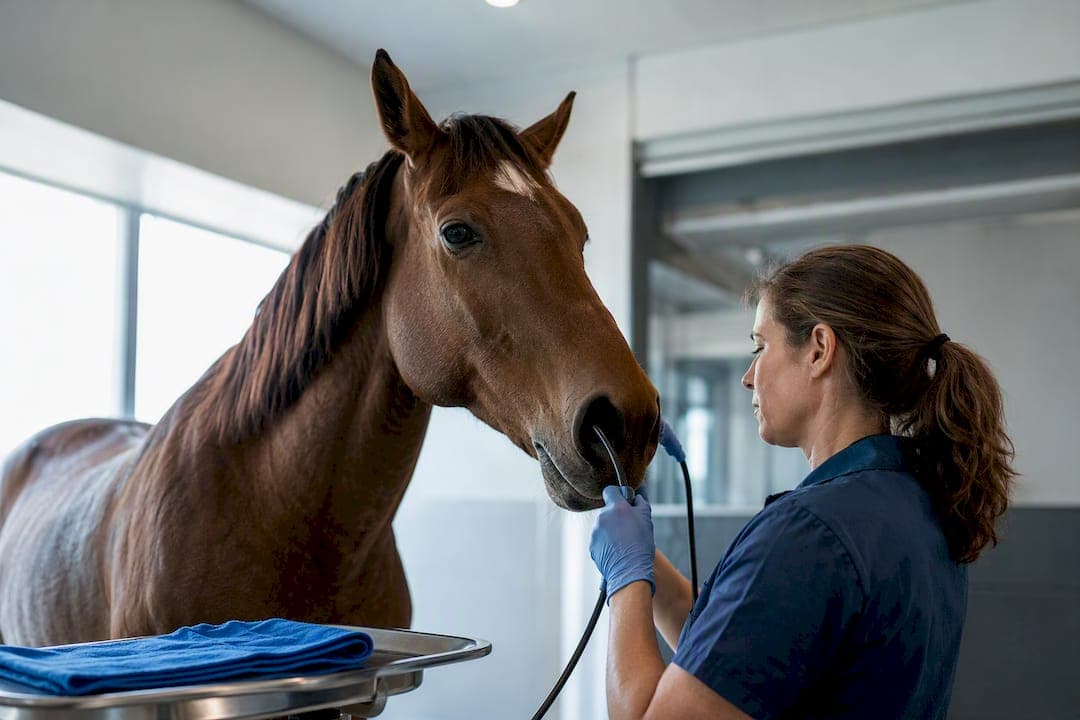
Match working length to the exam: approximately 1.0 to 1.5 meters for upper airway and rhinoscopy, about 1.5 to 2.5 meters for deeper bronchial work, and around 3.0 to 3.5 meters for gastroscopy and duodenoscopy in adult horses. Commercial lines cluster around these lengths for such reasons. Diameter and working channel size come next, and they decide what instruments you can actually pass once the scope is in place.
TL;DR:
- A 1.0 to 1.5 meter scope is ideal for upper airway exams, with 1.0 meter being the standard for most cases, while longer scopes risk unwieldiness.
- Bronchoscopes should range from 1.5 to 2.5 meters, especially when sampling deep bronchi, with the length chosen based on the required reach.
- For gastroscopy and duodenoscopy, lengths of 3.0 to 3.5 meters are necessary to reliably access the duodenum, with longer scopes providing more reach but increased handling difficulty.
- Selection should match the practice’s primary procedures, with airway-focused practices favoring shorter scopes and clinics performing frequent GI work investing in longer devices.
- Diameter and working channel size are critical for instrument compatibility, with smaller diameters reducing trauma in foals but limiting accessory options.
Table of Contents
- What Equine Endoscope Length Works Best for Each Procedure?
- How Should a Clinic Choose Its Endoscope Lengths?
- What Diameter and Working Channel Size Do You Need?
- Why Human Endoscopes Are Risky for Horses
- How 1800endoscope Supports Length-Based Equipment Decisions
- What Actually Matters When You're Buying by Length
- Ready to Match Your Clinic's Scope to Your Caseload?
- Sources
- FAQ
What Equine Endoscope Length Works Best for Each Procedure?
Equine endoscope length isn't a single number you pick once and forget. It's a decision you make per procedure, because the anatomy you're trying to reach changes dramatically between a nasal exam and a duodenal one.
For upper airway work and rhinoscopy, a flexible endoscope between 80 and 120 centimeters strikes the right balance between reach and control, according to rhinoscopy-specific clinical guidance. Most practitioners default to roughly 1.0 meter for these exams, and a proceedings review on upper airway endoscopy confirms that's the standard working length for the pharynx, larynx, and guttural pouches. A 1.5-meter scope gives you extra reach into the same structures without sacrificing much handling precision.
Bronchoscopy, especially when you need to sample the distal bronchi rather than just the trachea, calls for more length. Depending on how deep the exam needs to go, 1.5 to 2.5 meters is typical, and some university veterinary equipment recommendations specify 1.80 m and 2.50 m scopes for exactly this purpose.
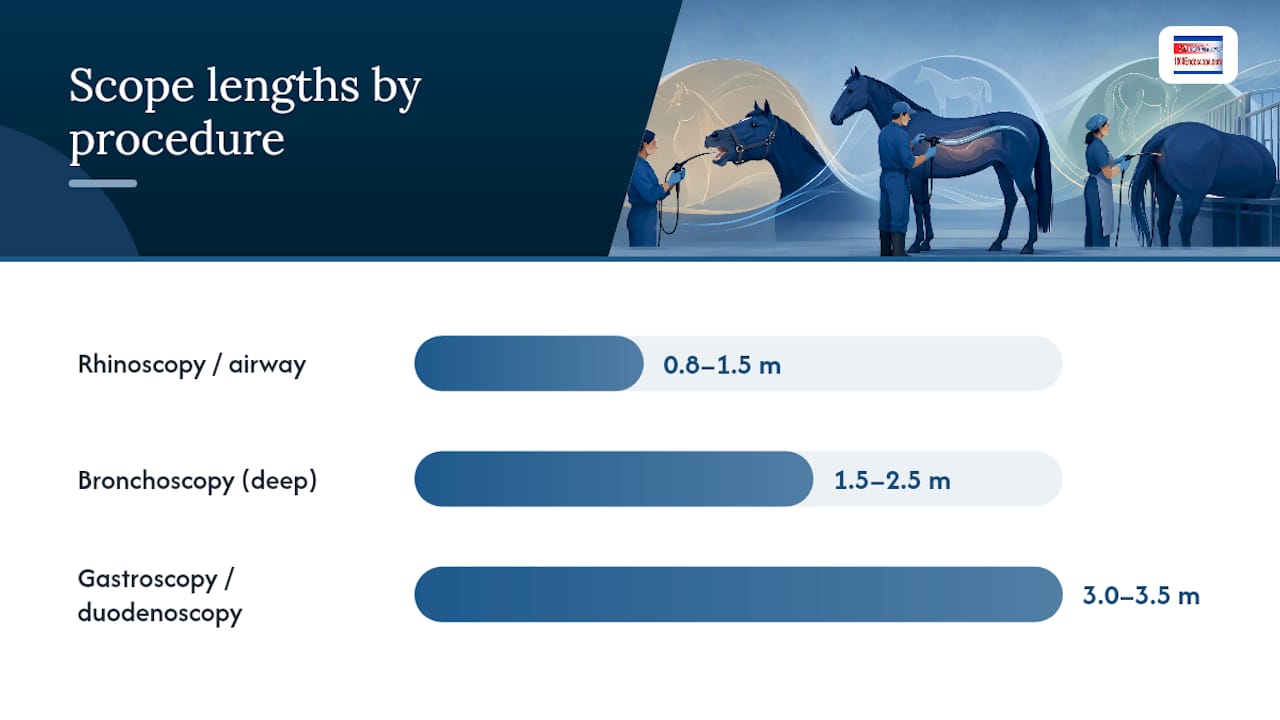
Gastroscopy and duodenoscopy are a different category entirely. Adult horse duodenoscopy requires a minimum of about 3.0 meters of working length just to reliably reach the duodenum, per AAEP clinical guidance. Scopes in the 3.3 to 3.5 meter range improve duodenal access further, though they come with added handling complexity.
Why not just buy one long scope and use it for everything? Because a 2.5 to 3.0 meter scope, while technically capable of imaging the upper airway, is awkward to control in that shorter space. The same proceedings source that recommends 1.0 m for airway work also warns that longer scopes get unwieldy for that task, making a dedicated shorter scope the better investment for high-volume airway caseloads.
- Rhinoscopy/upper airway: 0.8 to 1.5 m, commonly 1.0 m
- Bronchoscopy/deep bronchial: 1.5 to 2.5 m
- Gastroscopy/duodenoscopy: 3.0 to 3.5 m
How Should a Clinic Choose Its Endoscope Lengths?
Your caseload should drive the purchase, not the other way around. A clinic that sees mostly performance horses for airway evaluations has different priorities than one running frequent GI workups on colic referrals or geriatric patients.
Start by mapping your patient population. Foals need different handling than adult horses, and if your practice sees a steady stream of them, that shapes both length and diameter choices well before you get to gastroscopy questions. From there, work through a short decision sequence:
- Count your procedures by type. If gastroscopies make up a meaningful share of your caseload, a dedicated 3.0 to 3.5 meter gastroscope pays for itself faster than trying to stretch a shorter scope beyond its design.
- Weigh portability against reach. Field respiratory work favors shorter, lighter scopes you can carry to a barn. A buying guide for matching endoscope specs to caseload walks through this trade-off in more detail.
- Factor in repair realities. Long, custom gastroscopes generally carry longer repair turnarounds and higher replacement costs than shorter airway scopes, so factor downtime tolerance into the purchase.
If most of your work is airway evaluation, a 1.0 to 1.5 meter scope covers the vast majority of cases without the added bulk of a longer instrument. Practices running a mixed caseload often end up owning two scopes rather than one that compromises on both jobs. A resource on prioritizing a clinic's first endoscope purchase is worth reviewing before you commit budget.
Pro Tip: Don't buy your longest scope first if airway work dominates your schedule. Buy for your highest-frequency procedure, then add length as your gastroscopy caseload actually justifies it.
What Diameter and Working Channel Size Do You Need?
Length gets the attention, but outer diameter and working channel size determine what you can actually do once the scope is inside the horse.
Airway scopes typically run 5.8 to 11.0 millimeters in outer diameter, with working channels around 2.0 to 3.0 millimeters, according to tabulated veterinary endoscope guidelines. That channel size handles lavage and passage of small biopsy forceps, which covers most tracheal wash and guttural pouch work.
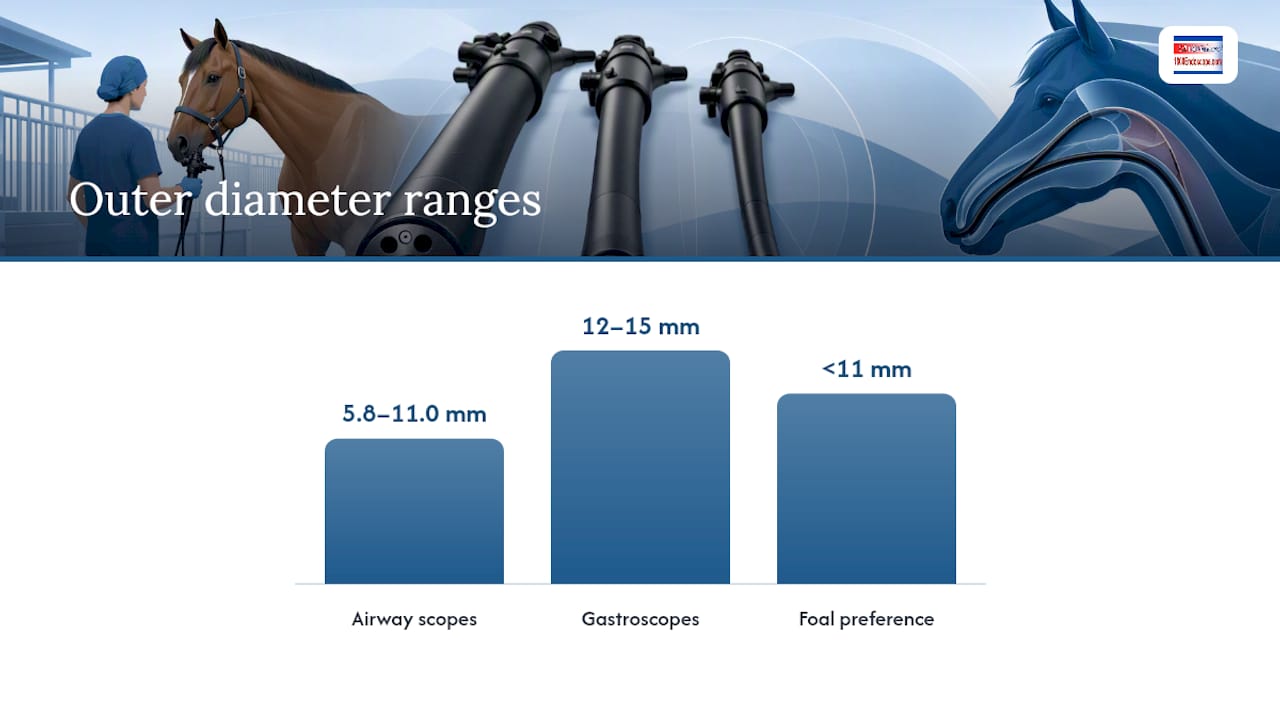
Gastroscopes need more room. Outer diameters of 12 to 15 millimeters are common, paired with working channels of at least 2.8 millimeters to accommodate biopsy instruments and therapeutic tools passed during duodenoscopy.
Foals change the calculation. Because their airways and esophagus are smaller and more prone to trauma, an outer diameter under 11 millimeters is generally preferable for foal exams, even when the working length matches an adult protocol.
- Airway scopes: 5.8 to 11.0 mm OD, 2.0 to 3.0 mm working channel
- Gastroscopes: 12 to 15 mm OD, ≥2.8 mm working channel
- Foals: prioritize OD under 11 mm to reduce trauma
The trade-off runs both directions. A smaller diameter scope passes more easily and causes less irritation, but it limits which forceps, brushes, or catheters will fit through the channel. A diameter selection guide breaks down which instruments require which minimum channel size, which is worth checking before you specify a scope for a procedure you haven't done before.
Why Human Endoscopes Are Risky for Horses
Human small-bowel endoscopes look appealing on paper. They're often thinner and marketed with generous length. In practice, that flexibility is the problem, not the feature.
Human scopes are built to navigate the tight, curved geometry of the human GI tract, which means they're far more pliable than an equine-specific instrument needs to be. That extra flexibility raises the risk of retroflexing inside the equine pharynx, a failure mode that has caused catastrophic scope damage in documented cases, per AAEP proceedings on equine gastroduodenoscopy. If a practice does adapt a human scope for equine use, it needs strict handling protocols and should expect a higher repair rate than a purpose-built instrument would carry.
A few other handling habits matter just as much as scope choice:
- Skip routine sedation for upper airway exams. Sedation alters pharyngeal and laryngeal function and can mask the exact pathology you're trying to diagnose.
- Use an assistant to maintain tip position when advancing a long gastroscope. Three meters of scope is hard to manage single handed, and losing tip control mid-exam wastes time and stresses the horse.
- Confirm the light source is adequate for the full length of the scope before you start. A weak source that works fine at 1 meter often can't illuminate the stomach properly at 3 meters.
Pro Tip: If you're evaluating a longer scope for the first time, do a dry run on light output and image clarity at full insertion length before you're mid-procedure on a patient.
How 1800endoscope Supports Length-Based Equipment Decisions
Various providers carry veterinary endoscopy equipment across the length ranges covered here, from portable airway scopes to longer gastroscopy systems, alongside accessories like pumps and biopsy forceps. Product listings often map to the respiratory and gastroscopy categories discussed above, so practitioners can match a specific SKU to the procedure they run most. Buying guides and diameter references help narrow that choice further, and repair services are available for practices that already own equipment needing service rather than replacement.
What Actually Matters When You're Buying by Length
The conventional advice treats endoscope length like a single spec to compare across brands. It isn't. The more useful question is which two or three lengths cover your actual caseload, because almost no equine practice runs a single procedure type consistently enough to justify one universal scope.
Where most buying guides fall short is glossing over the diameter and working channel trade-offs that come bundled with length. A 3.5 meter scope with an undersized channel is a worse purchase than a 3.0 meter scope that fits your biopsy forceps, even though the spec sheet makes the longer one look like the upgrade.
If you're prioritizing one thing first, prioritize matching length to your highest-volume procedure, not your most complex one. A practice running ten airway exams for every gastroscopy should own a 1.0 to 1.5 meter scope before it owns a 3.5 meter one, regardless of how impressive the longer instrument looks in a catalog.
— Endoscope
Ready to Match Your Clinic's Scope to Your Caseload?
An advantage over hospital-grade human endoscopy systems can be veterinary-specific scopes built for equine anatomy, often at prices below traditional medical-grade equipment, sometimes backed by support that understands retroflexing and durability concerns.
If your caseload leans toward field respiratory work, the portable airway inspection scope built for mobile use is worth a look. Clinics running regular gastroscopies should check the 3-meter monitor gastroscope, sized for adult duodenoscopy without the handling penalty of an oversized human-scope substitute. For full processor setups, accessories, or a repair inquiry on equipment you already own, the medical endoscope and accessories catalog and the endoscope repair and equipment page are the fastest starting points. Reach out with your procedure mix and a team can help you land on the right length and diameter combination before you commit budget.
Sources
The scope itself is only half the equipment decision. Shorter scopes in the 1.0 to 1.5 meter range often pair well with portable USB or video setups, since field-ready product lines in that length range commonly build in LED lighting adequate for barn-side bronchoscopy.
Long gastroscopes are a different story. At 3.0 to 3.5 meters, most systems need a dedicated processor and a stronger light source to produce a usable image of the stomach lining, particularly in poor ambient light.
For a mobile kit, plan around these basics:
- How to perform and interpret equine upper airway endoscopy (Proceedings)
- Guidelines for Selecting Veterinary Endoscopes - SioMedical
A guide on optimizing video recording setups covers storage and resolution considerations worth checking before you finalize a mobile kit.
FAQ
What is the length of an endoscope used on horses?
It depends on the procedure. Upper airway and rhinoscopy exams typically use scopes around 1.0 to 1.5 meters, bronchoscopy runs 1.5 to 2.5 meters, and gastroscopy or duodenoscopy needs 3.0 to 3.5 meters.
What is the 1/2/3 rule in horses?
There's no established "1/2/3 rule" tied to equine endoscope length in clinical literature. If you've seen this phrase, it likely refers to a different clinical protocol, and it's worth confirming the source before applying it to scope selection.
What is the typical length of an endoscopy tube for a horse's stomach?
Gastroscopy and duodenoscopy tubes generally have working lengths around 3.0 to 3.5 meters, with outer diameters often ranging from 12 to 15 millimeters.
How long does an equine endoscopy exam take from start to finish?
Exam duration depends on the procedure and findings rather than scope length alone, and can range from a quick 10 to 15 minute airway check to a longer gastroscopy that includes biopsy sampling. The article above focuses on equipment specifications rather than procedure timing, since duration varies too much by case to state a single figure reliably.
Does 1800endoscope sell both short airway scopes and long gastroscopes?
Yes. 1800endoscope carries portable airway inspection scopes in the 1.0 to 1.5 meter range alongside 3-meter gastroscopy systems, plus accessories like biopsy forceps and pumps sized to match either category.