
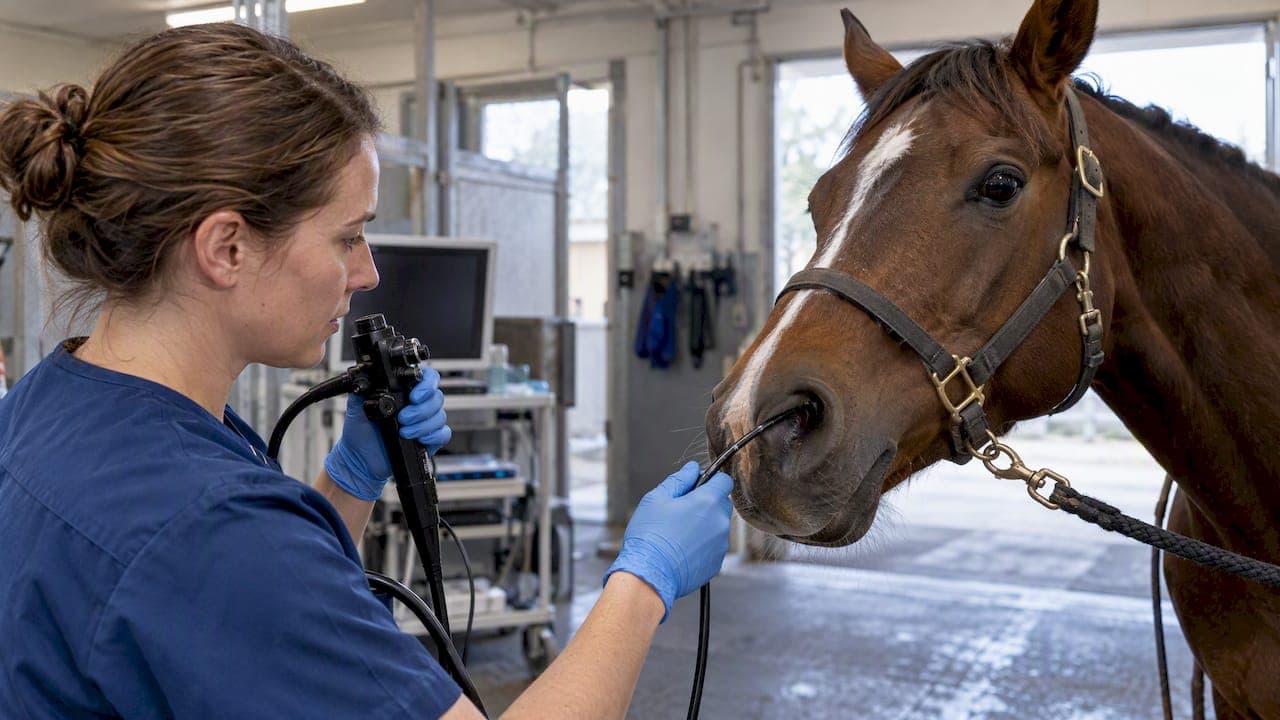
For most equine airway work, a 1-meter flexible videoendoscope paired with a portable, battery-powered HD monitor is the practical purchase, and it covers upper airway exams in the barn or at the track. Add recording capability and confirm your disinfectant protocol before you buy. Step up to a 3-meter scope or a dedicated dynamic endoscopy setup only when your caseload includes guttural pouch, lower airway, or gastric work.
TL;DR:
- A 1-meter flexible videoendoscope with recording capability is suitable for most upper airway exams and portable enough for barn or track use.
- A 3-meter scope is necessary only for lower airway or gastric work, and should be cart-mounted for stability during frequent or complex procedures.
- High-level disinfection with orthophthalaldehyde takes around 12 minutes, but residual bacterial DNA may cause false-positive strangles tests if sampling occurs too soon after cleaning.
- Proper reprocessing involves immediate precleaning, thorough brushing and flushing, validated disinfectant contact, and complete drying to ensure safety and accuracy.
- For exercise assessment, embarked systems with a 45-minute battery life are sufficient for ridden airway evaluation without needing a treadmill.
Table of Contents
- Equipment types and where each one fits your caseload
- Specifications worth comparing before you commit
- Field versus hospital systems, and when exercising endoscopy matters
- Accessories that determine real diagnostic capability
- Reprocessing between horses: what the evidence actually supports
- How we support purchase, maintenance, and clinical setup
- Why the spec sheet isn't the whole decision
- Get the right configuration for your practice
- FAQ
- Sources
Equipment types and where each one fits your caseload
Flexible videoendoscopes dominate equine airway work, and the length you need depends on what you are examining. A 1-meter scope reaches the nasal passages, pharynx, larynx, and guttural pouches, which covers the bulk of ambulatory upper respiratory exams. A 3-meter scope extends into the trachea, bronchi, and stomach, so it belongs on the truck only if you regularly handle lower airway disease or gastric scoping. University equine service pages confirm this split: a 1-meter or 3-meter endoscope covers nearly all respiratory and gastrointestinal indications, with the shorter scope doing the upper airway and the longer one reaching the lower tract and stomach.
Portable battery-powered units are built for stall-side and trailer-side work, while hospital cart or tower systems suit a fixed clinic room with steady power and more storage. Recording matters regardless of setting, since image review catches findings a live exam misses.
- Field exams: a 1-meter portable videoscope with onboard SD or USB recording.
- Lower airway or gastric work: a 3-meter scope, often cart-mounted for stability.
- Documentation: any system you buy should record to removable media, not just display live.
Specifications worth comparing before you commit
Vendor spec sheets vary in how they present the same numbers, so ask for these in plain terms before comparing quotes.
- Diameter: scopes in the 6 to 9.5 millimeter range handle adult nasal passages comfortably; foals and narrow-nostril cases need the smaller end of that range.
- Working length: 1 meter for upper airway and guttural pouch exams, 3 meters when you need to reach the trachea, bronchi, or stomach.
- Field of view: wider angles help you orient quickly in the pharynx and larynx, where anatomy shifts fast during swallowing or coughing.
- Tip deflection: look for angulation in multiple directions, since guttural pouch access and bronchial branching both demand tight steering.
- Working channel: a channel large enough for lavage or small biopsy forceps adds diagnostic reach without a second scope.
Diameter and channel size trade off against each other on budget units, so confirm both numbers rather than assuming a wider scope automatically has a larger channel. A scope marketed as "field ready" should still list these four specs plainly. If a listing omits tip deflection range or channel diameter, ask directly, since that gap usually means the spec is average at best.
Field versus hospital systems, and when exercising endoscopy matters
Your exam volume and travel pattern should drive the purchase more than any single spec. A solo ambulatory practitioner seeing a handful of airway cases weekly needs a rugged, light, battery-efficient unit that survives a truck cab and a dusty barn. A referral hospital running multiple scopes a day can justify a cart system with mains power and a larger monitor.
- Count your monthly airway exams. Under ten favors a compact portable unit; above that, a cart system earns its cost in uptime.
- Check battery life against your exam length. Field reports on embarked exercising systems note battery life around 45 minutes at full light output, which sets a practical ceiling for a day of back-to-back exams, per exercising endoscopy field notes.
- Decide if you need dynamic endoscopy. Resting exams miss many exercise-induced airway collapses, so a horse with intermittent noise or poor performance under saddle often needs an embarked exercising system, rather than a treadmill referral.
Embarked exercising endoscopy adds its own accessory list: a secure harness, a lens rinse routine before exercise starts, and weatherproofing against rain, since watertight integrity failures are a documented risk in that same field literature.
Pro Tip: Rinse the lens and check battery charge before the horse leaves the barn, not after it is tacked up and ready to go.
Accessories that determine real diagnostic capability
A scope body is only part of the purchase. The accessories around it decide whether you get usable images and can actually act on what you see.
- Light source: LED units run cooler and last longer between replacements than xenon, a meaningful difference for daily field use.
- Recording media: SD card, USB, or network storage all work, but confirm the format your practice management software can actually import.
- Irrigation and lavage: a working channel sized for lavage lets you clear mucus or blood mid-exam instead of withdrawing the scope.
- Biopsy forceps: match forceps diameter to your channel size, since an oversized set simply will not pass.
- Spares: a second battery, a transport case, and a harness for exercising work prevent a single failure point from canceling an exam day.
Image recording is not optional for defensible documentation. Institutional guidance on video endoscopy notes that high-quality recorded video lets you review findings in slow motion, since many airway abnormalities happen too fast to catch live.
Reprocessing between horses: what the evidence actually supports
Reprocessing is where field endoscopy most often goes wrong, and the sequence matters as much as the chemistry. A defensible protocol runs: precleaning with an enzymatic solution immediately after use, manual brushing and flushing of all channels, full immersion in a high-level disinfectant for its validated contact time, thorough rinsing, an alcohol final rinse, then complete drying and dry storage.
- Preclean immediately, before organic material dries on the scope or in the channels.
- Brush and flush every channel the scope has, not just the obvious ones.
- Time the disinfectant contact exactly, then rinse and dry fully before storage.
A controlled comparison found that endoscopes can test qPCR-positive for residual bacterial DNA even after disinfection that clears culture testing, which creates a real risk of false-positive strangles carrier results if you test too soon after a contaminated exam, according to a disinfection efficacy study. The same study found that accelerated hydrogen peroxide (AHP) needed roughly 8 minutes of contact time and was less corrosive to scope materials than higher-concentration hydrogen peroxide in testing, while orthophthalaldehyde (OPA) typically requires around 12 minutes.
Confirm your scope manufacturer's chemical compatibility list before switching to AHP, and if you have just handled a suspected strangles case, plan your next diagnostic sampling schedule around a qPCR-negative confirmation rather than assuming disinfection alone cleared the risk. Our sterilization guide walks through contact times and channel-specific steps in more detail.
How we support purchase, maintenance, and clinical setup
We carry the field-ready and hospital-grade equipment this guide describes, and we built our catalog around the gaps ambulatory and clinic vets run into most often.
- Portable airway scopes with onboard recording: our 9.5mm x 150cm and 6mm x 150cm systems cover adult and narrower-nostril cases.
- A USB-enabled 8mm field scope for practices that want direct-to-computer recording alongside SD storage.
- Longer-reach options, including 3-meter semi-portable scopes, for lower airway and gastric work.
- Repairs, biopsy forceps, and other accessories through our medical endoscope catalog.
Our recording optimization guide covers format and storage questions in more depth. Before you order, confirm disinfectant compatibility and warranty terms directly with us for your specific scope model.
Why the spec sheet isn't the whole decision
The industry's conventional buying advice fixates on scope diameter and pixel count, but the reprocessing protocol you commit to matters just as much as the hardware you pick. A top-tier scope run through a sloppy disinfection routine still risks a false-positive qPCR result after a strangles case, and that single error costs more in quarantine time and client trust than the price difference between a mid-range and premium scope.

If you are buying your first field unit, prioritize in this order: a scope with a channel size that actually fits the forceps you plan to use, a battery that outlasts your longest exam day, and a written reprocessing protocol with contact times you have actually timed yourself, not just read off a label. Dynamic exercising endoscopy gets treated as a luxury add-on in a lot of buying guides, but for performance horses with vague exercise intolerance, it is often the exam that actually answers the clinical question a resting scope cannot.
Buy for the exam you do every week, not the rare case you might see once a year.
— Endoscope
Get the right configuration for your practice
We supply field and hospital equipment suitable for a range of airway scopes and offer biopsy forceps, valves, and repair support to complete a working setup.
Ask about disinfectant compatibility and spare parts availability when you request a quote, as these details can affect your reprocessing workflow. Browse our medical and veterinary endoscope catalog or reach out through our repairs and equipment page for help matching a configuration to your caseload.
FAQ
What scope length do I need for a standard airway exam?
A 1-meter flexible videoendoscope covers nasal passages, pharynx, larynx, and guttural pouches, which handles most upper airway exams. A 3-meter scope is needed only for lower airway, tracheal, or gastric work.
How long does high-level disinfection take for an equine endoscope?
Contact time depends on the disinfectant: AHP requires roughly 8 minutes, while OPA typically needs around 12 minutes, according to disinfection efficacy testing. Always confirm the validated time against your scope manufacturer's compatibility guidance before choosing a product.
Can residual contamination cause a false-positive strangles test?
Yes. The same disinfection study found that some endoscopes tested qPCR-positive for bacterial DNA even after disinfection cleared culture testing, which can produce a false-positive carrier result if you sample too soon after a contaminated exam.
Do I need a treadmill for dynamic exercising endoscopy?
No. Embarked exercising systems let you assess dynamic airway collapse during ridden exercise without a treadmill facility, according to field endoscopy reports. These systems typically run about 45 minutes on a full battery charge.
What accessories should I budget for beyond the scope itself?
Plan for a light source, recording media, irrigation capability, correctly sized biopsy forceps, and at least one spare battery. We carry biopsy forceps and related accessories sized to match our scope channel diameters.
Sources
- Efficacy of high‐level disinfection of endoscopes contaminated with Streptococcus equi subspecies equi with 2 different disinfectants
- How to Perform Endoscopy During Exercise Without a Treadmill | IVIS