
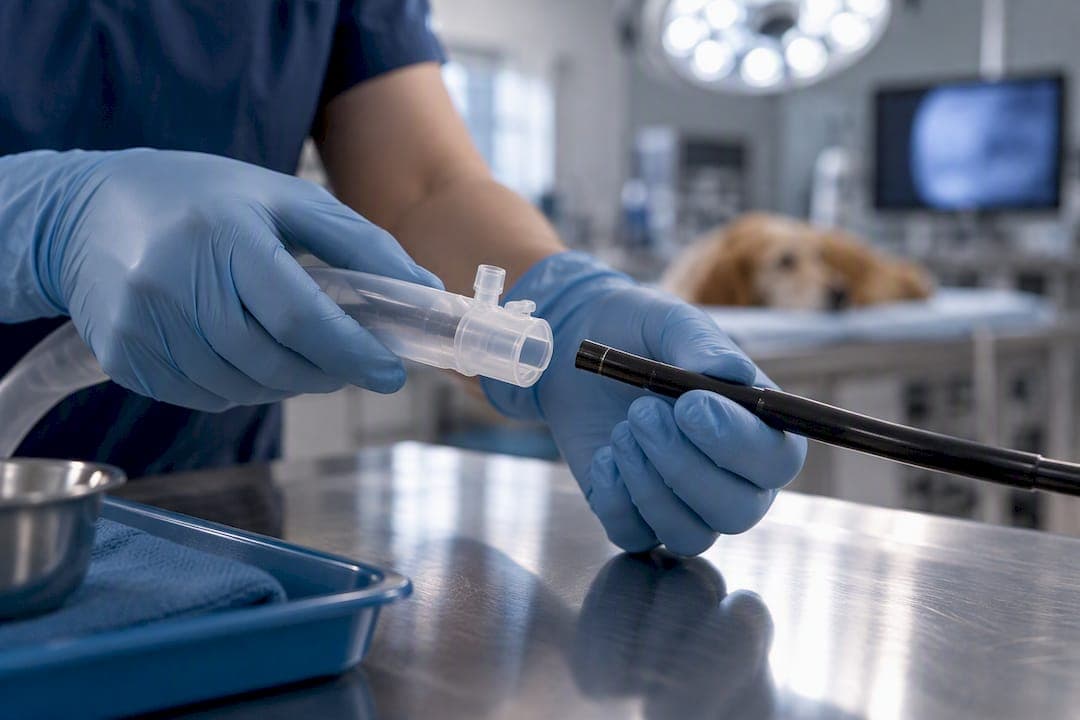
Yes, veterinary clinics performing any patient-contact endoscopy should use an endoscope sheath. It protects the optical system from mechanical damage, cuts cross-contamination risk between patients, and shortens turnover time between cases. Whether you land on single-use or reusable comes down to procedure volume, your sterilization setup, and how well the sheath fits your existing scope.
TL;DR:
- Reprocessing capacity and sterilization methods influence whether clinics should choose reusable or single-use sheaths; high-volume practices may benefit from durable, autoclave-compatible options.
- Sheath inner and outer diameters must match the scope's measurements within tolerances to prevent damage, leakage, or contamination during procedures.
- Long scopes for large animals require longer, reinforced flexible sheaths, while small animals typically need shorter, thinner options suited for their anatomy.
- Leak testing before and after each procedure is vital to prevent internal damage, with stainless steel rigid sheaths tolerating steam sterilization better than polymer flexible ones.
- Compatibility checks should include scope model, diameter, working length, and instrument port size, with sample testing recommended before bulk procurement.
Table of Contents
- What Is an Endoscope Sheath and Which Type Fits Your Scope?
- How Do You Match a Sheath to Your Existing Scope?
- Which Sheath Works Best for Each Species and Procedure?
- How Should You Reprocess and Sterilize Sheaths Between Patients?
- What Should Procurement Check Before Buying Sheaths?
- What Accessories Do You Need to Run a Sheath Properly?
- How Does 1800endoscope Support Sheath Selection and Fit?
- A Vendor's View on Making Sheaths Actually Work in Practice
- Where to Find Compatible Sheaths, Kits, and Support
- Sources
- FAQ
What Is an Endoscope Sheath and Which Type Fits Your Scope?
An endoscope sheath is a protective sleeve, typically stainless steel, polymer, or a hybrid composite, that slides over the insertion tube and distal end of a rigid or flexible scope. It creates a barrier between the animal and the optical components, and in most designs it carries its own ports for instrument passage and irrigation fluid, so the working sheath contains ports for instruments and irrigation that keep the field visible during a procedure.
Rigid sheaths dominate arthroscopy, otoscopy, and cystoscopy, where a stainless outer shell adds torsional stiffness and a well-defined instrument channel. Flexible sheaths, usually a reinforced polymer, are built for bronchoscopy, GI endoscopy, and any procedure where the scope needs to follow a curved anatomical path. The choice isn't really optional. A rigid sheath on a flexible scope defeats the purpose of flexibility, and a flexible sheath can't survive the leverage rigid procedures demand.
Specifications vary more than most buyers expect. Diameters run anywhere from 1.9 mm for small-patient arthroscopy up to 10 mm or larger for equine airway work, and working lengths span from roughly 55 cm to 170 cm, with the longer end of that range reserved for duodenoscopy and colonoscopy in large-breed dogs. Viewing angle (commonly 0°, 30°, or 70° on rigid scopes) has to match the sheath's window design, or you lose image clarity at the periphery.
Single-use and reusable sheaths trade off differently depending on your case load:
- Single-use disposable sheaths eliminate reprocessing labor and remove any risk of residual bioburden, but the per-procedure cost adds up fast in high-volume practices.
- Reusable sheaths, usually stainless steel or autoclavable polymer, cost more upfront but amortize well past 50 to 100 procedures if your sterilization workflow can keep pace.
- Hybrid kits pair a reusable outer sheath with disposable inner liners, splitting the difference for clinics that want lower per-use cost without full disposable dependency.
- Waterproof, stainless steel construction is standard for facilitating disinfection compliance across most rigid sheath lines, which is part of why rigid systems dominate high-turnover surgical suites.
How Do You Match a Sheath to Your Existing Scope?
Sheath fit comes down to two numbers most buyers skip: the sheath's inner diameter (ID) against the scope's outer diameter (OD), and the sheath's outer diameter against whatever cannula or trocar it needs to pass through. A sheath ID that's too tight will scratch or crack the scope's outer jacket during insertion. Too loose, and the sheath rattles, leaks irrigation fluid, and loses the seal that keeps contamination out.
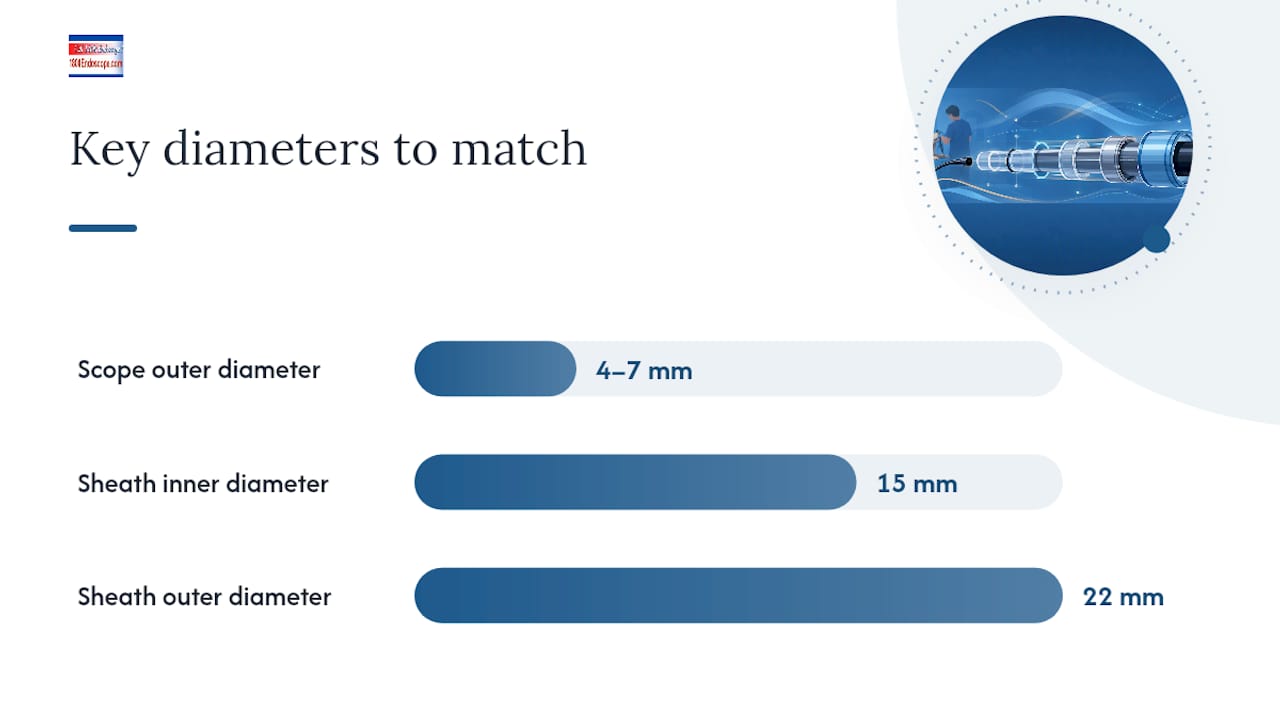
Camera and light coupling adds a second compatibility layer. Rigid endoscopy setups commonly use C-mount couplers to attach cameras, and a coupler standard mismatch is one of the most common return reasons procurement teams report. If you're also ordering an endotracheal adapter for airway work, check the anesthesia circuit dimensions against the adapter's rated OD and ID before you order. A common design supports 4–7 mm scopes with 22 mm OD and 15 mm ID connections, which lines up with standard veterinary anesthesia circuits but not every legacy setup.
Before placing an order, work through this sequence:
- Confirm the exact scope model and manufacturer, not just the diameter class.
- Measure the distal end OD with calipers rather than trusting the spec sheet alone. Manufacturing tolerances shift over a scope's service life.
- Note the instrument channel diameter if you need biopsy or foreign-body retrieval capability.
- Record the working length required for your longest routine procedure, not your average one.
- Request the manufacturer's instructions for use (IFU) or, better, a sample sheath for a physical fit test before committing to a bulk order.
Pro Tip: Keep a laminated card at the sterilization station listing every scope's OD and channel size. Techs reordering sheaths months later won't have to hunt down the original invoice or guess.
Which Sheath Works Best for Each Species and Procedure?
Small animal and large animal endoscopy demand different sheath geometry, and treating them the same is a common procurement mistake. A 55 cm to 70 cm flexible sheath handles most feline and canine upper GI and airway work, but equine gastroscopy and duodenoscopy in large-breed dogs routinely require scopes and sheaths exceeding 125 cm to reach the target anatomy.
Rigid scopes and sheaths hold their ground in specific niches: otoscopy, arthroscopy, cystoscopy, and rhinos copy in cats and small dogs, where the rigid shaft's precision and stiffness outperform a flexible system's maneuverability. Flexible systems win everywhere else, particularly bronchoscopy and colonoscopy, where the scope has to navigate turns a rigid shaft simply can't manage.
Instrument-channel sizing tracks species size closely:
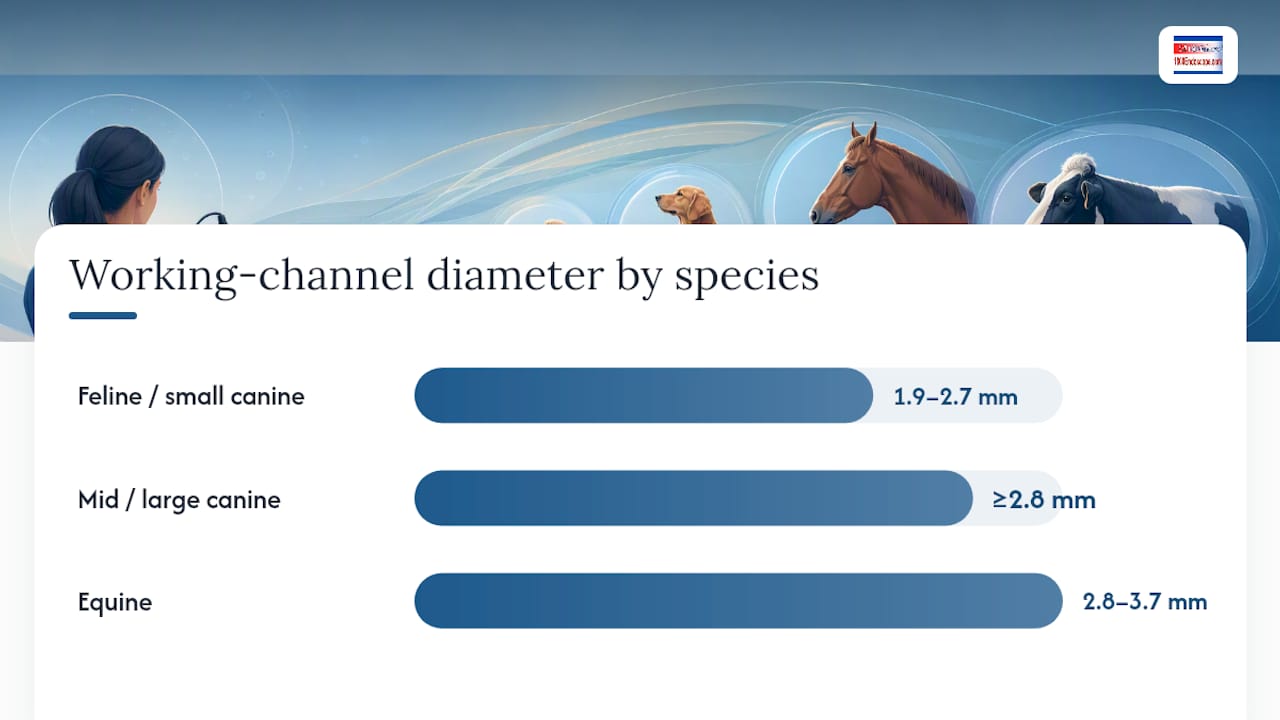
- Feline and small canine ENT procedures typically need a 1.9 to 2.7 mm working channel, adequate for fine biopsy forceps but not much else.
- Mid-size and large canine GI work benefits from a 2.8 mm or larger channel to accommodate standard flexible biopsy forceps and foreign-body retrieval baskets.
- Equine airway and GI endoscopy usually calls for channels of 2.8 mm to 3.7 mm, paired with the longer working lengths those procedures demand.
- Foreign-body retrieval in any species is where channel size matters most. Undersized channels force clinicians to choose weaker grasping instruments or abandon the endoscopic approach for surgery.
Matching channel size to your actual case mix, not your largest hypothetical patient, keeps both sheath cost and instrument compatibility manageable.
How Should You Reprocess and Sterilize Sheaths Between Patients?
Reprocessing starts before the scope ever leaves the exam room. Precleaning, wiping down gross debris and flushing the working channel immediately after use, prevents bioburden from drying and hardening inside channels where it's nearly impossible to remove later. Leak testing follows precleaning and precedes full immersion cleaning, and it is not optional.
Clinical literature identifies leak testing as essential for preventing fluid ingress and internal damage to flexible endoscopes, a failure mode that often shows up weeks after the actual leak occurred, once moisture has already reached internal electronics.
Run a leak test before the first procedure of the day and again immediately after each use, not just at end-of-day cleaning. Catching a pinhole leak in real time can save a $10,000 scope; catching it a week later usually means a repair bill or a replacement.
Reprocessing steps generally follow this order:
- Precleaning at point of use, within minutes of the procedure ending.
- Leak testing, performed manually or with an automated tester, before any immersion cleaning begins.
- Manual channel brushing and enzymatic cleaning to remove organic material from lumens.
- High-level disinfection or sterilization, chosen based on sheath and scope material tolerance.
- Visual and functional inspection before the sheath returns to circulation.
Material tolerance dictates your reprocessing path. Stainless steel rigid sheaths generally tolerate steam autoclaving, which is faster and more reliable than chemical disinfection when your sterilizer load allows it. Polymer flexible sheaths and most flexible scope bodies cannot withstand autoclave temperatures and require chemical high-level disinfectants such as glutaraldehyde or peracetic acid systems instead, following the manufacturer's contact-time specifications exactly. Skipping a step to save five minutes is how clinics end up with a scope repair invoice larger than the sheath cost that would have prevented it.
What Should Procurement Check Before Buying Sheaths?
Total cost of ownership rarely matches the sticker price on a sheath box. A $40 disposable sheath used on 15 procedures a week costs more annually than a $600 reusable sheath rated for 200 reprocessing cycles, but only if your sterilization turnaround can actually keep pace with same-day scheduling.
Work through these questions with any vendor before signing a purchase order:
- What is the realistic per-use cost once you include disposal fees, reprocessing labor, and any required chemical disinfectant?
- Are spare parts, replacement seals, and gaskets stocked and available on short lead time, or does a broken seal mean a full sheath replacement?
- What does the warranty actually cover, and does it exclude damage from improper reprocessing, which is the most common failure mode?
- Does the vendor offer repair services for damaged sheaths and scopes, or is replacement the only path?
- Is it more economical to buy a bundled kit, sheath plus forceps plus irrigation tubing, rather than sourcing each component from a different supplier?
Kits make sense when you're standing up a new procedure line from scratch; individual components make more sense once you already own compatible accessories and just need a replacement sheath. Either way, ask for the datasheet and IFU before you order, not after. A vendor that can't produce basic specification documents on request is a vendor that will struggle to support you when something doesn't fit.
What Accessories Do You Need to Run a Sheath Properly?
A sheath by itself doesn't complete a procedure. Biopsy and foreign-body forceps pass through the sheath's instrument port to collect tissue samples or retrieve swallowed objects, and their diameter has to clear your channel size with margin to spare, not just fit exactly.
Irrigation and insufflation systems maintain visibility by flushing debris and distending hollow organs during GI and airway procedures. Leak testers, whether manual bulb-and-gauge units or automated testers, verify sheath and scope integrity before each use. Endotracheal tube adapters deserve particular attention in airway work. Adapters built with a double-swivel elbow and an integrated suction port allow the scope to rotate a full 360 degrees during the procedure without placing torsional stress on the ET tube, while the suction port lets staff clear secretions without breaking the airway seal.
Before the first clinical case with any new sheath and accessory combination, run these bench checks:
- Dry-fit the sheath onto the scope and confirm smooth insertion with no binding.
- Pass the intended forceps or retrieval instrument through the channel to confirm clearance.
- Attach the camera coupler and light source cable, then confirm image focus and brightness on a test target.
- Perform a full leak test on the assembled system, not just the bare scope.
Pro Tip: Assign one tech to "own" the compatibility log for every scope-sheath-accessory combination in the clinic. When a new hire grabs the wrong forceps size, that log saves the scope.
How Does 1800endoscope Support Sheath Selection and Fit?
Picking the right sheath is easier when you can see the full range of compatible hardware in one place. The veterinary rigid endoscopy catalog lays out scope and sheath combinations for otoscopy, arthroscopy, and cystoscopy, and the flexible biopsy forceps line covers the instrument side of GI and airway procedures.
A practical procurement path looks like this:
- Pull the IFU for your current scope model and confirm OD, channel size, and working length against your case mix.
- Request a sample sheath or kit for a physical test fit before ordering in bulk.
- Run a full leak test and bench check on the assembled system.
- Scale to a full order once fit and function are confirmed.
Clinics dealing with a damaged or aging scope can also route it through repair services rather than replacing the whole unit outright, which often costs a fraction of a new scope purchase.
A Vendor's View on Making Sheaths Actually Work in Practice
Most sheath adoption failures aren't technical. They're operational. A clinic buys the right sheath, skips staff training, and three weeks later someone forces a mismatched forceps through the channel and cracks it.
Run a short pilot with two or three staff members before rolling a new sheath system out clinic-wide. Train on assembly, leak testing, and disassembly as a single sequence, not three separate lessons. The cost objection usually fades once staff see how much reprocessing time a well-fitted sheath saves versus a leaking one that fails mid-procedure. Build a quarterly competency check into your existing continuing-education schedule, and audit your compatibility log every time you add a new scope. Small drift in fit tracking is how mismatches happen months down the line, not on day one.
— Endoscope
Where to Find Compatible Sheaths, Kits, and Support
A practical alternative to paying hospital-grade pricing for veterinary endoscopy hardware is available: portable, veterinary-specific scopes, sheaths, and accessories priced for clinic budgets, sometimes backed by repair services to extend device life.
Browse the medical and veterinary product lines for scopes, sheaths, and endoscopic accessories sized for small and large animal practice, or check the rigid endoscopy catalog if your case mix leans toward otoscopy, arthroscopy, or cystoscopy. Clinics building out a full procedure line should also look at biopsy forceps options to pair with a new sheath order, and anyone weighing repair against replacement on an existing scope can reach out through the main product and service page for a repair quote. Request a datasheet, order a sample kit for a test fit, or contact the team directly to confirm compatibility before committing to a full order.
Sources
- PubMed: Leak testing and scope damage prevention (study reference)
- Endotracheal Tube Adapter 4~7mm Scopes | DVM Central
- Endoscopic Equipment for the Veterinary Practitioner
- How to handle, care for and prepare an endoscope
FAQ
What Does an Endoscope Sheath Actually Protect Against?
A sheath shields the scope's optical and mechanical components from patient contact and fluid exposure, cutting the risk of cross-contamination and physical damage. It also simplifies reprocessing because the sheath, not the scope body, absorbs most direct contact.
Are Single-Use or Reusable Sheaths Better for a Small Clinic?
It depends on procedure volume and sterilization capacity. Low-volume clinics often save money and staff time with single-use sheaths, while high-volume practices with reliable autoclave or high-level disinfection workflows tend to get better value from reusable stainless steel sheaths.
How Long Should a Veterinary Endoscope Working Length Be?
Most small animal procedures use scopes between 55 cm and 100 cm, but duodenoscopy and colonoscopy in large-breed dogs, plus most equine work, often require lengths exceeding 125 cm. Match the working length to your longest routine procedure, not your average case.
How Often Should You Leak Test a Flexible Endoscope?
Run a leak test before the first procedure of the day and again immediately after each use. Clinical guidance treats leak testing as a critical safeguard against fluid ingress that can silently damage internal electronics.
Where Can Clinics Source Sheaths Compatible With Existing Scopes?
1800endoscope offers a rigid endoscopy catalog and medical and veterinary product lines covering sheaths, scopes, and accessories for small and large animal practice. Current pricing details and information on repair services can be found on the vendor's official website.