
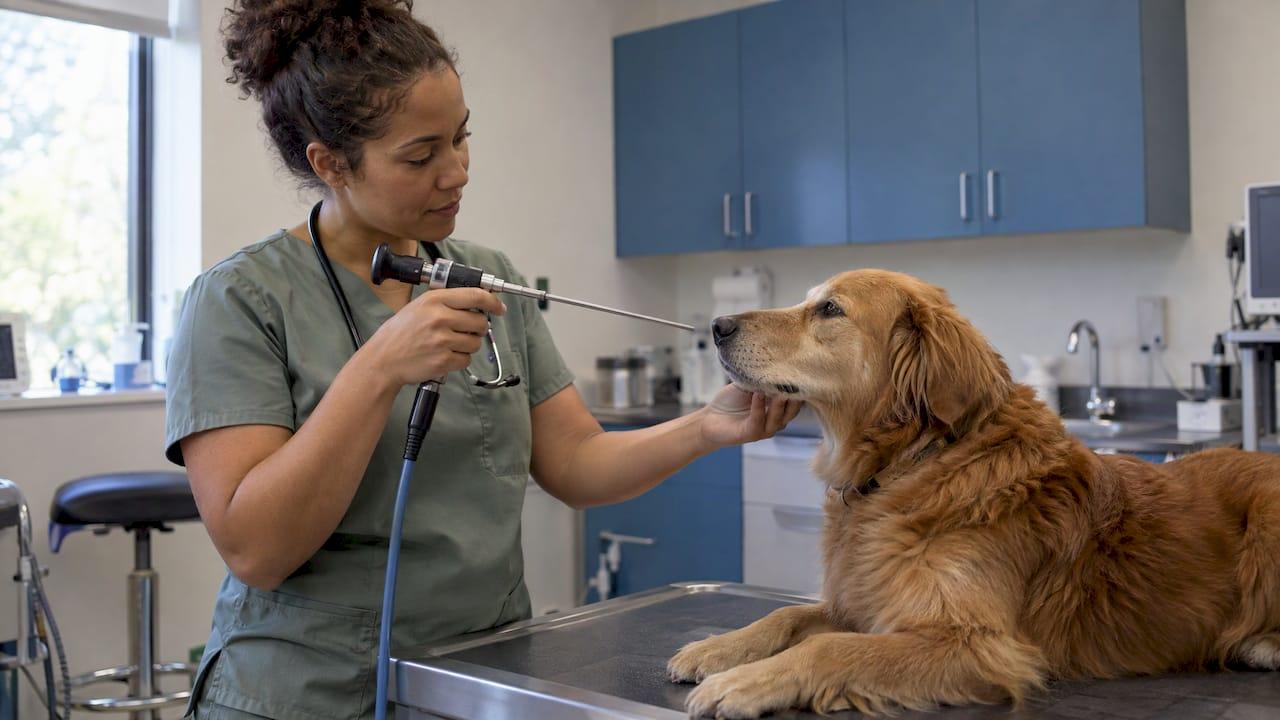
For most dogs, canine rhinoscopy starts with a 2.7 mm, 30-degree rigid telescope. Dogs under about 10 kg (and cats) move down to a 1.9 mm scope, and giant breeds move up to 4.0 mm. A flexible scope of roughly 5 to 6 mm covers the nasopharynx from behind. The right kit is the set that matches your caseload by weight, so you can examine both nasal cavities and take biopsies without swapping systems mid-case. Our rigid endoscopy catalog and portable airway videoscopes are built for this work. Below is how the sizes break down, what the studies used, and what to buy around the scope.
TL;DR
- A 2.7 mm, 30-degree rigid scope is the standard for dogs over 10 kg. Use a 1.9 mm scope for dogs and cats under 10 kg and a 4.0 mm scope with a modular sheath for giant breeds (Veterian Key, 2016).
- Rigid-only examination misses nearly half of the caudal nasal cavity. Add a flexible scope of about 5 to 6 mm for retrograde nasopharyngoscopy (J Vet Sci, 2010).
- Size the sheath, forceps and irrigation to the scope. A 2.7 mm telescope in a sheath is typically paired with 2.5 to 3 mm biopsy forceps.
- For cats, go smaller: 1.9 mm is the common choice, and 0.9 mm is described for the smallest patients.
Table of Contents
- The short answer: scope size by patient weight
- What the studies actually used
- Length matters as much as diameter
- Rigid and flexible: two scopes for one nose
- Sheaths, irrigation and forceps: the part that decides the biopsy
- Feline rhinoscopy: a different size class
- Safe use: anesthesia, positioning and limits
- How to build a kit for your caseload
- Our perspective
- Where to start
- FAQ
- Sources
The short answer: scope size by patient weight
The published sizing logic is simple and consistent across sources. Patient weight sets the telescope diameter, and head shape adjusts the result.
| Patient | Rigid telescope | Notes |
|---|---|---|
| Cats and dogs under 10 kg | 1.9 mm, 30 degrees | Sheath with stopcock irrigation |
| Dogs over 10 kg | 2.7 mm, 30 degrees | Triport cystoscopy-type sheath |
| Giant breeds | 4.0 mm | Modular cystoscopy sheath |
That table follows the rhinoscopy chapter by Saylor and Williams, which also notes that the working length of the 1.9 and 2.7 mm scopes allows adequate visualization of the choanae and nasopharynx in all but the largest dogs (Veterian Key, 2016).
The 10 kg line is not arbitrary. In a 2010 study of 54 dogs with chronic nasal disease, a 2.7 mm rigid scope gave complete visualization of the ventral meatus only in dogs heavier than 10 kg. Brachycephalic head shape made forward visualization harder regardless of body weight (J Vet Sci, 2010). A pug at 9 kg and a whippet at 9 kg are not the same nasal cavity. Plan around skull shape as well as the scale.
What the studies actually used
Diameter figures differ a little between papers, because each team used the equipment it had. Reading them side by side shows the usable range.
- 2.7 mm rigid, 119 dogs. A 1992 JAVMA study of dogs examined from 1985 to 1989 used a 2.7 mm rigid fiberoptic endoscope for gross rhinoscopy and 2 × 3 mm biopsy forceps for pinch biopsy. It reported an 83% diagnostic success rate (78 of 94 evaluable cases) (JAVMA, 1992).
- 2.7 mm, 19 cm, 30 degrees in a 4 mm cannula. The 2010 study of 54 dogs paired this telescope with a Luer-lock irrigation tap and a 2.5 mm endoscopic forceps (J Vet Sci, 2010).
- A 2 to 5 mm rigid range. A Polish study of 29 dogs describes anterior rhinoscopy most often using rigid endoscopes of 0 to 30 degrees, up to 50 cm long and 2 to 5 mm in diameter. Its own kit included rigid scopes of 3 mm × 28 cm and 5.5 mm × 30 cm (Jankowski et al., 2010).
- Variable diameter by patient. A retrospective study of 80 dogs with persistent nasal disease used flexible or rigid endoscopes of variable diameter to accommodate patient size (Canadian retrospective, 2013).
The pattern: about 2.7 mm is the working center for a general canine practice, 1.9 mm extends your range down, and larger sheathed or 4 to 5.5 mm scopes serve big heads.
Length matters as much as diameter
Diameter gets the attention, but a scope that is too short cannot reach the choanae in a deep-nosed dog. The rigid telescopes in the studies above run about 19 to 30 cm. The 2.7 mm scope in the 54-dog study was 19 cm, and the Polish team used 28 and 30 cm rigid scopes. The same Polish paper reports posterior rhinoscopy using only flexible scopes of 6 to 10 mm, and its flexible units were 60 and 100 cm long (Jankowski et al., 2010).
Before you enter the nose, measure the scope against the skull to the medial canthus. This tells you how far you can advance it. The WSAVA 2013 lecture describes that step, and also advises examining the less affected side first (WSAVA 2013). If you are buying for a mixed caseload that includes deep-nosed dolichocephalic breeds, check the length on the spec sheet, not just the diameter.
Rigid and flexible: two scopes for one nose
A rigid telescope and a flexible endoscope do different jobs, and a complete rhinoscopy often uses both.
Lynelle Johnson of UC Davis summarizes the trade-off: rigid scopes have better optics, are easier to maneuver and come in smaller sizes. Flexible scopes allow greater access to the nasal cavity and can reach the frontal sinuses when marked turbinate destruction is present, as in aspergillosis (WSAVA 2013).
The 54-dog study put numbers on it. A 6 mm, 105 cm flexible bronchoscope was used for the retrograde oral approach, and the authors noted that rigid-only examination precludes visualization of nearly 50% of the caudal nasal cavity. Their conclusion was that the combined approach, rigid anterograde plus flexible retrograde, gives a broader view (J Vet Sci, 2010).
Retrograde choanal exam
Examination of the choanae is generally done first with a flexible endoscope of more than 5 mm outer diameter. The patient is fully anesthetized and the oropharynx is anesthetized with lidocaine gel. The non-flexed scope goes into the oral cavity and is flexed until light shows above the soft palate. You then pull it forward until the choanae come into view, with the image upside down and backwards. A moistened lap pad packs the throat to prevent aspiration during rostral rhinoscopy (WSAVA 2013).
For this role, a pediatric-class fiberoptic scope of 5.0 mm outer diameter with a 2.0 mm biopsy channel is described as ideal for retroflexion (DVM360, 2009). The same source notes that gastroscopes of 7.8 mm or larger cannot be used in smaller dogs and cats for rhinoscopy (Veterian Key, 2016). Small-diameter fiberscopes of 2 to 6 mm, with limited tip deflection and smaller working channels, are described there as the second and third most popular flexible scopes in small animal practice.
Our fully portable 6 mm airway inspection videoscope with a direct monitor and SD card recording sits in this diameter class. For a general look at how diameter affects access and image, see our endoscope diameter guide.

Anterograde rostral exam
Rostral rhinoscopy can be done with the bare rigid telescope (about 2.7 mm outer diameter) or a sheathed scope of about 5 mm outer diameter. The sheath should have flush and suction ports and a biopsy port that accepts standard endoscopic biopsy or foreign-body retrieval instruments (WSAVA 2013).
Sheaths, irrigation and forceps: the part that decides the biopsy
The telescope diameter is only one number. The sheath and instruments change what you can actually do once you are in.
Sheath type. Saylor and Williams describe integrated operating sheaths with a parallel biopsy channel plus two 90-degree channels with stopcocks for irrigation and suction. An arthroscopy sheath has one 90-degree irrigation channel and a slightly smaller working diameter with greater flow rate, which some clinicians prefer when heavy irrigation is needed (Veterian Key, 2016).
Viewing angle. The same chapter states that 30-degree scopes give a greater rotated hemispheric view with less traumatic leverage than 0-degree scopes. A 30-degree telescope is the default for that reason.
Irrigation. E. Robertson stresses that continuous irrigation through the sheath stopcocks is a key advantage of the 1.9 mm feline telescope. It clears blood, mucus and debris, and fluid acts as a better optical medium than air, enhancing magnification (WSAVA 2018).
Forceps. Published setups used 2 to 3 mm biopsy forceps: 2 × 3 mm in the 1992 study, a 2.5 mm endoscopic forceps in the 2010 study, and 3 mm rigid cupped forceps for the 1.9 mm feline scope. Match the forceps to the channel, not the other way around. In a 2.5 mm single-channel fiberscope, passing an instrument drastically cuts irrigation flow and impairs visualization during biopsy (Veterian Key, 2016). That is a reason to prefer a sheath with a separate biopsy channel when you plan to sample.
A basic checklist for a canine rhinoscopy tower, per the Clinicians Brief overview: a forward-viewing scope (0 to 10 degrees) of 4 mm for medium to large dogs and under 2.7 mm for small dogs and cats, a light guide and source, biopsy and grasping forceps, and optionally a sheath and video equipment (Clinicians Brief, 2007). The DVM360 overview adds a C-clamp camera attachment with a light guide cable for rigid scopes (DVM360, 2009).
Our rigid endoscopy catalog covers rigid scopes, arthroscopes and otoscopes, and our flexible biopsy forceps page lists forceps to pair with them.

Feline rhinoscopy: a different size class
Cats are the reason the 1.9 mm scope exists in most clinics. Their nasal passages are narrower and deeper, and their conchae are stiffer and harder to move than a dog's.
The WSAVA 2018 presentation recommends a 1.9 mm, 30-degree rigid telescope with a two-way stopcock irrigation sheath for rostral examination to the ethmoid turbinates, with 3 mm rigid cupped biopsy forceps. For retroflexed nasopharyngoscopy it recommends a 4.0 to 5.0 mm two-way deflection flexible endoscope, in all but the smallest dogs or cats (WSAVA 2018). A chapter on the feline nose describes anterior rhinoscopy with a 2.7 mm or 0.9 mm forward-viewing rigid endoscope, with 0.9 mm for smaller cats. It also advises retrograde rhinoscopy first, so hemorrhage does not obscure the view of the nasopharynx and choanae (Ladlow, 2013).
There is a practical case for owning the equipment. A 2013 technical article notes that feline upper respiratory endoscopy once lagged canine practice because of anatomic limits and a lack of appropriately sized equipment. With training, the feline rhinarium, sinuses, pharynx and trachea can now be visualized in most clinical scenarios (Sobel, 2013). Our guide to feline rhinoscopy setup covers equipment, room and patient prep.
Safe use: anesthesia, positioning and limits
These points affect scope choice and technique, so they belong in the buying conversation.
- Full anesthesia. Harcourt-Brown stresses that the strong feline sniff reflex requires full anesthesia before endoscopic examination, to prevent injury to the patient or damage to the scope (In Practice, 2006).
- Monitoring. Because cats are small and light, a nurse should watch the cat during rhinoscopy to ensure correct positioning. After the procedure, drain the nose by tilting the head lower than the body for about 30 seconds (same source).
- Not every region is reachable. Even in cats, a large proportion of the meati and conchae are accessible, but the sinuses are not. In dogs, the frontal sinuses and maxillary recess are not accessible by rhinoscopy (Clinicians Brief). The same source cautions that rhinoscopy is rarely appropriate as a sole procedure, and that in smaller dogs and cats the nasopharynx is examined by the retrograde route through the mouth.
- Hemorrhage. In the 1992 study, protracted hemorrhage occurred in 2 of 109 rhinoscopy-assisted biopsy cases (JAVMA, 1992). Continuous saline infusion with intermittent suction keeps the field clear (WSAVA 2013).
How to build a kit for your caseload
Start from the dogs you see, not from a catalog.
- Count patients by weight. If most nasal cases are over 10 kg, a 2.7 mm, 30-degree scope with a sheath is the core purchase. If you also see cats and toy breeds, add the 1.9 mm size.
- Add the retrograde scope. A flexible scope of about 5 to 6 mm covers the choanae and nasopharynx. A video unit that records to SD card gives you a case record and lets the team see the image.
- Choose sheaths for the work. Pick an operating sheath with a biopsy channel if sampling is routine. Think about irrigation flow for dogs with heavy discharge.
- Match forceps. Confirm channel diameter and length against the forceps before ordering.
- Plan for repair and support. Scopes are delicate. Knowing where the instrument goes if a fiber bundle or sheath fails keeps cases on schedule.
If your clinic also scopes ears, reptiles or other small patients, the same small-diameter logic applies. Our guides to small animal endoscope size and small diameter endoscopes go into more detail.
Our perspective
Most clinics we talk to want one question answered before they buy: will this kit handle the Labrador and the Persian on the same afternoon? The literature gives a clear answer. Pair a 2.7 mm rigid telescope with a 1.9 mm option for small patients, and add a flexible scope for the nasopharynx.
We build our offer around that reality. Our veterinary catalog covers rigid scopes, arthroscopes and otoscopes, flexible biopsy forceps, light sources and portable videoscopes with HD recording, so you can assemble a rhinoscopy set from one place. Our aim is high-resolution, portable equipment at lower prices than hospital-grade human-use systems, with 24/7 support and rapid shipping.
We also repair endoscopes, which matters when a scope you rely on for nasal cases needs attention.
Endoscope
Where to start
For a rhinoscopy set, begin with our rigid scopes, arthroscopes and otoscopes. Then add a portable airway videoscope for the retrograde approach, with a direct monitor and SD card recording. Biopsy forceps and accessories are on our medical endoscopes and accessories page. If you have a question about which size fits your caseload, you can reach us through 1800endoscope.com.
Our endoscope repair service means a scope that needs work does not have to leave your rhinoscopy set permanently short.
FAQ
What size rhinoscope do I need for a dog?
For dogs over 10 kg, a 2.7 mm, 30-degree rigid telescope is the usual choice. For dogs under 10 kg use a 1.9 mm scope, and for giant breeds a 4.0 mm scope with a modular sheath (Veterian Key, 2016). Brachycephalic breeds can be harder to examine regardless of weight.
What size scope is used for feline rhinoscopy?
A 1.9 mm, 30-degree rigid telescope with an irrigation sheath is recommended for rostral examination of the feline nose. A 0.9 mm forward-viewing rigid scope is described for smaller cats (WSAVA 2018; Ladlow, 2013). The nasopharynx is examined retrograde with a flexible scope.
Do I need a flexible scope as well as a rigid one?
A rigid scope alone leaves nearly half of the caudal nasal cavity unseen. Adding a flexible scope of about 5 to 6 mm for the retrograde approach gives the broader view reported in the 54-dog study (J Vet Sci, 2010). Most clinics that scope noses regularly use both.
What biopsy forceps fit a rhinoscope?
Published setups used forceps of 2 to 3 mm: 2 × 3 mm in the 1992 JAVMA study, 2.5 mm in the 2010 study and 3 mm cupped forceps in the feline protocol. Always confirm that the forceps fit the sheath's biopsy channel and the scope length.
Sources
- Rhinoscopy, Veterian Key (2016)
- Evaluation of rhinoscopy and rhinoscopy-assisted mucosal biopsy, JAVMA (1992)
- Clinical findings, rhinoscopy and histological evaluation, J Vet Sci (2010)
- A retrospective study of canine persistent nasal disease (2013)
- Rhinoscopy in dogs, Jankowski et al. (2010)
- Evaluation of Chronic Nasal Disease in Dogs: Rhinoscopy, Clinicians Brief
- Lessons Learned in Respiratory Endoscopy, WSAVA 2013
- Clinical Approach to Chronic Upper Respiratory Tract Disease, WSAVA 2018
- Nose, Ladlow (2013)
- Upper Respiratory Tract Endoscopy in the Cat, Sobel (2013)
- Rhinoscopy in the cat, In Practice (2006)
- Overview of small animal respiratory endoscopy, DVM360 (2009)
- Endoscopic Instrumentation and Documentation for Flexible and Rigid Endoscopy, Veterian Key (2016)