
Industrial borescopes in the U.S. run from under $500 for basic consumer-grade inspection cameras to well over $100,000 for fully articulating, measurement-capable systems used in aviation and power generation. Most professional buyers land somewhere in the $1,000–$10,000 range, where you get genuine articulation, HD imaging, and probe lengths suited to real industrial work. Before you request a single quote, build a one-page spec sheet: minimum probe diameter, required reach, articulation needs, and whether you need measurement or reporting software. Suppliers who see that sheet give you apples-to-apples pricing; suppliers who don't will quote you whatever moves fastest off their shelf.
According to a market analysis of industrial endoscope pricing, the four factors that drive the largest price differences are probe diameter and length, articulation type, image quality, and the presence of 3D measurement or AI analytics. Get those four specs right and the price almost takes care of itself.
Key Takeaways
Industrial borescope cost ranges from under $500 for basic fixed-tip units to over $100,000 for high-end articulating systems with 3D measurement, and the single most important step before comparing prices is defining your minimum probe diameter and required reach.
| Point | Details |
|---|---|
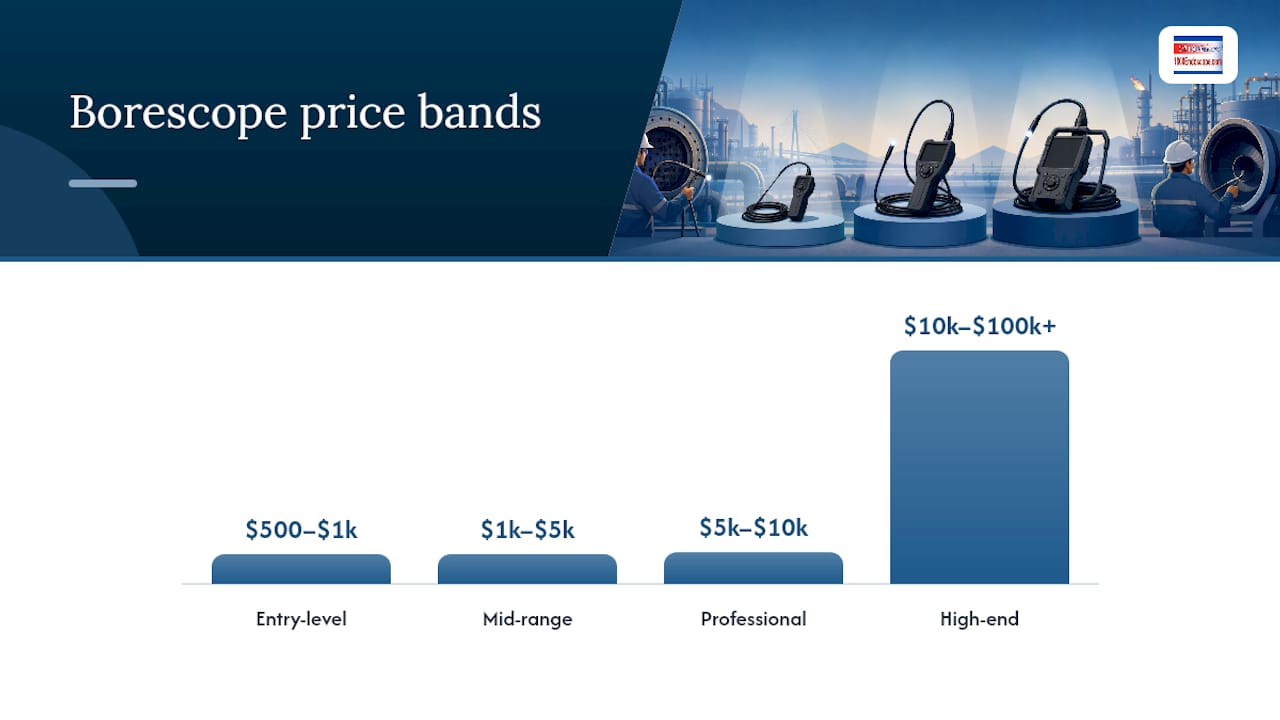
| U.S. price bands | Entry-level runs $500–$1,000; mid-range $1,000–$10,000; high-end $10,000–$100,000+. |
| Biggest cost drivers | Probe diameter, articulation type, sensor quality, and measurement software drive the largest price differences. |
| TCO over sticker price | Add accessories, software, calibration, and repairs; a mid-range scope used weekly costs roughly $15 per inspection over three years. |
| Spec before price | Define probe diameter, reach, articulation, and measurement needs before requesting any quote to avoid mismatched purchases. |
| 1800endoscope | Offers U.S.-available portable HD videoscopes across multiple probe diameters with direct catalog pricing and spec-matched quote support. |
Table of Contents
- What does industrial borescope cost look like across budget bands?
- What features actually drive the price up?
- How do you choose the right borescope for your inspection job?
- Buy new, refurbished, or rent: which route makes financial sense?
- Total cost of ownership: two real-budget examples
- What most buyers get wrong when purchasing a borescope
- 1800endoscope offers U.S. buyers a direct path to spec-matched pricing
- Sources
What does industrial borescope cost look like across budget bands?
The spread between a $300 inspection camera and a $50,000 articulating videoscope is not arbitrary. Each price band reflects a specific set of engineering trade-offs, and knowing what you actually get at each level prevents both overspending and buying something that fails on the job.
Entry-level: $500–$1,000
At this price point you're looking at semi-rigid or basic flexible probes, fixed (non-articulating) tips, and image sensors that deliver acceptable still images but struggle with low-light cavities. Probe diameters typically run 5.5mm–8.5mm, lengths top out around 1–2 meters, and most units record to a microSD card with no PC software included.
A real-world example: the PCE-VE 200-S industrial borescope lists at US$855 (excluding tax and delivery), which is representative of what a small-diameter, non-articulating scope with a built-in display costs in this band. It works for straightforward pipe or duct inspections where you don't need to steer the tip.
The risk at this tier is reliability under daily use. Consumer-grade units sold on Amazon's borescope listings often look similar on paper but use lower-grade cables and connectors that degrade quickly in industrial environments. If you're running more than a few inspections per week, entry-level pricing tends to cost more over time in replacements and downtime than a mid-range unit would have upfront.
Mid-range: $1,000–$10,000
This is where professional industrial inspection actually lives. You get 2-way or 4-way articulation, HD or near-HD sensors, probe diameters as small as 2.8mm–6mm, and lengths from 1.5 to 10 meters. Many units in this band include PC connectivity, basic measurement software, and LED lighting arrays that handle darker cavities.
A buyer's guide summary of borescope price tiers places the mid-range professional and video systems in the $500–$3,000 zone for lighter professional use, with more capable articulating video systems running into the several-thousand-dollar range. For NDT technicians and maintenance engineers doing weekly turbine, engine, or weld inspections, the $3,000–$8,000 segment offers the best balance of capability and durability.
High-end: $10,000 and above
Above $10,000, you're paying for features that matter in specific, high-stakes applications: 3D stereo measurement, AI-assisted defect detection, explosion-proof or ATEX-rated housings, probe diameters below 2mm, and reach beyond 10 meters on reel-based systems. Aviation MRO, nuclear inspection, and petrochemical plant maintenance are the primary use cases.
| Budget Band | Typical Price Range | What You Get | Best For |
|---|---|---|---|
| Entry-level | $500–$1,000 | Fixed tip, 5.5–8.5mm probe, basic LED, SD recording | Occasional pipe/duct checks |
| Mid-range | $1,000–$5,000 | 2-way articulation, HD sensor, 3–6mm probe, PC software | Regular NDT, engine, weld inspection |
| Professional | $5,000–$10,000 | 4-way articulation, longer reach, measurement-ready | High-frequency industrial programs |
| High-end | $10,000–$100,000+ | 3D measurement, AI analytics, ATEX-rated, reel systems | Aviation, nuclear, petrochemical |
What features actually drive the price up?
Understanding the cost drivers lets you make deliberate trade-offs instead of guessing which spec to cut.
Probe diameter and length are the two biggest levers. Smaller diameters require tighter manufacturing tolerances, higher-grade optical fiber or miniaturized camera modules, and more precise cable construction. A 2.8mm probe costs significantly more to manufacture than a 6mm one. Length compounds the cost: beyond roughly 3–4 meters, manufacturers often switch to reel-based systems with sealed housings, and the materials and tolerances scale nonlinearly. A 10-meter articulating probe at 4mm diameter can cost three to four times more than a 3-meter version of the same model.
Articulation type and range add cost in a predictable staircase:
- Fixed tip: no articulation, lowest cost
- 2-way articulation (up/down): adds roughly 20%–40% over a fixed equivalent
- 4-way articulation (up/down/left/right): another meaningful step up, typically doubling the cost of a fixed-tip unit at the same diameter
- 360° continuous articulation: found mainly on high-end systems, adds significant cost and mechanical complexity
Sensor resolution and imaging matter more than the megapixel number suggests. HD sensors with proper low-light performance and accurate color rendering cost more than sensors that look similar in spec sheets. Lighting arrays (LED count, angle, and intensity control) also affect price, particularly for deep-cavity inspections where shadows hide defects.
Ruggedization and environmental ratings carry real premiums. An IP67-rated probe costs more than an unrated one. Explosion-proof or ATEX-certified systems for hazardous areas can add $5,000–$15,000 to the base price, reflecting the testing, certification, and materials required.
Software and accessories are where buyers frequently underestimate total spend. Measurement software licenses, reporting modules, and AI defect-detection packages are often sold separately and can run $500–$3,000 per year. Carrying cases, spare cables, adapters, and calibration targets add $200–$800 at purchase.
Pro Tip: *If your inspection program runs more than 200 inspections per year, calculate cost-per-inspection rather than sticker price.
For a broader look at how these specs map to real inspection scenarios, the industrial borescope uses field guide covers application-specific spec choices in detail.
How do you choose the right borescope for your inspection job?
Spec-first, price-second. That sequence sounds obvious, but most buyers who end up with the wrong tool started with a budget number rather than a job description.
The pre-purchase checklist:
- Define access geometry. What is the smallest opening the probe must pass through? That number sets your maximum probe diameter — and your minimum price.
- Measure required reach. How far does the probe need to travel from insertion point to inspection target? Add 20% for routing around bends.
- Determine articulation needs. Can you reach the target in a straight line, or do you need to steer around corners? If you need to steer, decide between 2-way and 4-way based on the geometry.
- Set resolution requirements. Are you looking for gross defects (cracks, corrosion, debris) or fine surface detail (weld quality, coating integrity)? Fine detail needs HD and good lighting.
- Decide on measurement. Do your inspection reports require dimensional data (crack length, pit depth)? If yes, budget for a measurement-capable system from the start.
- Check hazardous-area requirements. Is the inspection environment classified (flammable gas, dust)? If yes, ATEX or NEC-rated equipment is not optional.
- Estimate inspection throughput. How many inspections per week? High throughput justifies better durability, faster image processing, and service contracts.
Questions to ask every supplier before signing:
- What is the warranty period and what does it cover (probe cable, camera module, display unit separately)?
- What is the typical repair turnaround time, and do you offer a loaner unit during repair?
- Is calibration included, and how often is it required for your application?
- Are software licenses perpetual or subscription-based, and what does an upgrade cost?
- Are spare probe cables and camera modules stocked in the U.S.?
Red flags in quotes:
- Accessories listed as "available separately" with no prices attached
- Measurement specs described as "optional upgrade" without a clear price or compatibility statement
- Warranty language that excludes the probe cable (the highest-wear component)
- No mention of a U.S.-based service or repair contact
When to rent instead of buy:
Renting makes sense when the project is under 3 months, the inspection type is unlikely to recur, or you need a spec (ATEX, 3D measurement) you can't justify buying for a single job. Buying makes sense when you run inspections weekly, need a customized probe configuration, or when the cost of rental over 12 months exceeds the purchase price of a mid-range unit.
Comparing three suppliers:
Start with your spec sheet. Send it to all three simultaneously and request itemized quotes: base unit, accessories, software, warranty, and calibration. Ask each for a reference customer in your industry. Evaluate repair SLA and loaner terms alongside price.
Buy new, refurbished, or rent: which route makes financial sense?
Each procurement path has a different risk profile, and the right choice depends almost entirely on how often you'll use the scope.
Buying new gives you full warranty coverage, current firmware, and a known service history. The downside is the highest upfront cost. For teams running inspections more than twice a week, new is almost always the right call — the warranty and support alone offset the premium within the first year.
Buying refurbished cuts upfront cost by 30%–60% on professional-grade systems. The eBay borescope marketplace shows a wide range of used and refurbished units across all price bands, from sub-$200 consumer scopes to professional articulating systems in the $2,000–$8,000 range. The risk is variable: some refurbished units come with limited warranties from reputable resellers; others are sold as-is. Always ask for a service history and confirm that spare parts are still available for that model before buying used.
Renting is the right move for short-duration projects or one-off inspections requiring a spec you don't own. Rental rates for professional articulating videoscopes typically run $150–$500 per day or $500–$2,000 per week depending on capability. For a two-week project, rental often costs less than purchase even after factoring in the resale value of a new unit. For anything longer than a month, the math usually flips.
When each option wins:
- New: weekly or daily use, need for full warranty, custom probe configuration
- Refurbished: budget-constrained teams with moderate use (a few times per month), willing to accept limited warranty
- Rental: single project under 4 weeks, specialized spec not worth owning, uncertain future inspection volume
Total cost of ownership: two real-budget examples
The sticker price of a borescope is rarely what you actually spend in year one. Here are two TCO examples built on realistic assumptions for U.S. industrial buyers.
Scenario A: Mid-range articulating scope, weekly use (maintenance engineering team)
| Cost Item | Estimated Amount |
|---|---|
| Base unit (4-way articulation, HD, 6mm × 3m) | $3,000–$8,000 |
| Carrying case and spare probe cable | $200–$800 |
| Measurement software license (year 1) | $500–$3,000 |
| Extended warranty (year 2–3) | $800 |
| Annual calibration | $300 |
| Expected repairs over 3 years (cable wear) | $500–$3,000 |
| Operator training (half-day) | $200–$800 |
| 3-year TCO | $3,000–$8,000 |
| Cost per inspection (150/year × 3 years) | ~$15 |
Scenario B: High-end scope, daily use (aviation MRO / power generation)
| Cost Item | Estimated Amount |
|---|---|
| Base unit (4-way, 3D measurement, 4mm × 6m) | $10,000 and above |
| Accessories (adapters, calibration targets, case) | $500–$3,000 |
| Measurement and reporting software | $3,000–$8,000 |
| Full-coverage service contract (3 years) | $3,000–$8,000 |
| Annual calibration (3 years) | $500–$3,000 |
| Expected repairs over 3 years | $500–$3,000 |
| 3-year TCO | $10,000 and above |
| Cost per inspection (500/year × 3 years) | ~$25 |
The aviation scenario costs more per inspection despite higher volume because the base unit and service contract are substantially more expensive. That gap narrows if AI defect detection reduces re-inspection rates. Factoring in borescope repair and calibration services from the start prevents budget surprises in year two.
Procurement worksheet template (copy into your internal spreadsheet):
- Base unit price
- Accessories (cables, adapters, case, targets)
- Software licenses (year 1 and renewal)
- Warranty / service contract
- Annual calibration cost × expected years
- Expected repairs (estimate 10%–15% of base unit over 3 years for mid-range; 5%–8% for high-end with service contract)
- Training
- Total ÷ (inspections per year × years) = cost per inspection
What most buyers get wrong when purchasing a borescope
The most common mistake is buying the cheapest unit that appears to meet the spec on paper. Probe diameter and length are easy to verify. Articulation range, image quality in low light, and cable durability under repeated flexing are not. A scope that looks identical to a $6,000 unit at $1,800 almost always has a shorter cable lifespan, a lower-grade sensor, or articulation mechanics that wear out within 18 months of regular use.
The second mistake is ignoring spare-parts availability. Some manufacturers discontinue probe cables for older models within three years of release. If your unit needs a cable replacement and the part is no longer stocked, you're buying a new scope. Ask every supplier directly: "Is this probe cable stocked in the U.S., and how long will it remain available?"
Service terms deserve as much attention as the unit price. A service contract that includes a rapid-exchange loaner unit is worth paying for in mission-critical operations. Downtime on a daily-use scope in an aviation MRO shop costs far more per day than the annual premium on a loaner-included contract.
Pro Tip: When negotiating, ask for a trade-in or upgrade path in writing. That term is almost never offered unless you ask for it.
One pattern worth noting: teams that specify probe diameter correctly from the start almost always spend less over three years than teams that buy a slightly larger diameter "just in case." A 4mm probe that fits your access geometry costs less, weighs less, and is easier to maneuver than a 6mm probe bought for flexibility you never use. Match the spec to the job, not to a hypothetical future job.
1800endoscope offers U.S. buyers a direct path to spec-matched pricing
Sorting through industrial borescope pricing across dozens of suppliers takes time most procurement managers and NDT technicians don't have. 1800endoscope's catalog covers portable HD videoscopes, multiple probe diameters, and NDT-ready configurations, all available for direct purchase in the U.S. with transparent pricing and no distributor markup.
The catalog includes compact portable systems like the 6mm airway inspection videoscope and the 9.5mm portable inspection scope, giving buyers entry points across the mid-range band without the lead times typical of larger distributors. Accessories, spare parts, and service support are available alongside the units themselves, so your TCO calculation starts with real numbers rather than estimates.
Ready to match a scope to your inspection spec? Browse the full borescope and endoscope catalog or reach out directly for a spec-matched quote. The catalog is organized by probe diameter and application, which makes it straightforward to filter by your access geometry and get to a realistic price fast.
Sources
- Industrial Endoscope Price: 2026 Market Analysis and Buying Guide
- Industrial Endoscope PCE-VE 200-S | PCE Instruments
- How Much Does a Borescope Cost? - Ultimate Status Bar
- Borescopes & Fiberscopes for sale
- Borescoperepairs