
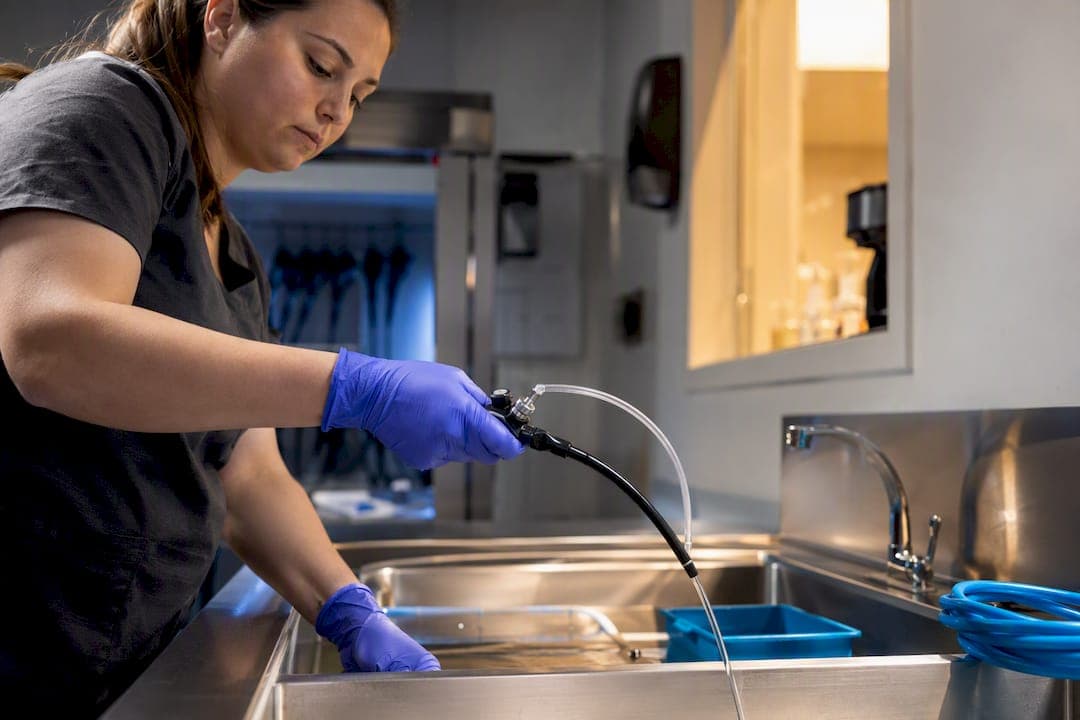
Sterilization destroys every microorganism on a device, including bacterial spores. High-level disinfection (HLD) kills or inactivates vegetative bacteria, viruses, fungi, and most mycobacteria, but it may leave a population of resistant spores intact. The working rule: sterilize critical items that enter sterile tissue or the vascular system; use validated HLD for semicritical items only when sterilization isn't feasible for the device. Always check the manufacturer's instructions for use (IFU) and the FDA-cleared contact time before you choose either path.
TL;DR:
- Sterilization eliminates all microbial life, including resistant spores, and is mandatory for devices entering sterile tissue or the bloodstream.
- High-level disinfection reduces most pathogens but does not guarantee spore inactivation, making it suitable only when sterilization is impractical for semicritical instruments.
- Common sterilization methods include steam for heat-tolerant devices and vaporized hydrogen peroxide or EtO for heat-sensitive equipment, with cycle times and material compatibility as key considerations.
- Proper cleaning, adherence to manufacturer instructions, and meticulous documentation are essential steps to ensure effective reprocessing and compliance.
- Rinse water quality significantly impacts disinfection outcomes, especially for flexible endoscopes, making it critical to use filtered or sterile rinse water in the process.
Table of Contents
- Definitions and Standards Behind Disinfection vs Sterilization
- Comparing Sterilization Methods and HLD Agents
- Why Device Design Changes the Sterilization Decision
- A Practical Checklist for Choosing HLD or Sterilization
- Reprocessing Portable and Veterinary Endoscopes: What the Data Sheets Don't Tell You
- Turning This Into a Standing Practice, Not a One-Time Decision
- Choosing the Right Endoscope for Your Reprocessing Workflow
- An Editorial Take on the HLD vs Sterilization Debate
- Sources
Definitions and Standards Behind Disinfection vs Sterilization
The distinction isn't just semantic. It comes from a specific microbiological threshold that the CDC's rational approach to disinfection and sterilization lays out clearly: sterilization achieves complete elimination of all microbial life, while the FDA defines high-level disinfection as a sterilant chemical used at a shorter contact time, engineered to achieve a 6-log10 kill of an appropriate Mycobacterium species rather than full sporicidal activity.
That "6-log" figure matters more than it sounds. A 6-log10 reduction means the microbial load drops to one-millionth of its starting point. Sterilization processes, by contrast, are validated to a sterility assurance level (SAL) of 10⁻⁶, meaning the probability of a single viable organism surviving is one in a million, applied specifically against bacterial spores, the most resistant life form your reprocessing cycle will ever face. HLD simply isn't designed or validated to that spore standard.
This threshold logic is exactly why the Spaulding classification still governs practice decades after it was introduced. It sorts devices by how they contact the patient and assigns the minimum acceptable processing level for each:
- Critical items (surgical instruments, biopsy forceps, anything entering sterile tissue or the bloodstream) require sterilization, full stop.
- Semicritical items (flexible endoscopes, laryngoscope blades, respiratory therapy equipment touching mucous membranes) require, at minimum, high-level disinfection.
- Noncritical items (blood pressure cuffs, stethoscopes, surfaces touching intact skin) need only low or intermediate-level disinfection.
The Spaulding classification table is the backbone of most guideline-level (IA/IB) recommendations you'll see cited in infection control policy. If you remember nothing else from this article, remember that table.
Comparing Sterilization Methods and HLD Agents
Choosing a method comes down to four questions: what kills the organism, how long it takes, what materials survive the process, and what your facility can actually run reliably.
Steam sterilization (autoclaving) remains the default for heat and moisture-tolerant instruments. It works through pressurized saturated steam, typically at 121°C to 134°C, and it's fast, cheap, and well understood. It's also useless for anything heat-sensitive, which rules out most flexible endoscopes and fiber optic components.
Low-temperature sterilization fills that gap. Ethylene oxide (EtO), hydrogen peroxide gas plasma, and vaporized hydrogen peroxide systems sterilize heat-sensitive devices without melting seals or delaminating optics. The tradeoff is cycle time and, for EtO, toxicity and aeration requirements that add hours to turnaround.
Liquid chemical agents split into two functional tiers depending on exposure time. Glutaraldehyde, ortho-phthalaldehyde (OPA), peracetic acid, and hydrogen peroxide solutions all function as HLD agents at their FDA-cleared exposure times, but several of the same chemistries can act as liquid chemical sterilants if you extend contact time to 3 to 12 hours. The catch, per CDC's methods guidance, is that devices processed in liquid chemical sterilants can't be wrapped or packaged afterward, so sterility can't be maintained in storage. That single limitation is why liquid chemical sterilants stay a niche fallback rather than a mainstream sterilization method.
Statistic Callout: Contact times for the same HLD chemistry can range from a few minutes to well over 45, depending entirely on temperature and whether the cycle runs manually or in a validated automated endoscope reprocessor. An AER holding elevated temperature can legitimately shorten some FDA-cleared glutaraldehyde or OPA claims to 5 to 12 minutes, but only when the device IFU explicitly supports that cycle.
Material compatibility is the quiet dealbreaker here. Repeated glutaraldehyde exposure degrades certain adhesives and lens cements over time, and EtO residue can linger in porous plastics if aeration is cut short.
Why Device Design Changes the Sterilization Decision
A rigid biopsy forceps and a flexible colonoscope face wildly different reprocessing realities, even though both might touch mucous membranes.
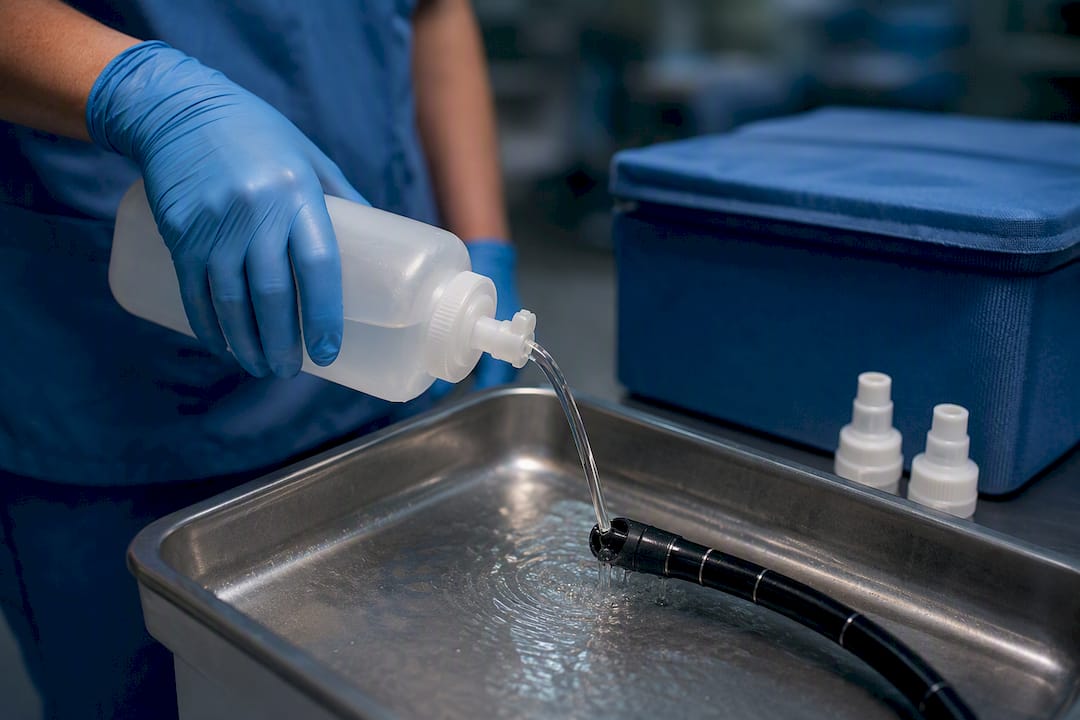
Flexible endoscopes carry long, narrow channels that trap organic debris and biofilm in places a visual inspection will never catch. That's precisely why endoscope-linked outbreaks account for a disproportionate share of device-associated infection incidents compared to other reusable equipment. Rinse water quality matters here too. Tap water used for a final rinse can reintroduce nontuberculous mycobacteria and other waterborne organisms onto a device that was just disinfected, which is why many high-volume programs specify filtered or sterile rinse water for the final step.
For rigid scopes, laparoscopes, and arthroscopes, the evidence is murkier than most practitioners assume. A peer-reviewed review in AJIC notes that observational data and infection surveys show low infection rates under HLD, but no randomized trial has directly compared HLD against sterilization outcomes for these devices. The guideline recommendation still defaults to sterilization whenever the scope enters sterile tissue or the peritoneal cavity, with HLD as the historical fallback where sterilization wasn't practical.
Whichever path you choose, document the reasoning:
- Cite the specific IFU line that supports your chosen method.
- Record the risk assessment if you're using HLD on a device that ideally should be sterilized.
- Note any enhanced monitoring (extra biological indicators, more frequent leak testing) added to offset that risk.
For step-by-step procedure guidance specific to veterinary and industrial scopes, 1800endoscope's endoscope sterilization walkthrough breaks down cleaning and processing stages in more operational detail than guideline documents typically offer.
A Practical Checklist for Choosing HLD or Sterilization
Run through this sequence every time a device comes back for reprocessing:
- Clean first, always. Brush channels, flush lumens, and remove gross soil immediately after use. Delayed cleaning lets organic matter dry and bond to surfaces, and inadequate cleaning is the single most common cause of reprocessing failure, regardless of which disinfectant or sterilizer comes next.
- Confirm the IFU and the FDA-cleared claim. Match contact time, temperature, and concentration exactly. Don't assume one manufacturer's 12-minute OPA claim applies to a different chemistry.
- Classify the device with Spaulding. Critical goes to sterilization. Semicritical gets HLD as a floor, sterilization if feasible.
- Control chemical exposure. Glutaraldehyde and related aldehydes irritate skin and airways; use engineering controls, closed transfer systems, or substitute a less hazardous chemistry where the IFU allows it.
- Monitor and log everything. Biological indicators for every sterilization load, chemical indicators for HLD cycles, leak testing before every endoscope immersion, and a process log tying it all to a specific patient case.
Pro Tip: Keep a laminated card at the reprocessing sink listing each device's exact IFU contact time and temperature. Staff under time pressure default to habit, and habit is where label-claim deviations creep in.
Reprocessing Portable and Veterinary Endoscopes: What the Data Sheets Don't Tell You
Portable veterinary and industrial scopes get treated casually compared to hospital equipment, and that's a mistake. The same biofilm risk applies whether the channel belongs to a colonoscope or a horse-sized flexible scope.
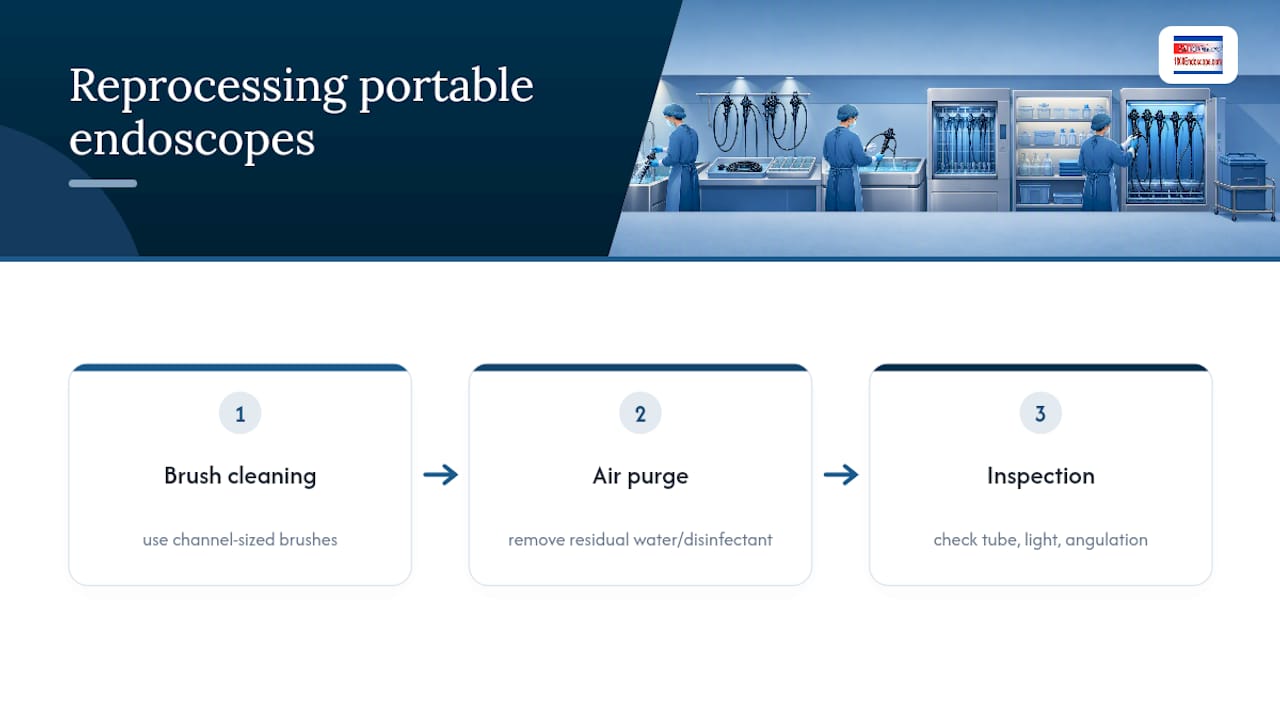
Manual cleaning needs brushes sized to the actual channel diameter, followed by a compressed air purge to clear residual rinse water and disinfectant from every lumen. Skipping the air purge is how disinfectant residue ends up trapped in a channel, which can cause chemical injury on the next patient. A quick visual and functional inspection, checking insertion tube integrity, light transmission, and angulation, catches damage before it becomes an infection control problem.
Decide early whether a scope needs low-temperature sterilization at a central sterile processing department (CSSD) or whether a validated AER cycle covers it. Heat-tolerant rigid borescopes used for industrial inspection have more sterilization flexibility than flexible fiber optic veterinary scopes, which usually stay in HLD territory. For the full veterinary-specific workflow, 1800endoscope's veterinary endoscopy sterilization guide and its storage and drying protocol cover the steps this section only has room to summarize.
Turning This Into a Standing Practice, Not a One-Time Decision
The rule of thumb hasn't changed in decades: sterilize critical devices, use validated high-level disinfection for semicritical ones when sterilization isn't possible, and never skip cleaning beforehand. What changes is your documentation discipline. Monitoring logs, biological indicators, and IFU citations are what let you defend a reprocessing decision if it's ever questioned.
Choosing the Right Endoscope for Your Reprocessing Workflow
Reprocessing burden should factor into your next equipment purchase, not just your infection control policy. A scope with fewer channels, simpler seals, and clearer manufacturer documentation on validated cycles saves your sterile processing team real time every single day. 1800endoscope's portable airway inspection endoscope system was built with that reprocessing reality in mind, with a design that supports straightforward manual cleaning and compatibility with standard HLD chemistries. If you're comparing options across rigid and flexible formats, the full borescope and endoscope catalog lists compatibility notes for each model so you can weigh reprocessing demands before you buy, not after. For broader context on disinfection principles across different equipment types, Demeter Bioscience's guide to maintaining health in aquatic display systems offers a useful parallel from outside clinical medicine.
An Editorial Take on the HLD vs Sterilization Debate
The evidence gap on rigid scopes bothers us more than it seems to bother most guideline committees. Infection control policy has settled on "sterilize when feasible" for laparoscopes and arthroscopes, and that's the right conservative call, but it's built on observational surveys and low event rates, not head-to-head trials against HLD. Practitioners should know that distinction exists rather than treating the recommendation as settled science.
What's genuinely underrated is rinse water quality. Facilities pour resources into disinfectant chemistry and AER validation while treating the final rinse as an afterthought, even though contaminated rinse water can undo a technically correct HLD cycle. If we had to pick one lever most sterile processing programs should pull harder, it's tightening rinse water standards and documenting them with the same rigor as contact time and temperature.
The IFU is not a formality. It is the actual boundary of what your chosen method is validated to do.
— Endoscope
Sources
- A Rational Approach to Disinfection and Sterilization | CDC
- Disinfection and Sterilization in Health Care Facilities - PMC
- Spaulding classification (table) — NCBI/Bookshelf