
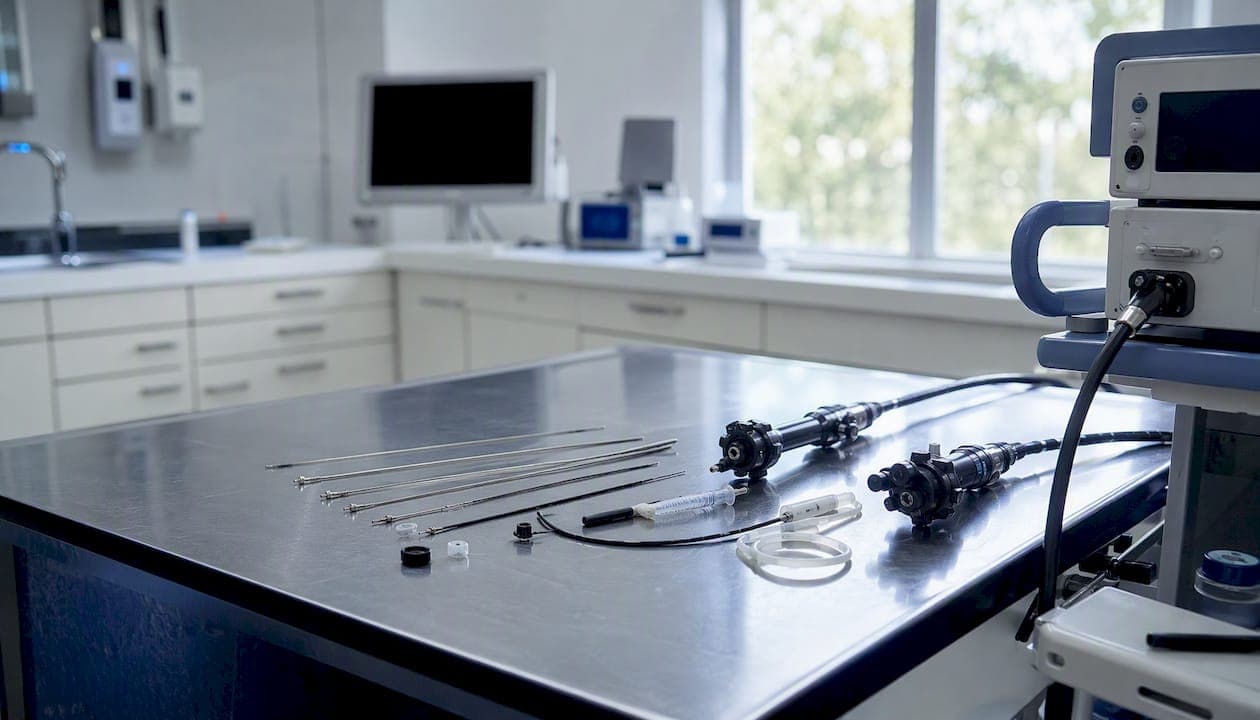
For U.S. veterinary clinics searching for mdsvet.com alternatives, three routes cover nearly every procurement scenario: specialist e-commerce platforms like 1800endoscope, OEM-authorized distributors for brands such as Olympus, Fujifilm, Pentax, and Karl Storz, and vetted refurbishers or industrial borescope vendors. Site analysis data places mdsvet.com among online endoscopy sellers, but U.S. clinics frequently need domestic service support and faster shipping that overseas-based sites cannot reliably provide.
Which route fits your situation:
- Specialist e-commerce (e.g., 1800endoscope): Best for budget-conscious clinics, portable field use, and clinics that need HD video recording without a full OEM tower commitment.
- OEM-authorized distributors (Olympus, Fujifilm, Pentax, Karl Storz): Best for high-resolution diagnostic imaging, large referral hospitals, and practices that require full manufacturer warranties and certified repair networks.
- Refurbishers and industrial borescope vendors: Best for low-volume practices, equine field work, or clinics piloting endoscopy before committing to a full system.
Pro Tip: Before contacting any supplier, write down your current scope's outer diameter, working channel size, and video processor model. That three-item list eliminates 80% of compatibility questions on the first call.
Table of Contents
- What are the best mdsvet.com alternatives for U.S. clinics?
- How do you evaluate and choose the right alternative supplier?
- What technical specs should you verify before replacing MDsVet equipment?
- New versus refurbished: which makes more sense for your clinic?
- Where can U.S. clinics procure veterinary endoscopes right now?
- Key Takeaways
- The procurement decision most clinics get wrong
- 1800endoscope: a clinic-ready alternative to mdsvet.com
- Useful sources and further reading
What are the best mdsvet.com alternatives for U.S. clinics?
Community-sourced directories list dozens of sites similar to mdsvet, but most lack U.S. service infrastructure. The table below focuses on supplier types that actually deliver to U.S. clinics with domestic support.
| Supplier Type | Best For | New / Refurb | Price Band | Warranty & US Repair | Accessories | Imaging Features | Lead Time (US) | TCO Notes |
|---|---|---|---|---|---|---|---|---|
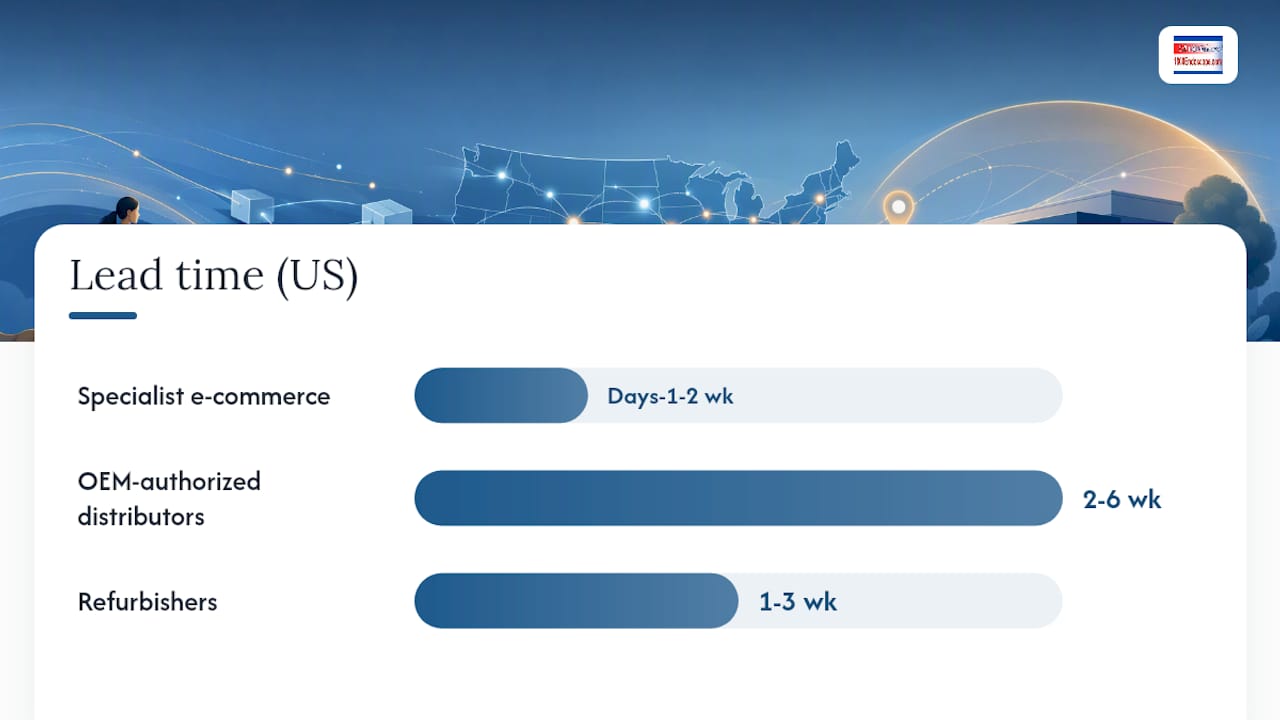
| Specialist e-commerce (1800endoscope) | Budget clinics, portable/field use, HD video | Both | $ to $$ | Varies by product; US shipping | Biopsy forceps, valves, pumps, cleaning tools | HD recording, wireless, portable options | Days to 1–2 weeks | Low upfront; verify repair channel |
| OEM-authorized distributors (Olympus, Fujifilm, Pentax, Karl Storz) | High-volume, imaging-critical, referral hospitals | Primarily new | $$$ to $$$$ | Full OEM warranty; certified US repair centers | Full OEM accessory catalogs | HD/4K, CMOS/CCD, modular towers | 2–6 weeks | High upfront; lowest long-term repair risk |
| Refurbishers | Low-volume clinics, budget-limited practices | Refurbished | $ to $$ | Limited; varies widely | Depends on refurbisher stock | Varies; often SD or early HD | 1–3 weeks | Lowest upfront; highest maintenance uncertainty |
| Industrial borescope vendors | Equine field work, large-animal airway, pilot programs | Both | $ to $$$ | Varies; often no veterinary-specific support | Limited veterinary accessories | Portable, often HD or SD | Days to 2 weeks | Good for niche use; not suited for GI diagnostics |
Today's Veterinary Practice identifies Olympus, Fujifilm, Pentax, and Karl Storz as the dominant OEMs in veterinary endoscopy, and notes that repairability and accessory availability are the primary long-term cost drivers. Karl Storz, for instance, markets HD multipurpose veterinary videoendoscopes alongside small-diameter arthroscopy tools, making it a strong fit for referral centers that need modular imaging systems.
Specialist e-commerce strengths: Lower upfront cost, faster delivery, portable options, accessories in stock. Limitation: Repair and loaner policies vary; confirm before ordering.
OEM distributor strengths: Full warranty, certified technicians, complete accessory ecosystem. Limitation: Higher purchase price; longer lead times for custom configurations.
Refurbisher strengths: Lowest entry cost; good for Olympus, Pentax, and Fujifilm models repurposed for veterinary use. Limitation: Service history may be incomplete; warranty terms are often short or limited.
How do you evaluate and choose the right alternative supplier?
Three criteria decide most procurement decisions: total cost of ownership, U.S. service and support access, and compatibility with your existing equipment. Get those three right and most other variables fall into place.
Vendor evaluation checklist:
- Confirm warranty length, what it covers (parts, labor, image quality), and whether a loaner scope is provided during repair.
- Verify the supplier has a U.S.-based repair center or a named authorized service partner.
- Ask for OEM authorization documentation if you are buying a branded scope.
- Request references from at least two veterinary clinics using the same model.
- Check accessory availability: biopsy forceps, valves, and cleaning tools should ship from domestic stock.
Questions to ask every supplier:
- What is the exact warranty period, and does it cover the insertion tube and bending section?
- Do you provide a loaner scope while mine is being repaired?
- Is this scope compatible with my current video processor (provide model number)?
- What training or setup documentation comes with the purchase?
- Are replacement parts stocked in the United States?
Red flags worth walking away from: no named U.S. repair center, vague warranty language ("limited warranty" with no specifics), no accessory list, and no veterinary clinical references. For a deeper look at comparing smaller supplier sites, the same evaluation framework applies regardless of vendor size.
What technical specs should you verify before replacing MDsVet equipment?
Video processor and light source compatibility usually determine whether a replacement scope works on day one or sits in a box waiting for an adapter. Everything else is secondary.
Specs to verify before purchase:
- Outer diameter and insertion tube length (critical for small-animal GI vs. equine airway)
- Working channel diameter (2.0 mm minimum for standard biopsy forceps; 2.8 mm for larger instruments)
- Articulation range (four-way, degrees up/down and left/right)
- Sensor type: CMOS sensors generally deliver better color reproduction for small-animal diagnostics; CCD remains common in older refurbished systems
- HD or 4K capability and recording format (SD card, USB, or integrated storage)
- Sterilization method compatibility (high-level disinfection vs. autoclavable components)
- Coupler and adapter requirements for your existing camera head or processor
Refurbished human-grade towers are commonly adapted for veterinary scopes using brand-specific or universal couplers. Confirm the exact coupler model number before purchase. For guidance on selecting the right light source, LED and xenon options each carry different TCO implications.
Pro Tip: Request the processor and camera head model numbers from the vendor, then cross-reference them against the scope's compatibility list. A five-minute check prevents a two-week return.
New versus refurbished: which makes more sense for your clinic?
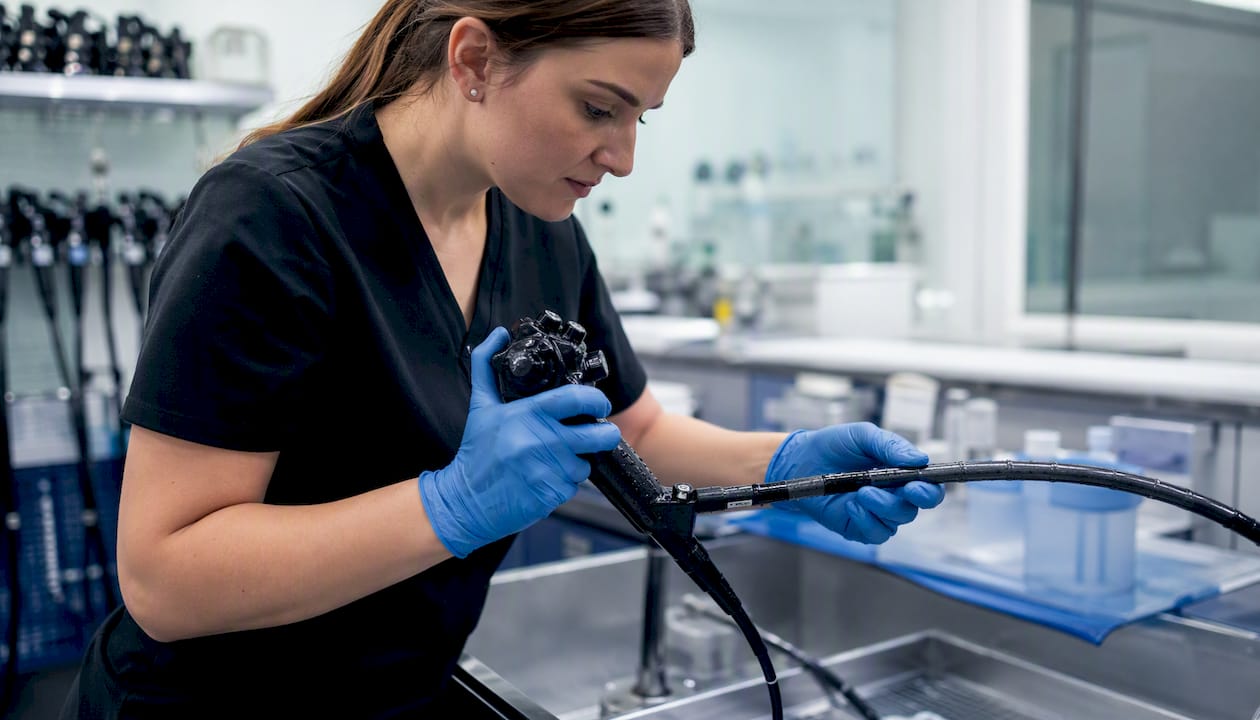
Refurbished makes sense for low-volume clinics, pilot programs, and practices where endoscopy is a secondary service. New is worth the premium when imaging quality drives diagnosis, procedure volume is high, or downtime is clinically unacceptable.
New systems:
- Full OEM warranty and certified repair network
- Latest sensor technology (CMOS, HD/4K)
- Predictable parts availability for 7–10 years
- Higher upfront cost; longer ROI horizon
Refurbished systems:
- Lower entry cost, often 40–60% below new list price
- Refurbished Olympus, Pentax, and Fujifilm models are widely used in veterinary practice
- Shorter or limited warranty; parts availability depends on model age
- Image quality varies; early HD systems may not meet current diagnostic standards
Inspection checklist for refurbished units:
- Request full service history and any prior repair records.
- Confirm leak test was performed and passed within the last 30 days.
- View a live or recorded image test on the actual unit before purchase.
- Check light source hours remaining (LED or xenon lamp).
- Inspect bending section and insertion tube for kinks, discoloration, or wear.
- Verify serial numbers match documentation and confirm OEM parts compatibility.
Expect a standard warranty on refurbished units; anything notably shorter carries added risk unless price reflects it. For repair and refurbisher alternatives, a review of scope repair vendors covers what to verify on warranties and loaner policies.
Where can U.S. clinics procure veterinary endoscopes right now?
Prioritize these channels in order: authorized OEM distributors for full-warranty new systems, specialist e-commerce platforms like 1800endoscope for faster delivery and competitive pricing, vetted refurbishers for budget purchases, and authorized service centers for certified pre-owned units.
Procurement tips:
- Get the scope's serial number and model number in writing before payment clears.
- Request lead times and shipping terms in the quote; domestic stock ships in days, but custom OEM orders can run 4–6 weeks.
- Ask whether calibration and setup support are included or billed separately.
- For any import or cross-border purchase, confirm customs clearance responsibility and whether the vendor handles FDA registration for the device class.
- Validate U.S. service availability before ordering from any site found through online directories. Community-sourced lists of similar sites to mdsvet can surface options, but each requires individual vetting for domestic support.
Typical procurement timeline:
- Specialist e-commerce (in-stock): quote to delivery in 3–10 business days.
- OEM distributor (standard configuration): 2–4 weeks from order confirmation.
- Custom OEM or large-animal specialty systems: 4–8 weeks.
- Refurbished units (in-stock): 5–14 business days including inspection documentation.
Check customer support responsiveness by sending a pre-sale technical question. A supplier that takes more than 48 hours to answer a spec question will not move faster when you have a scope down mid-procedure.
Key Takeaways
For U.S. veterinary clinics replacing mdsvet.com sources, TCO, U.S. service access, and compatibility with existing processors determine which supplier type delivers the best long-term outcome.
| Point | Details |
|---|---|
| TCO beats purchase price | Repairability and accessory availability drive long-term costs more than the sticker price. |
| Verify US service first | Confirm a named US repair center or authorized service partner before placing any order. |
| Compatibility check is non-negotiable | Processor, light source, and coupler compatibility must be confirmed before purchase, not after. |
| Refurbished requires inspection | Request service history, a leak test, and a live image test on any refurbished unit. |
| 1800endoscope is a clinic-ready option | 1800endoscope offers veterinary rigid/flexible scopes, HD recording, and portable systems with US shipping. |
The procurement decision most clinics get wrong
The conventional wisdom is to compare purchase prices across suppliers and pick the lowest. That framing is wrong, and it costs clinics money every year. The real decision is about system cost: what happens when the scope needs repair, who stocks the biopsy forceps you use weekly, and whether your video processor will still be supported in three years.
OEM distributors for Olympus, Fujifilm, Pentax, and Karl Storz carry the highest upfront cost for a reason. Their certified repair networks and full accessory ecosystems reduce the hidden costs that show up 18 months after purchase. Refurbishers offer genuine value, but only when the inspection checklist is followed and the warranty terms are specific. Specialist e-commerce platforms like 1800endoscope sit in a practical middle ground: faster delivery, competitive pricing, and a catalog that covers both rigid and flexible veterinary scopes without requiring a full OEM tower commitment.
The clinics that make the best procurement decisions treat the supplier evaluation as seriously as the scope evaluation. A scope that ships in three days from a vendor with no U.S. repair center is not a bargain. It is a liability.
1800endoscope: a clinic-ready alternative to mdsvet.com
OEM distributors, refurbishers, and overseas sites each have their place. But for U.S. veterinary clinics that need a specialist e-commerce source with domestic shipping, HD-capable systems, and a catalog built around clinical use, 1800endoscope is the direct answer.
The product range covers veterinary rigid endoscopy systems, flexible scopes, portable videoscopes with HD recording and SD card storage, and a full accessories line including biopsy forceps, valves, pumps, and cleaning tools. The portable airway inspection system is a practical option for equine and large-animal field work where a full tower is impractical. Clinics that need to evaluate borescope-based options can browse the borescope catalog for industrial-grade units adapted to veterinary inspection tasks.
Request a quote or review product specs directly at 1800endoscope.com to confirm compatibility with your existing equipment before ordering.
Useful sources and further reading
The sources below support the OEM comparisons, refurbished guidance, and compatibility recommendations throughout this article.
- Endoscopic Equipment for the Veterinary Practitioner | Today's Veterinary Practice
- Refurbished Endoscopes in Veterinary Medicine: Popular Options for Flexible and Rigid Models in 2025 - Infinium Veterinary
- Small Animals | KARL STORZ Endoskope | Cyprus
- Rigid and Flexible Endoscopes: MDsvet.com - StatsCrop
- mdsvet.by alternatives | Top 26 similar sites like mdsvet.by
- 1800endoscope
For additional guidance on veterinary scoping accessories and what to budget beyond the scope itself, the 1800endoscope blog covers biopsy forceps, valves, and cleaning tools in clinical context. When evaluating any vendor found through online directories, always verify OEM authorization status and confirm a U.S. service center is named in the warranty documentation before committing to a purchase. A veterinary clinical resource like skin cytology diagnostics illustrates how scope-assisted sampling fits into broader diagnostic workflows.