

What are the best alternatives to dvmcentral.com?
The strongest dvmcentral.com alternatives for veterinary and industrial endoscopy professionals are specialized suppliers that stock purpose-built scopes, carry the accessories to match, and back their products with real after-sales support. DVM Central operates as a multi-vendor marketplace connecting buyers with third-party sellers, which means product depth and consistency vary by vendor. Professionals who need a single, accountable source for HD videoscopes, rigid vet endoscopes, biopsy forceps, or industrial borescopes are better served by a dedicated equipment supplier.
The table below maps the core criteria that separate a capable supplier from a catalog aggregator.
| Criteria | What to look for |
|---|---|
| Product range and specialization | Veterinary rigid and flexible scopes, industrial NDT borescopes, small-diameter videoscopes |
| Compatibility | Works with existing processors, light sources, and documentation software |
| Pricing and cost-effectiveness | Transparent unit pricing, no hidden reprocessing or adapter fees |
| Advanced features | HD or 4K video recording, wireless connectivity, articulating camera heads |
| Accessories availability | Biopsy forceps, valves, pumps, cleaning tools stocked by the same supplier |

1800endoscope covers every row in that table with a catalog built specifically for veterinary clinics, animal health professionals, and industrial inspection teams. It is the clearest direct alternative for professionals who find dvmcentral.com's marketplace model too fragmented for specialized procurement.
Table of Contents
- How do dvmcentral.com alternatives compare on features and price?
- How to select the right endoscopy equipment provider
- What features and accessories define quality endoscopic equipment?
- Why does supplier reputation matter when buying endoscopy equipment?
- Key Takeaways
- The procurement mistake most professionals make
- 1800endoscope: a direct, specialized alternative worth your time
How do dvmcentral.com alternatives compare on features and price?
Product range and specialization
Veterinary endoscopy splits into two distinct tracks: flexible scopes for GI and airway work, and rigid scopes for arthroscopy, laparoscopy, and cystoscopy. Industrial inspection adds a third track with borescopes designed for confined-space access and NDT applications. A supplier that covers all three tracks from a single catalog eliminates the vendor-juggling that a marketplace model requires.
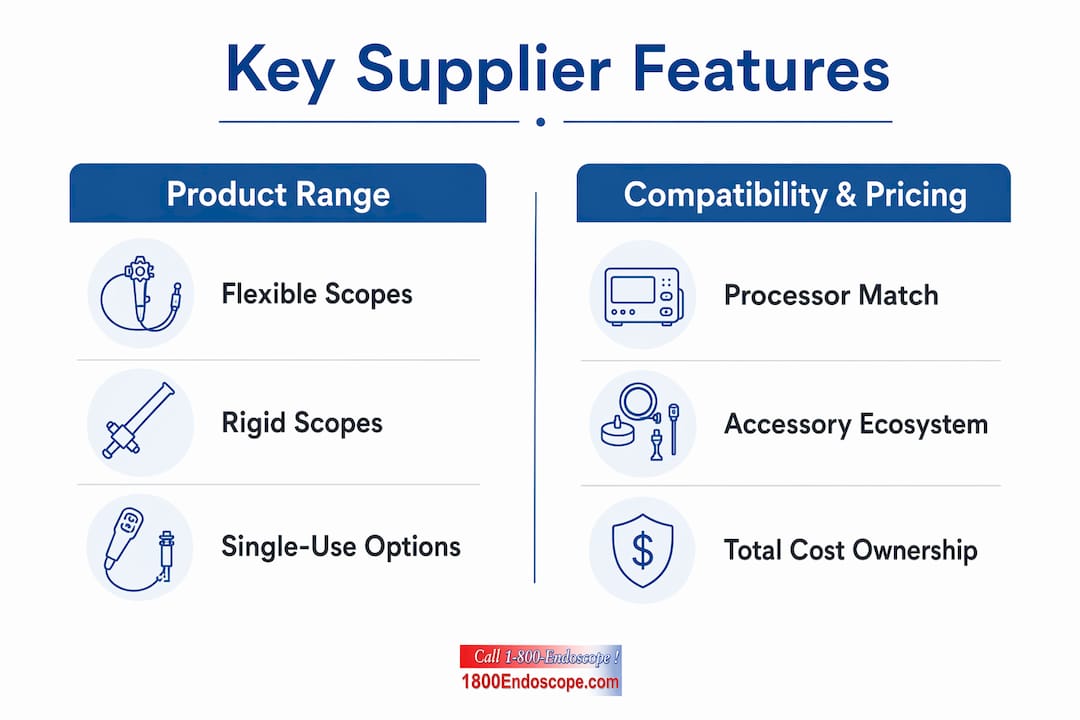
Single-use endoscopes are priced between $150 and $500 per unit, while reusable systems run $20,000–$120,000 depending on configuration. That cost gap makes specialization critical: buying a reusable system from a supplier with no repair network or spare-parts inventory is a procurement risk most clinics cannot absorb. That cost gap makes specialization critical: buying a reusable system from a supplier with no repair network or spare-parts inventory is a procurement risk most clinics cannot absorb.
Compatibility and ecosystem lock-in
Compatibility with existing processors and documentation software is the factor procurement managers most often underweight. A scope that requires a proprietary light source or a non-standard camera head connector forces an adapter purchase at best, a full tower replacement at worst. The hidden costs accumulate fast.
Suppliers that publish detailed compatibility specs upfront, and stock the adapters and cables to bridge legacy equipment, protect your existing investment. Generic or white-label scopes rarely come with that documentation.
Pricing, TCO, and advanced features
Upfront price is the wrong number to anchor on. Total cost of ownership includes repair frequency, service contract costs, downtime impact, and resale value after five years. Budget brands can look attractive at purchase and expensive by year two. High-quality reusable systems, by contrast, retain 30–40% of their original value on the secondary market after five years, a return most accounting models miss entirely.
On features, HD video recording and wireless connectivity are no longer premium add-ons. They are baseline expectations for any scope used in documentation-heavy veterinary or industrial workflows. A supplier that offers these features at accessible price points, rather than reserving them for top-tier configurations, gives professionals real flexibility.
How to select the right endoscopy equipment provider
Choosing a supplier is a longer-term commitment than the purchase order suggests. These are the factors that separate a reliable partner from a one-time transaction.
Compatibility checklist before you buy:
- Confirm the scope connects to your existing processor and light source without proprietary adapters
- Verify documentation software compatibility, especially if your clinic uses PACS or practice management systems
- Check that the supplier stocks replacement channels, valves, and insertion tubes for the specific model
Single-use vs. reusable procurement:
A hybrid procurement strategy allocates single-use scopes to high-risk or infectious disease cases and reusable scopes to routine, high-volume procedures. This approach balances infection control with cost management without forcing an all-or-nothing decision. For small animal endoscopy, reusable flexible scopes typically deliver the best cost-per-case outcome over a three-to-five year horizon.
Warranty, support, and shipping:
- Ask for repair turnaround time in writing before you sign. A scope out for six weeks cancels procedures and costs real revenue.
- Confirm the supplier ships from a U.S. location and can deliver replacement units or loaners during repair.
- Check whether financing or leasing is available. For capital equipment above $10,000, deferred payment structures can preserve clinic cash flow without sacrificing scope quality.
Pro Tip: Negotiate service contract terms before the sale closes, not after. Vendors are most motivated to offer favorable terms while the purchase is still in play, and upfront negotiation can reduce first-year service costs by up to 40%.
What features and accessories define quality endoscopic equipment?
The scope itself is only part of the system. What surrounds it determines whether a procedure runs smoothly or stalls.
Core scope features to evaluate:
- Image clarity: HD resolution (1280x720 minimum) for accurate tissue assessment; 4K for high-volume surgical centers where detail directly affects outcomes
- Articulation range: 4-way joystick-controlled articulation with bending angles above 180° gives access to anatomy a fixed-direction scope cannot reach. The PCE-VE 1500-60500 industrial borescope, for example, achieves a 190° bending angle with a 6mm camera diameter, a useful benchmark for confined-space access
- Illumination: 50,000 lux or higher for consistent visibility in deep cavities
- Portability: Battery-operated systems with more than three hours of runtime suit field veterinary work and remote industrial inspections
Accessories that directly affect workflow:
- Biopsy forceps sized to the working channel diameter of your specific scope
- Valves and water-jet pumps for GI procedures requiring irrigation
- Cleaning tools and channel brushes matched to the scope's internal diameter
- Light source cables and adapters for cross-compatibility with existing towers
Modular accessory design matters as much as the scope itself. A supplier that stocks the full accessory ecosystem for every scope in its catalog saves the time and cost of sourcing components from multiple vendors. For guidance on choosing the right light source, the illumination spec of the scope and the output rating of the light source need to match precisely.
Why does supplier reputation matter when buying endoscopy equipment?
Supplier reputation in the endoscopy market is not just about star ratings. It is about whether the company can support the equipment it sells after the invoice is paid. A marketplace aggregator like DVM Central depends on individual vendor quality, which varies. A dedicated supplier owns the product relationship from catalog to repair.
Professionals evaluating dvmcentral.com substitutes consistently flag two pain points: inconsistent product availability across vendors and slow or unclear warranty resolution when equipment fails. A supplier with a direct product catalog, published specifications, and a named support contact resolves both issues before they become procedure-day problems.
Industry reputation also tracks with parts availability. A supplier that cannot source a replacement biopsy channel or a valve within a week forces clinics to cancel procedures or rent equipment at daily rates. Checking parts lead times before purchase is as important as checking the scope's image resolution.
Key Takeaways
The best dvmcentral.com alternatives are dedicated endoscopy suppliers that combine a full product catalog, genuine compatibility documentation, and accountable after-sales support, with 1800endoscope standing out as the strongest option for U.S. veterinary and industrial professionals.
| Point | Details |
|---|---|
| Compatibility first | Confirm processor and software compatibility before purchase to avoid costly adapter fees or tower replacements. |
| TCO over sticker price | Reusable systems retain 30–40% resale value after five years; budget brands often cost more by year two. |
| Hybrid procurement | Allocate single-use scopes to infectious cases and reusables to high-volume procedures for the best cost-per-case outcome. |
| Negotiate service contracts early | Upfront negotiation can cut first-year service costs by up to 40% before the sale closes. |
| 1800endoscope as the alternative | 1800endoscope offers a direct, specialized catalog covering veterinary and industrial scopes, accessories, and HD recording systems. |
The procurement mistake most professionals make
The conventional wisdom in endoscopy procurement is to compare specs and pick the lowest price that meets the minimum threshold. That approach works for commodity supplies. It fails for capital equipment with a five-year service life.
The real decision is not scope A versus scope B. It is supplier A versus supplier B, and specifically: who will answer the phone when the scope fails at 7 AM before a full procedure schedule? Marketplace platforms distribute that accountability across multiple vendors, which means no single party owns the problem. Dedicated suppliers do.
The 4K versus HD debate is a good example of where spec-sheet thinking leads professionals astray. For most veterinary practices and industrial inspection teams, a well-maintained HD system delivers everything the clinical or inspection workflow needs. The jump to 4K adds cost at both the scope and monitor level, and the marginal image improvement rarely changes a diagnostic outcome in standard procedures. Upgrade based on clinical needs rather than solely on technical specifications.
1800endoscope: a direct, specialized alternative worth your time
If you have been searching for dvmcentral.com replacement sites that actually specialize in endoscopy rather than aggregating general veterinary supplies, 1800endoscope is built for exactly that. The catalog covers veterinary rigid endoscopy systems, flexible videoscopes for small and large animals, and industrial NDT borescopes, all with published specifications and direct purchasing.
The portable 6mm airway inspection system is a strong example: HD video recording, SD card storage, and a direct monitor in a package priced for clinics that need professional capability without enterprise-level spend. Financing options are available for capital purchases, and the support team handles compatibility questions before the order, not after. Browse the full borescope and endoscope catalog or reach out directly for a consultation on which system fits your existing equipment setup.