
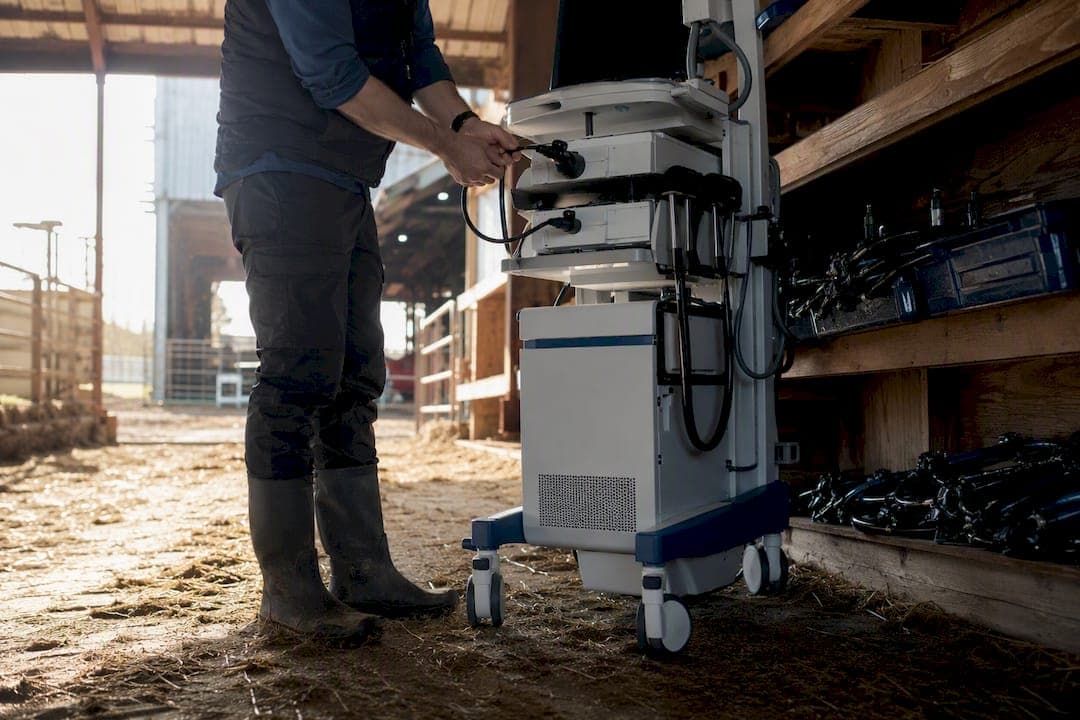
For most equine and bovine practices, the right choice is a heavy-duty mobile cart with dual scope cradles, a 360° monitor arm rated for at least a 24-inch display and locking casters sized for barn floors. 1800endoscope stocks the scopes, video systems, and accessories that pair with carts like this, and their product catalog is the fastest starting point if you already own a processor and just need to confirm mount compatibility. Call or submit a spec request through the site to get a quote and a lead time before you commit budget. If you're comparing an integrated system instead, the PVSM6150 is worth a look as a portable alternative to a full cart setup.
Table of Contents
- What large animal endoscopy carts actually need to do
- The spec sheet items to confirm before you sign off
- Making sure your scopes and monitors actually fit
- Mobility, durability, and keeping the cart clean
- What to lock down on warranty and service before you buy
- Your procurement checklist before placing the order
- What the industry gets wrong about cart shopping
- Order the cart setup that fits your caseload
- Frequently asked questions
What large animal endoscopy carts actually need to do
A cart built for small-animal work will not survive equine gastroscopy. The scopes are longer, the monitors need to be visible from farther back, and the whole unit has to roll across a barn aisle without catching a wheel on a floor drain. Large animal endoscopy carts exist because a countertop setup or a handheld monitor simply cannot manage a 3.3 to 3.5-meter gastroscope, a light source, a suction pump, and a recording unit all at once, in a space where the patient might move.
The core features that separate a purpose-built cart from a repurposed shelf on wheels:
- Shelving: at least two to three shelves, height-adjustable, with a stated load rating per shelf, not just a total cart capacity.
- Monitor mount: a 360-degree rotating arm with tilt, sized for 24 to 32-inch monitors on a standard VESA pattern.
- Integrated power: a medical-grade power strip with internal cable routing, not a loose extension cord taped to the frame.
- Scope storage: dual cradle holders built for long equine scopes, with enough vertical clearance that the scope tip doesn't drag the floor.
- Accessory mounts: brackets or trays for suction units, insufflators, and pump systems, plus a drawer for probes and biopsy tools.
- Casters: large-diameter, non-marking wheels with independent locks on at least two casters.
- Surface material: coated or stainless steel with rounded edges that tolerate hose-down cleaning and standard veterinary disinfectants.
Pro Tip: Ask the vendor specifically whether the cable harness detaches from the rear panel. Carts that force you to unscrew a fixed panel to trace a cable fault cost you twenty minutes mid-procedure. A removable harness costs almost nothing extra and saves real time in the field.
Clinician-designed carts consistently score better on setup time and usability than generic hospital equipment carts repurposed for endoscopy, largely because design input from people who actually run procedures tends to catch cable-routing and reach problems that engineers alone miss.
The spec sheet items to confirm before you sign off
Every cart quote should include a written spec sheet. If the vendor can't produce one, that's a red flag on its own. Here's what to check line by line.
| Spec category | What to confirm | Why it matters for large-animal work |
|---|---|---|
| Height | Fixed height or adjustable range (example range: 1200–1670 mm on some veterinary trolley models) | Tall handlers and short handlers both need to see the monitor without stooping |
| Width and depth | Confirm against your narrowest barn door or trailer opening | A cart that fits the clinic but not the trailer is useless on ambulatory calls |
| Total weight and max load | Cart weight plus rated payload, not just shelf capacity | Overloaded shelves warp and casters fail early |
| Shelf size and adjustment | Shelf dimensions and adjustment increment as specified by vendor | Fixed shelves that don't match your monitor footprint waste space |
| Casters | Diameter, material, swivel vs. rigid, lock type | Small hard-plastic wheels fail on gravel and mud |
| Electrical | Amps/volts supported, outlet count and type, cable length | Underpowered strips trip breakers mid-procedure |
| Monitor mount | VESA pattern, rotation and tilt range, load rating | Mismatched VESA means the monitor doesn't mount at all |
| Warranty | Coverage period on frame, casters, mount, and electrical | A one-year baseline is standard on most vet trolleys |
Ask for SKU-level part numbers on every included accessory, and get the manufacturing lead time and freight dimensions in writing before you finalize a purchase order. Bulky carts often ship on pallets, and freight quotes change fast if the actual crated dimensions differ from what sales first quoted you.
Making sure your scopes and monitors actually fit
A cart is only useful if what you already own mounts to it cleanly. Before ordering, measure your equipment and send the specifics to the vendor rather than relying on general compatibility claims.
- Measure your longest scope. Equine gastroscopes running 3.3 to 3.5 meters need cradle spacing that keeps the shaft from coiling on itself or dragging.
- Confirm your monitor and processor footprint against the cart's shelf depth, and leave clearance behind the monitor for HDMI and power cables.
- Check how suction units, insufflators, and pumps attach. Some carts use a clamp system, others a dedicated tray or side bracket.
- Account for light guide leads and water or air lines when planning cable routing. These add bulk that a tight cable channel won't handle.
- Ask about drying racks or lockable drawers if you need somewhere to stage cleaned scopes between cases.
When you contact sales, give them your scope model and length, your monitor's exact dimensions, and your available circuit amperage. That's usually enough for a configuration that arrives ready to plug in rather than requiring a rebuild on delivery. If you're running a mixed setup, comparing a portable all-in-one system against a modular cart is worth doing before you buy, since integrated units trade some flexibility for a smaller ambulatory footprint.
Mobility, durability, and keeping the cart clean
Barn floors are not hospital corridors. Concrete with drainage grooves, straw, mud tracked in from the paddock, gravel aprons outside the clinic doors. A cart built for a quiet exam room will shake apart within a year of that kind of use.
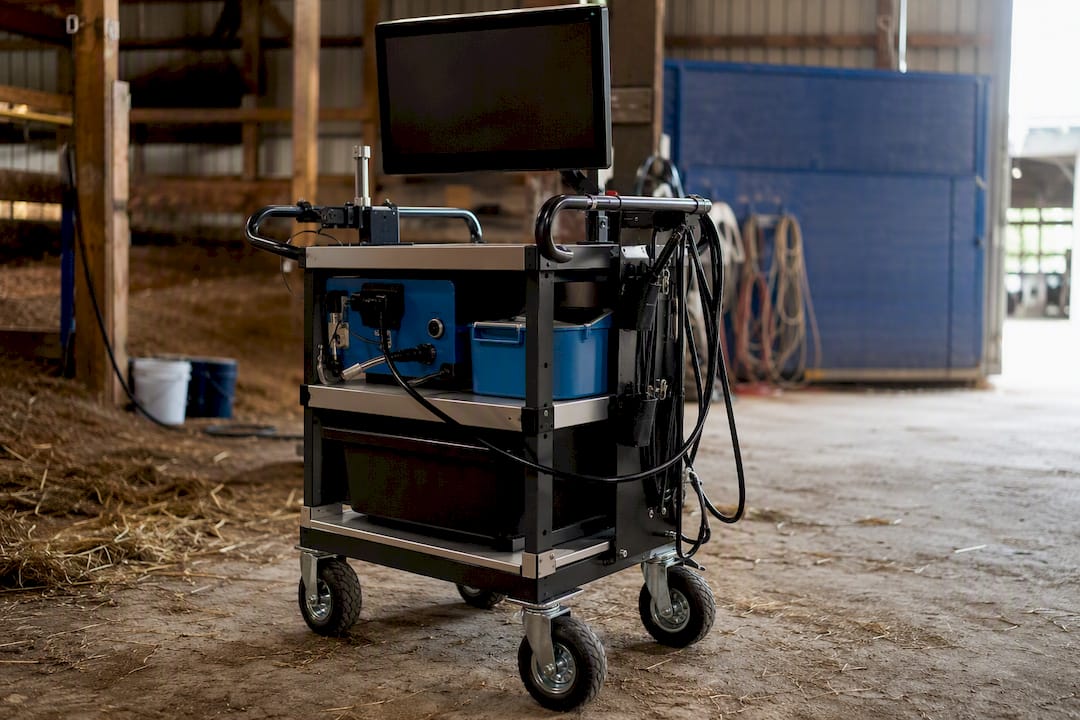
Look for casters at least 4 inches in diameter with a rubber or polyurethane tread, since smaller hard wheels catch on floor seams and doorway thresholds. Chassis welds hold up better than riveted joints under repeated loading and unloading, especially if the cart travels in a trailer between calls. Surface finishes matter just as much: powder-coated or stainless steel resists the chemical load of standard veterinary disinfectants far better than painted mild steel, which chips and rusts within months of regular wipe-downs.
Sealed rear panels keep bedding dust and stray liquid out of the cable routing. Loose cables hanging behind an open panel are the single most common failure point on field carts.
Pro Tip: If you run ambulatory calls regularly, ask whether the casters are quick-release. Swapping a damaged wheel roadside beats driving back to the clinic mid-farm-call.
What to lock down on warranty and service before you buy
A cart is a piece of capital equipment, and it should come with the same aftercare language you'd expect on a processor or light source. Push for specifics rather than accepting a vague "one year warranty, parts and labor" line.
- Request separate coverage terms for the frame, casters, monitor mount, and any electrical components, since these fail at different rates.
- Ask whether shelves, casters, and monitor arms are stocked as spare parts with listed SKUs, or whether a failure means a custom fabrication delay.
- Find out if the vendor offers on-site fitment or an annual safety check, particularly if you're running multiple carts across satellite clinics.
- Get the RMA process and typical spare-parts lead time in writing before you need it, not after a wheel breaks the week of a busy surgical schedule.
- Reach out to 1800endoscope's sales team for quotes on carts, spare parts, and compatible scopes, and to confirm installation support for your specific setup.
Your procurement checklist before placing the order
- Measure your access points. Check door widths, trailer clearance, and clinic aisle space against the cart's stated width and depth.
- Send your equipment specs to the vendor. Provide scope models and lengths, monitor dimensions, required accessories, and your available electrical circuit capacity.
- Confirm logistics in writing. Get lead time, freight method, and whether on-site delivery or installation is included or billed separately.
- Build the full budget. Base cart price, the accessories you'll actually need (drawers, brackets, power modules), shipping, and any installation or service fees.
- Finalize the quote. Request an SKU-level breakdown, confirm the warranty terms on frame, casters, and mount, and get the spare-parts list before you sign.
- Schedule delivery. Set a firm delivery and installation date, and confirm who's on-site to receive and set up the cart.
What the industry gets wrong about cart shopping
Most buying guides treat endoscopy carts like generic furniture: pick a size, pick a color, done. That's backward for large-animal work. The scope length should drive the cart choice, not the other way around. A cart sized for a 1-meter flexible scope and a cart sized for a 3.5-meter equine gastroscope are different pieces of engineering, even if they look similar in a catalog photo.
The other blind spot is warranty language. Buyers obsess over shelf count and caster size, then accept a one-line warranty clause without asking what's actually covered. Casters and monitor arms are the parts that fail first in field use, and they're rarely covered the same way the frame is.
If there's one thing to prioritize first, it's giving your vendor real measurements before you look at a single catalog photo. Scope length, monitor footprint, door widths. Everything else on the spec sheet exists to serve those three numbers.
Order the cart setup that fits your caseload
Generic medical-supply carts and repurposed hospital trolleys can technically hold a monitor and a shelf, but they're rarely built for the scope lengths and floor conditions large-animal work demands. 1800endoscope solves that gap by pairing cart-ready scopes and video systems with the specs procurement teams actually need: exact dimensions, load ratings, and accessory compatibility, confirmed before you order rather than discovered after delivery.
Whether you're outfitting a new cart or replacing an aging one, the PVSM6150 offers a portable option worth comparing against a full cart build, and the rigid endoscopy catalog covers compatible scopes if you're sourcing new equipment alongside the cart. Call 1800endoscope's sales line or submit your scope and monitor specs through the site to get a written quote and a firm lead time before your next budget cycle closes.
Frequently asked questions
What size monitor mount do most large animal endoscopy carts support? Most commercial carts support 24 to 32-inch monitors on a standard VESA pattern, with a 360-degree rotating arm and tilt adjustment. Confirm the exact VESA spec and load rating against your monitor's weight before ordering.
How long do equine gastroscopy carts need to accommodate a scope? Equine gastroscopes commonly run 3.3 to 3.5 meters, so cradle spacing and vertical clearance need to accommodate that length without the scope tip touching the floor or coiling against itself.
What's the typical warranty on a veterinary endoscopy trolley? Baseline coverage on many vet trolleys runs around one year on the frame and core components. Push for separate terms on casters, monitor mounts, and electrical parts, since those wear faster than the frame itself.
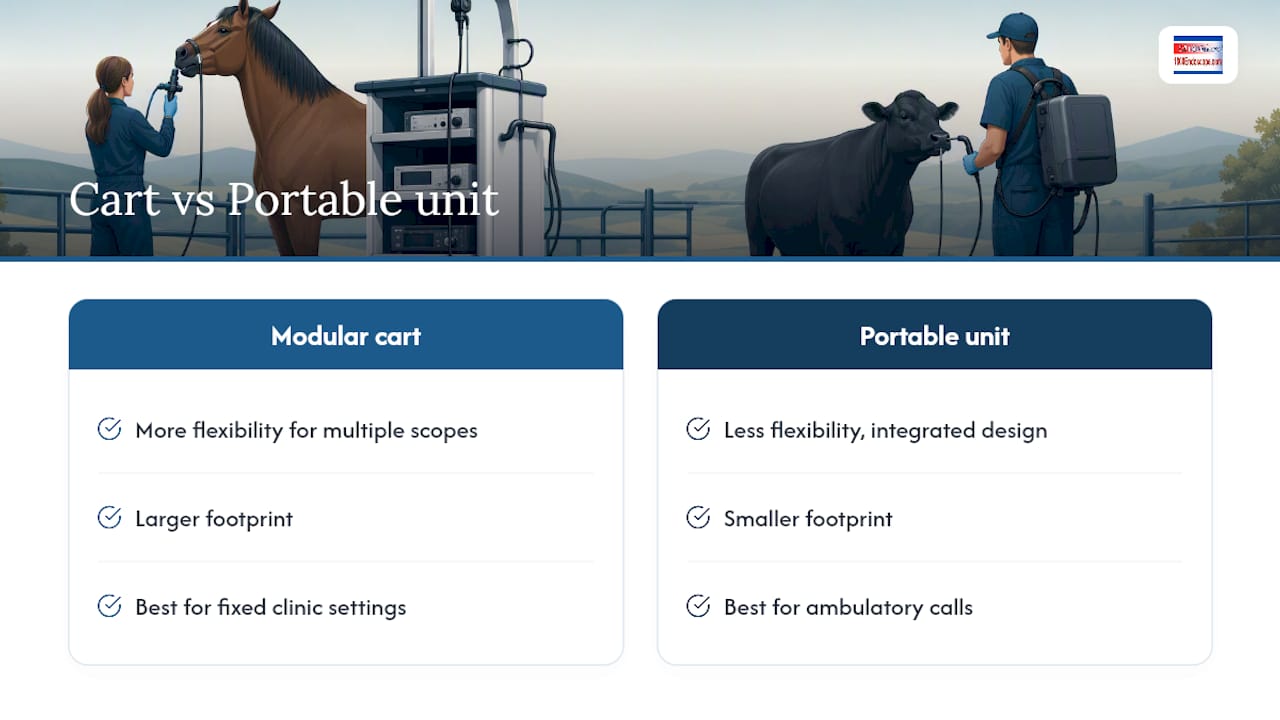
Should I buy a cart or an all-in-one portable endoscopy system? It depends on your caseload. A modular cart offers more flexibility for multiple scopes and accessories in a fixed clinic setting, while an integrated portable unit trades some of that flexibility for a smaller footprint on ambulatory calls.
What information should I send a vendor to get an accurate cart quote? Provide your scope model and length, your monitor's exact dimensions, your required accessories, and your available electrical circuit capacity. That combination is usually enough for a vendor to configure a cart that arrives ready to use.